Psychology
The Spotlight Effect: Why Nobody’s Watching You as Much as You Think
Wear an embarrassing T-shirt into a room and you’ll guess half the people noticed. In the famous Cornell study, about a quarter did. Here’s what the spotlight effect is, why it happens and how to worry less.
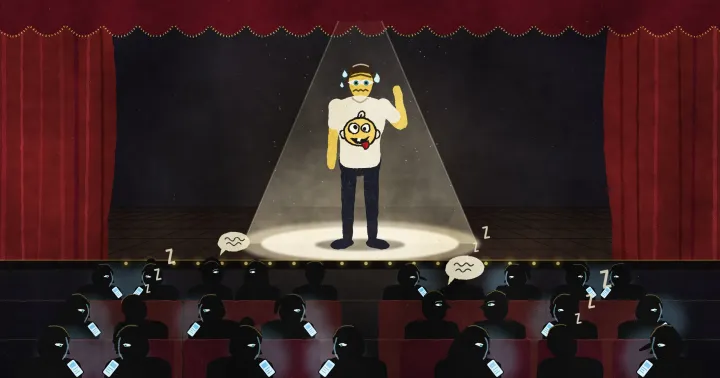
The spotlight effect is the tendency to overestimate how much other people notice your appearance, your actions and your mistakes. In the classic 2000 Cornell study, students made to wear an embarrassing Barry Manilow T-shirt guessed that about half the people in a room would notice it, when only about a quarter could say who was on the shirt.
That one result has comforted a generation of the blushing, the stammering and the badly dressed. The same bias shapes how we think our nerves and slip-ups look to everyone else. Here is what the study really found, with its actual numbers, why the brain does it, and how to use it to worry less.
- What it is: an egocentric bias. We believe the social spotlight shines on us more brightly than it really does.
- Who named it: the psychologists Thomas Gilovich (Cornell), Victoria Husted Medvec (Northwestern) and Kenneth Savitsky (Williams College), who set out the evidence in a 2000 paper in the Journal of Personality and Social Psychology.
- The famous number: wearers of the Barry Manilow shirt estimated that 46 percent of observers could name the face on it. The real figure was 23 percent.
- It isn’t only about embarrassment: students in shirts they were happy to be seen in guessed 48 percent would notice. Just 8 percent did.
- Why it happens: we start from our own vivid experience and adjust too little for how busy everyone else is.
- The good news: the effect fades as you get used to a situation, and learning about its cousin, the illusion of transparency, helped nervous speakers give talks that observers rated more highly.
What is the spotlight effect?
Gilovich, Medvec and Savitsky put it neatly: people tend to believe “that the social spotlight shines more brightly on them than it really does.” Each of us is the center of our own world, so our bad haircut, clumsy remark or brilliant point looms large. Everyone else is busy being the center of theirs.
The team presented early results at conferences in 1994 and 1996, sketched the idea alongside the illusion of transparency in a 1999 review, and set out the full evidence, five studies in all, in their 2000 paper. More than 25 years later, Gilovich still stands by it. In a May 2026 interview for the Social Science Bites podcast, he said that while some questions remain, “nothing I’ve learned qualifies or challenges that original idea.”
The Barry Manilow T-shirt study: what really happened
The setup was a small piece of theater. Study 1 involved 109 Cornell undergraduates: 15 shirt wearers, 64 observers and 30 controls. The observers sat along one side of a long table, facing the door, filling in a questionnaire.
Each wearer was handed a T-shirt bearing a large picture of Barry Manilow, whom the researchers described as “a musician who is not terribly popular among college students.” Pretest interviews suggested that most Cornell students would be embarrassed to wear him. Every wearer put the shirt on anyway, knocked, walked into the room of observers and was about to sit down when the experimenter hesitated and, “on second thought,” sent them out to wait in the hall. There, the wearer was asked how many people in the room could say who was on the shirt. Meanwhile the observers were asked, one by one, whether they had noticed.
The wearers’ average estimate was exactly twice the real rate: 46 percent against 23 percent. Control participants who watched a staged video of the procedure, with no shirt and no stake in it, gave much lower estimates. So the problem wasn’t a general belief that people are observant. It was the feeling of being the one in the shirt. The wearers were still reading the room (their guesses rose with the number of people who really noticed), but they read it through a magnifying glass.
Flattering shirts and group discussions
Study 2 asked whether the spotlight burns only when you’re embarrassed. This time 15 wearers chose a shirt they would be pleased to be seen in, showing Bob Marley, Jerry Seinfeld or Martin Luther King Jr. They guessed that 48 percent of observers would notice. Only 8 percent did. The authors suspected the observers’ questionnaire was more absorbing that time, so take the sixfold gap with a pinch of salt, but the direction matched.
Study 3 moved from clothes to conduct. In 42 small groups, 193 students discussed the problems of America’s inner cities, then predicted how their groupmates would rank them. On all six measures, from helping the discussion along to speech errors and remarks that might have offended someone, people thought they stood out more than their groupmates’ rankings showed. The spotlight shone on the good and the bad alike.
One honest caveat: the T-shirt studies were small, with 15 wearers in each. The case for the spotlight effect rests less on any single percentage than on how often the same pattern turns up in different designs.
Spotlight effect examples from everyday life
The researchers’ own examples are painfully familiar: a gaffe on a first date, a stumble at the front of a line, a fluffed passage in a prepared speech. Each can feel unforgettable to you and pass unnoticed by everyone else.
- Bad hair days. In a seminar study described in the 2000 paper, students predicted 24 percent more day-to-day variation in how classmates would rate their appearance than the classmates actually reported. Gilovich, Medvec and Justin Kruger later published this line of work as “The Spotlight Effect Revisited” (2002).
- The party where you know nobody. Gilovich describes standing alone at a cocktail party, sure that everyone is wondering why you have no one to talk to, while they are all busy in their own conversations.
- The missed shot. Teammates notice a bad play to some degree, he says, but they have their own performances to worry about.
The effect can also run in reverse. Once you stop noticing something about yourself, you may underestimate how much others notice it, like the person wearing cologne they can no longer smell.
And sometimes the spotlight is real. As Gilovich points out, a tennis player serving in a tied match does have every eye on them. The bias is feeling that way when you don’t.
Why does the spotlight effect happen?
The short answer is anchoring and adjustment. You start from your own experience, which in the moment is loud and vivid: I am wearing Barry Manilow. You know other people are less focused on you, so you adjust your guess downward. But the adjustment stops too soon, and your estimate stays too close to your own feelings. The 2000 paper tested this in two ways.
In Study 4, 44 Northwestern students wore a shirt showing Vanilla Ice above the words “Ice, Ice, Baby,” walked briefly into a room of people, and estimated how many could say who was on it. Asked whether they had considered any other numbers first, 32 said yes. Setting aside two who named numbers on both sides of their answer, 23 of the remaining 30 had first thought of a higher number. They started high and came down, just not far enough.
In Study 5, 30 students wore the Manilow shirt. Some went into the room straight away; others first sat alone for 15 minutes, getting used to it. The immediate group estimated that 51 percent of observers would notice. The delayed group estimated 37 percent. Same shirt, lower starting point.
Later work backs this up. In a 2004 study of perspective taking, Nicholas Epley, Gilovich and colleagues found that people judge how others see things by adjusting from their own view, and that this egocentric bias grew under time pressure and shrank when accuracy was rewarded. The 2000 paper traced the root to the egocentrism Jean Piaget saw in young children. Adults outgrow much of it. Not all of it.
The illusion of transparency and other close cousins
If you overestimate how visible your shirt is, it’s no surprise that you overestimate how visible your feelings are. Gilovich, Savitsky and Medvec called this the illusion of transparency in a 1998 paper. People asked to lie overestimated how easily their lies would be spotted; Gilovich recalled in 2026 that liars guessed about twice as many people would catch them as actually did. The authors even linked the illusion to bystanders who hold back in an emergency: each thinks their own alarm is showing, and takes everyone else’s calm at face value.
Three follow-ups extend the comforting news:
- Your mistakes look smaller from outside. In four studies published in 2001, Savitsky, Epley and Gilovich found that people who imagined social blunders, failed publicly at an intellectual task, or were described in an embarrassing way expected harsher judgments than observers actually gave. Part of the reason: the person who slipped fixates on the slip, while observers also take in the situation around it.
- Your nerves don’t show as much as you think. In a 2003 study, Savitsky and Gilovich found that speakers overestimated how nervous they looked, and that speakers told about the illusion of transparency beforehand gave talks that observers rated more highly.
- People like you more than you think. In 2018, Erica Boothby and colleagues described the liking gap: after conversations, people consistently underestimated how much their partners liked them. Among first-year college dorm mates, it lasted for several months.
Fear of standing out reaches into conformity, too. In Solomon Asch’s famous line experiment, some people who went along with a wrong majority said they hadn’t wanted to look foolish. Knowing how dim the spotlight really is can make it easier to be the one who disagrees.
Why do I feel like everyone is watching me?
Almost everyone feels the spotlight sometimes, and it burns hottest when you feel judged. In a 2007 study, Michael Brown and Lusia Stopa found that people doing a memory task under high social-evaluative pressure reported a stronger spotlight effect, and rated their own performance more harshly, than people under low pressure. They suggested the spotlight effect may be tied specifically to worries about being evaluated, a central fear in social anxiety.
Growing up may help less than you’d hope. In 2026, Gilovich said their data give some support to a peak in the preteen and teen years, but nowhere near as strong as they expected, and that the effect doesn’t fade in later life as much as they thought it would. Whether it differs between cultures is, he said, still an open question.
Your phone may be turning up the brightness. A 2024 study in Marketing Letters by Matthew Hall found that getting more attention after posting online increased people’s egocentrism and, with it, their spotlight bias offline, while getting less attention reduced it. The link depended on people’s need for attention and how heavily they used social media. It’s a single paper, but an intriguing one.
If the feeling of being watched and judged is intense, lasts, or keeps you from work, school or friends, talk to a doctor or mental health professional. The National Institute of Mental Health notes that social anxiety disorder is common, and that with the right treatment and support people can manage it.
How to stop caring what people think (or at least care less)
Knowing about a bias doesn’t switch it off, but the research suggests some practical moves.
- Halve your estimate. When you’re sure everyone noticed, remember the Manilow math: the wearers’ guesses were double the reality.
- Give it 15 minutes. A quarter of an hour of getting used to the shirt brought estimates down from 51 to 37 percent. Don’t judge a party, a new job or a new haircut by its first awkward minutes.
- Name the illusion before you speak. Speakers who learned that their nerves were less visible than they felt gave better-rated talks. You can tell yourself the same thing on the way to the podium.
- Remember the observer sees the whole scene. After a slip, people tend to judge you less harshly than you expect, partly because they weigh the circumstances, not just the stumble.
- Assume the conversation went better than it felt. Thanks to the liking gap, the person you just met probably liked you more than you think.
- Take the social chance. The 2000 paper grew out of research on regret, which found that people’s biggest regrets tend to be things they didn’t do, many of them for fear of looking bad. The spotlight effect suggests that fear is often overblown.
The authors ended their paper with a nod to Lincoln’s Gettysburg Address, which predicted that the world would “little note, nor long remember” what was said there. Lincoln was wrong about his own speech, they pointed out. But for the rest of us, the social spotlight “has less wattage than we generally believe.”
Put your energy where it counts
The spotlight effect means a lot of everyday worry is spent on an audience that is mostly thinking about itself. If you would rather spend that energy somewhere better, R.K. Jones’s book Don’t Give Two Sh*ts, subtitled Navigating the Modern World’s Insanity by Focusing on What Matters, is available now. It’s profane, practical and honest, about how to stop burning yourself out on everything the modern world throws at you and put your energy where it counts.
For older tools against worry, see our guide to Stoicism for anxiety. The Stoic teacher Epictetus was already advising people to be “content to be thought foolish” about external things more than eighteen centuries before anyone put on a Barry Manilow T-shirt.
Sources
- The spotlight effect in social judgment (Gilovich, Medvec and Savitsky, 2000), Journal of Personality and Social Psychology
- The spotlight effect and the illusion of transparency (Gilovich and Savitsky, 1999), Current Directions in Psychological Science
- The spotlight effect revisited (Gilovich, Kruger and Medvec, 2002), Journal of Experimental Social Psychology
- The illusion of transparency (Gilovich, Savitsky and Medvec, 1998), Journal of Personality and Social Psychology
- Do others judge us as harshly as we think? (Savitsky, Epley and Gilovich, 2001), Journal of Personality and Social Psychology
- The illusion of transparency and the alleviation of speech anxiety (Savitsky and Gilovich, 2003), Journal of Experimental Social Psychology
- Perspective taking as egocentric anchoring and adjustment (Epley, Keysar, Van Boven and Gilovich, 2004), Journal of Personality and Social Psychology
- The spotlight effect and the illusion of transparency in social anxiety (Brown and Stopa, 2007), Journal of Anxiety Disorders
- The liking gap in conversations (Boothby, Cooney, Sandstrom and Clark, 2018), Psychological Science
- Embracing the spotlight (effect) (Hall, 2024), Marketing Letters
- Tom Gilovich on the Spotlight Effect (Social Science Bites, 4 May 2026), Social Science Space
- The line between conformity and resistance (Jetten and Hornsey, 2014), The Psychologist
- Social Anxiety Disorder: What You Need to Know, National Institute of Mental Health
- The Gettysburg Address (Bliss copy), Abraham Lincoln Online
- The Enchiridion (Epictetus, translated by Elizabeth Carter), MIT Internet Classics Archive
Questions people ask
What is the spotlight effect?
The spotlight effect is the tendency to overestimate how much other people notice your appearance and actions. The psychologists Thomas Gilovich, Victoria Husted Medvec and Kenneth Savitsky set out the evidence in a 2000 paper and described it as an egocentric bias.
What was the Barry Manilow T-shirt study?
In a 2000 study at Cornell, 15 students wore a T-shirt showing the singer Barry Manilow into a room of observers. They estimated that 46 percent of the observers could say who was on the shirt; in fact, 23 percent could.
What causes the spotlight effect?
The researchers’ explanation is anchoring and adjustment: people start from their own vivid experience of the moment and adjust too little for how much less attention others are paying. Students who spent 15 minutes getting used to an embarrassing shirt guessed that 37 percent of observers would notice it, against 51 percent for those who walked in straight away.
What is the difference between the spotlight effect and the illusion of transparency?
The spotlight effect is overestimating how much others notice your appearance and actions. The illusion of transparency, described by the same research team in 1998, is overestimating how much your inner states, such as nervousness or the fact that you are lying, show to other people.
How do you overcome the spotlight effect?
Knowing about the bias helps but doesn’t remove it. Studies suggest others judge our slips less harshly than we expect, the feeling fades as we get used to a situation, and speakers told about the related illusion of transparency gave talks that observers rated more highly. If fear of being judged is disrupting your life, talk to a doctor or mental health professional.