History
Pretexts for War: Six Real Examples and How Wars Are Sold
Some wars began with events that were staged, misread or never substantiated. Six cases historians accept, from Mukden to Iraq, how each war was sold, and how to spot the next sales job.
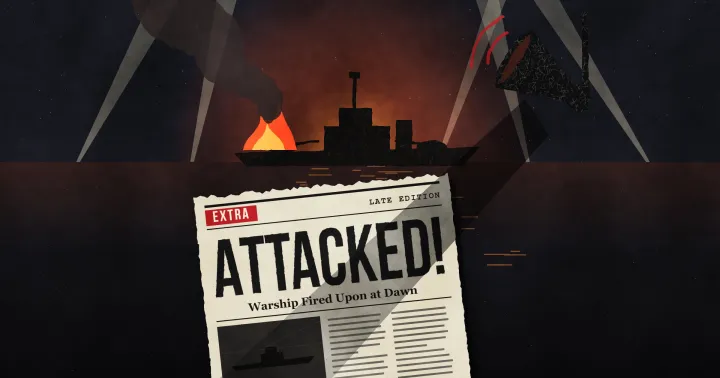
A pretext for war is a public reason for fighting that hides, stretches or replaces the real one. Historians have documented several examples of a pretext for war in which the triggering event was staged, misread or never substantiated: Japanese officers bombed their own railway at Mukden in 1931, the SS faked a Polish raid at Gleiwitz in 1939, the second Gulf of Tonkin attack in 1964 almost certainly never happened, and Iraq’s weapons of mass destruction turned out not to exist.
The differences matter. “They faked it” is not the same as “they got it wrong,” or “nobody knows for sure.” Here is what the records show, and what they reveal about how wars are sold.
- Two were staged: Mukden (1931) and Gleiwitz (1939) were false flags, carried out by the side that used them.
- One is disputed: the USS Maine exploded in 1898 and was blamed on Spain, but a 1976 study published by the US Navy pointed to an accidental fire.
- One was misread: the reported Gulf of Tonkin attack of 4 August 1964 most likely never happened, according to an NSA history declassified in 2005.
- One never held up: the 1990 testimony that Iraqi soldiers took babies from incubators in Kuwait came from the Kuwaiti ambassador’s daughter and was never substantiated.
- One was wrong and oversold: a US presidential commission called the prewar intelligence on Iraq’s weapons “dead wrong.”
What is a pretext for war?
The old diplomatic term is casus belli, Latin for “occasion of war”: the act that justifies a war or sets it off. A pretext is a casus belli that can’t bear the weight put on it. A false flag is a special kind of pretext, an attack disguised so that someone else takes the blame, like a ship sailing under another country’s colors.
Most attacks are exactly what they appear to be, and treating every headline as a hoax is its own kind of gullibility. The six cases below are famous because confessions, declassified files or official inquiries later showed what happened, and each is labeled the way historians label it.
Pretext for war examples: six cases historians accept
USS Maine, 1898: disputed, probably an accident
At 9:40 p.m. on 15 February 1898, the American battleship Maine blew up in Havana harbor, killing more than 260 of the men aboard. Cuba was then a Spanish colony in revolt, and the New York papers of Hearst and Pulitzer had been fanning anti-Spanish feeling, even printing rumors of plots to sink the ship.
A US Navy court of inquiry reported in March that a mine had set off the ship’s forward magazines, though it could not fix responsibility “upon any person or persons.” Spain’s own inquiry blamed an internal cause. “Remember the Maine! To hell with Spain!” became the rallying cry, and by late April 1898 the two countries were at war.
A second Navy board in 1911 also found an external blast. But in 1976 a study by Admiral Hyman Rickover, published by the Navy, found no compelling evidence of an external explosion and pointed to a fire in a coal bunker beside a magazine. A 1998 analysis for National Geographic found that either a fire or a small mine could have done it. So the Maine is not a proven false flag but a disaster blamed on an enemy before anyone could know the cause, though the State Department’s historians note that the press did not by itself cause the war.
Mukden, 1931: staged by Japanese officers
Late on 18 September 1931, a small charge went off beside the Japanese-owned South Manchuria Railway near Mukden, today’s Shenyang, in northeast China. The damage was so slight that a train passed over the spot minutes later. Japan’s army in the region, the Kwantung Army, blamed Chinese soldiers, attacked at once and within months had overrun Manchuria.
The bomb was its own. Japan’s National Diet Library states plainly that the track was “blown up by officers of the Kwangtung Army”, and historians name the staff officers Seishirō Itagaki and Kanji Ishiwara as its planners. The cabinet in Tokyo tried to keep the fighting from spreading, and the army ignored it. In 1932 Japan recognized Manchukuo, a puppet state installed by the Kwantung Army. A League of Nations inquiry rejected Japan’s claim of self-defense, and when the League adopted its report in 1933, Japan walked out and left the League.
Gleiwitz, 1939: staged by the SS
On the evening of 31 August 1939, a small team of SS men disguised as Poles seized the German radio station at Gleiwitz, now Gliwice in Poland, and broadcast a short anti-German message in Polish. To make the raid look real, they left a body behind: Franciszek Honiok, a local Silesian farmer known for his Polish sympathies, who had been arrested the day before, drugged and shot. Gleiwitz was the best known of some two dozen incidents manufactured as an excuse for war. Germany invaded Poland the next day.
The raid’s leader, Alfred Naujocks, described it in a sworn affidavit for the Nuremberg trials in November 1945. He said Reinhard Heydrich had ordered him to “simulate an attack,” explaining that “practical proof is needed for these attacks of the Poles for the foreign press as well as for German propaganda purposes.” Some details rest on Naujocks’s word alone, but the staging itself is not in doubt: as the US Holocaust Memorial Museum puts it, the Germans “falsely accused the Poles.”
Gulf of Tonkin, 1964: an attack that most likely never happened
On 2 August 1964, North Vietnamese torpedo boats attacked the US destroyer Maddox in the Gulf of Tonkin. That clash was real. Two nights later, the Maddox and a second destroyer, the Turner Joy, reported another attack. President Lyndon Johnson ordered retaliatory air strikes and asked Congress for broad powers. Yet the Maddox‘s captain later cabled that “freak weather effects on radar and overeager sonarmen may have accounted for many reports.”
Congress passed the Gulf of Tonkin Resolution on 7 August, three days after the attack that wasn’t. The House vote was unanimous; in the Senate, only Wayne Morse and Ernest Gruening voted no. The resolution approved “all necessary measures” to repel attacks on US forces, and it stood until Congress repealed it in January 1971.
In 2005 the National Security Agency declassified an internal history by its historian Robert J. Hanyok. His verdict on 4 August: “it is not simply that there is a different story as to what happened; it is that no attack happened that night.” He found that the intercepted communications had been mishandled, with only the material that seemed to support an attack passed on to Johnson’s officials. He also stressed that this “was not done in a manner that can be construed as conspiratorial.” Misread, then used.
The Nayirah testimony, 1990: an atrocity story that didn’t stand up
Iraq really did invade Kuwait, on 2 August 1990. On 10 October a 15-year-old girl, introduced only as Nayirah, told the Congressional Human Rights Caucus, an informal group rather than a formal committee, that she had seen Iraqi soldiers take babies out of hospital incubators and leave them “to die on the cold floor.” She was not under oath.
President George H. W. Bush repeated the story often in the weeks that followed, and seven senators cited it in speeches supporting the use of force. In January 1992 it came out that Nayirah was the daughter of Kuwait’s ambassador to the United States. Her appearance had been arranged by the public relations firm Hill & Knowlton, which was working for Citizens for a Free Kuwait, a group funded almost entirely by the Kuwaiti government.
After the war, investigators could not substantiate her account. Amnesty International, which had initially reported the incubator claim, retracted it. An inquiry commissioned by Kuwait’s own government reported that Nayirah had seen one baby outside an incubator, for no more than a moment. The war itself, authorized by the UN Security Council, had other and real causes. The incubator story helped sell it.
Iraq’s weapons of mass destruction, 2002-03: wrong, and oversold
The main public case for invading Iraq in 2003 was that Saddam Hussein held chemical and biological weapons and was rebuilding a nuclear program. On 5 February 2003, Secretary of State Colin Powell described mobile biological weapons labs to the UN Security Council. His key source, unnamed in the speech, was an Iraqi defector code-named Curveball, handled by German intelligence and never questioned directly by the CIA.
After the invasion, the Iraq Survey Group found no stockpiles of biological or chemical weapons, no mobile labs and no evidence that Iraq had tried to restart nuclear weapons work after 1991. In 2005 a US presidential commission concluded that the intelligence community had been “dead wrong in almost all of its pre-war judgments” about Iraq’s weapons, and that Curveball “was a fabricator.” It found no sign that analysts had distorted the evidence: “They were simply wrong.” Britain’s Chilcot inquiry went further in 2016. It found that the threat had been presented with a certainty the intelligence didn’t justify, and that the UK joined the invasion before peaceful options were exhausted. Misread, then oversold.
How are wars sold? The pattern behind the pretexts
Side by side, the cases share a shape.
- One vivid moment. An explosion, a radio raid, a radar contact, a weeping witness. One image is easier to rally around than a complicated history.
- Speed. The Tonkin resolution passed three days after the attack that wasn’t. Some corrections took decades.
- Certainty. The doubts existed at the time, in the Maddox captain’s cable and in a defector the CIA never questioned, and they fell away on the way to the podium.
- A middleman. Hill & Knowlton showed that the selling can be contracted out.
- Little dissent. Only two senators voted against the Tonkin resolution. Standing alone against a room is hard, as the Asch conformity experiments showed.
The people who staged the fakes understood this. Addressing his generals on 22 August 1939, according to a record used as evidence at Nuremberg, Hitler promised a propaganda reason for starting the war, adding that “the victor will not be asked whether he talked the truth or not.”
The pattern hasn’t retired. Russia justified its full-scale invasion of Ukraine on 24 February 2022 partly with claims that Ukraine was committing genocide in Donetsk and Luhansk. Three weeks later, the International Court of Justice said it was “not in possession of evidence substantiating” that allegation and ordered Russia, by 13 votes to 2, to suspend its military operations. The case is still open: in December 2025 the court agreed to hear Russian counter-claims, and as of November 2026 it has not ruled on the merits.
What does perpetual war mean?
Perpetual war means war without an end point, a conflict that becomes a permanent condition instead of an emergency. The idea’s most famous home is George Orwell’s Nineteen Eighty-Four, published in June 1949. Its superstates are always at war, the enemy changes without explanation, and the Party’s slogan is WAR IS PEACE. In the forbidden book inside the novel, the war’s real object is “not to make or prevent conquests of territory, but to keep the structure of society intact.” The fighting is aimed at the home front.
Twelve years later, a war hero turned president gave a related warning. On 17 January 1961, three days before he left office, Dwight D. Eisenhower used his televised farewell address to note that the United States had been compelled to create “a permanent armaments industry of vast proportions.” Then came the line everyone remembers: “In the councils of government, we must guard against the acquisition of unwarranted influence, whether sought or unsought, by the military-industrial complex.” His safeguard was “an alert and knowledgeable citizenry.”
The spending he worried about hasn’t gone away. According to the Stockholm International Peace Research Institute, world military expenditure rose 2.9 percent in real terms in 2025, to $2,887 billion, the 11th increase in a row.
How to spot a war being sold
None of this means every attack is staged. It means the first account of a war’s trigger deserves scrutiny. A few questions help:
- Who saw it, and how do they know? A single source nobody can question, like Curveball, is a red flag.
- Is the decision outrunning the facts? The Tonkin resolution took three days; the full truth took four decades.
- Who is the witness, and who arranged the appearance? Nayirah’s family connection stayed hidden until after the war.
- Where did the doubts go? Real intelligence comes with caveats. If the public version has none, ask what was left out.
- Will you update later? The truth about the Maine, Tonkin and Iraq arrived years afterward, through inquiries and declassified files.
And hold two thoughts at once: a pretext can be false while the conflict behind it is real. Iraq’s invasion of Kuwait happened. The incubator massacre, as told, was never substantiated.
Perpetual War: a novel about how a war is sold
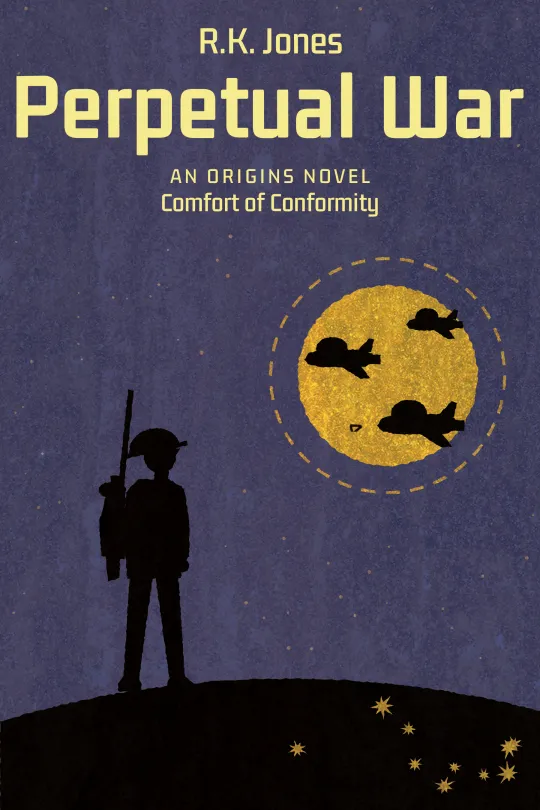
How a war is sold is also the subject of R.K. Jones’s Perpetual War, the origins novel of the Comfort of Conformity series, coming soon. It is set eons ago, in an invented and distant civilization. The Zalforian Union has known nearly a century of peace at home when catastrophe strikes, and the Hierarch has no weapon, no suspect and no evidence, only a line across the sky that ends at Galdassia, the desert world whose helium keeps the Union running.
Zadie Hinwell, a young aide who notices too much, is posted to Galdassia. A conscript, a boy who lies about his age, a doctor and a bomber are swept up in the same war. Each learns how a war is sold, and why it never quite ends.
Sources
- Modern Japan in Archives, chapter 4: the Manchurian Incident, National Diet Library (Japan)
- Mukden Incident and Manchukuo, 1931, Office of the Historian, US Department of State
- Mukden incident, Wikipedia
- Lytton Report, Wikipedia
- Affidavit of Alfred Helmut Naujocks, 20 November 1945 (PS-2751), Harvard Law School Nuremberg Trials Project
- Invasion of Poland, Fall 1939, United States Holocaust Memorial Museum
- Gleiwitz incident, Wikipedia
- Nuremberg trial proceedings, 21 November 1945 (document 1014-PS), Holocaust History Project archive
- Milestones: U.S. Diplomacy and Yellow Journalism, 1895-1898, Office of the Historian
- The World of 1898: Cuba Chronology, Library of Congress
- The Maine explodes, History.com
- USS Maine (1889), Wikipedia
- How the Battleship Maine Was Destroyed, Wikipedia
- Robert J. Hanyok, Skunks, Bogies, Silent Hounds, and the Flying Fish: The Gulf of Tonkin Mystery, 2-4 August 1964, NSA / Naval Historical Center
- Gulf of Tonkin intelligence documents release (2005), National Security Archive
- Tonkin Gulf Resolution (1964), National Archives
- The Gulf of Tonkin and Escalation, 1964, Office of the Historian
- Nayirah testimony, Wikipedia
- Big lobbying firm helps shape U.S. foreign policy, critics say, Deseret News (1992)
- Al Miskin, The News Industry, Middle East Report (MERIP), 1992
- Debate on the Hill & Knowlton Kuwait campaign, Democracy Now! (2003)
- The Gulf War, 1991, Office of the Historian
- The Record on CURVEBALL, National Security Archive (2007)
- Transmittal letter, Commission on the Intelligence Capabilities of the United States Regarding Weapons of Mass Destruction (2005)
- Report of the WMD Commission (2005), UNT CyberCemetery
- The Report of the Iraq Inquiry, GOV.UK (2016)
- Iraq Inquiry, Wikipedia
- Allegations of Genocide (Ukraine v. Russian Federation), International Court of Justice
- Allegations of Genocide (Ukraine v. Russian Federation), Wikipedia
- George Orwell, Nineteen Eighty-Four, Project Gutenberg Australia
- President Dwight D. Eisenhower’s Farewell Address (1961), National Archives
- Trends in World Military Expenditure, 2025, SIPRI (April 2026)
Questions people ask
What is a pretext for war?
A pretext for war is a public justification for fighting that hides, stretches or replaces the real reason, often an incident that was staged, misread or exaggerated. The classic term is casus belli, Latin for “occasion of war.”
What are real examples of false flag attacks?
Two of the best documented are the Mukden incident of 1931, when Japanese army officers blew up a stretch of railway and blamed Chinese troops, and the Gleiwitz incident of 1939, when SS men disguised as Poles seized a German radio station the night before Germany invaded Poland.
Did the second Gulf of Tonkin attack really happen?
Almost certainly not. The attack on USS Maddox on 2 August 1964 was real, but an internal NSA history by Robert J. Hanyok, declassified in 2005, concluded that no attack happened on the night of 4 August. Congress had passed the Gulf of Tonkin Resolution on 7 August after reports of it.
Was the USS Maine sunk by Spain?
There is no evidence that it was. A US Navy court in 1898 blamed a mine but could not say who was responsible, and a 1976 study by Admiral Hyman Rickover, published by the Navy, pointed to an accidental coal-bunker fire. The cause is still debated.
What does perpetual war mean?
Perpetual war is war with no end point, a permanent condition rather than an emergency. The idea is best known from George Orwell’s Nineteen Eighty-Four (1949). In 1961 President Eisenhower warned Americans to guard against the “unwarranted influence” of the military-industrial complex.