Psychology
Why People Conform: What the Asch Line Experiment Really Showed
In the 1950s, Solomon Asch got students to deny what they could plainly see. Here is what his line experiment really found, why people go along with groups, and what seventy years of research says helps us resist.
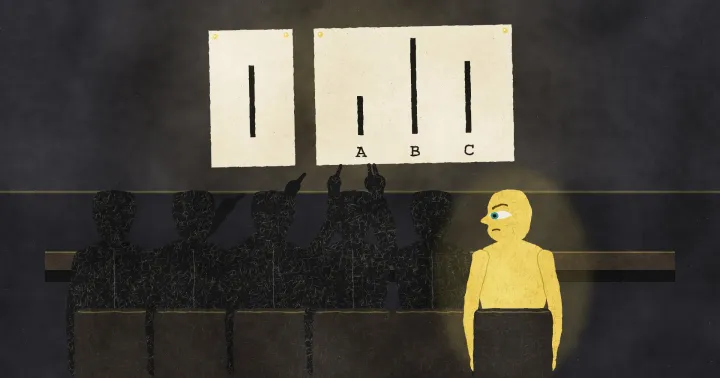
In the early 1950s, the psychologist Solomon Asch asked college students a question a child could answer: which of these three lines matches this one? Judging alone, people almost never got it wrong. But when everyone else in the room gave the same wrong answer first, participants went along with them on 36.8 percent of those trials, and about three in four gave in at least once. That is the famous result. The less famous one matters just as much: about a quarter of participants never gave in at all, and a single ally in the room cut the pressure to a fraction. So why do people conform? Decades of research point to two pulls, wanting to be right and wanting to belong. Both are real, and both are easier to resist than the legend suggests.
What happened in the Asch conformity experiment
The setup was simple and a little sly. A group of seven to nine young men, all college students, sat in a classroom for what they were told was an experiment in visual judgment. On each trial the experimenter showed two cards: one with a single standard line, the other with three comparison lines, one of which matched. Each man called out his answer in turn.
Only one of them was a real participant. The others were confederates working for Asch, and the real participant sat near the end of the row, so he heard most of the group answer before he did. In Asch’s own description there were 18 trials in each series, and on 12 of them the majority gave the same wrong answer. The wrong lines were off by three quarters of an inch to an inch and three quarters. People matching the lines on their own made mistakes less than 1 percent of the time.
Asch, who joined Swarthmore College in 1947, first reported the line studies in 1951 and gave fuller accounts in a 1955 Scientific American article and a 1956 monograph. In the 1955 account, which covered 123 participants from three institutions, the lone participants accepted the majority’s wrong judgment in 36.8 percent of the critical trials. About a quarter stayed completely independent, while 75 percent agreed with the majority to some degree. Even when the lines differed by seven inches, Asch reported, some still yielded.
He didn’t treat this as a curiosity. He called it a matter of concern that “reasonably intelligent and well-meaning young people are willing to call white black.”
The half of the story that usually gets left out
Flip the numbers and you get a different headline: nearly two thirds of the answers on the critical trials were correct. The social psychologists Jolanda Jetten and Matthew Hornsey point out that for every conforming answer, participants dissented twice. Reviewing textbooks in 2015, the psychologist Richard Griggs found that most repeated the 75 percent figure, while none mentioned that about 95 percent of participants defied the group at least once. Asch himself was as interested in what helped people resist as in what made them cave.
What changed the result: group size, one ally and private answers
Asch varied the setup to see what made the pressure rise and fall.
- Group size: Facing a single person who contradicted them, participants erred only 3.6 percent of the time. With two, it was 13.6 percent. With three, 31.8 percent. Beyond that, Asch wrote, larger majorities “did not increase the weight of the pressure substantially.”
- One ally: When one confederate gave the correct answer, participants erred only about a quarter as often as they did against a unanimous group. When that partner switched sides after six trials, errors rose abruptly.
- Any dissent at all: In another version, the lone dissenter picked a line even more wrong than the majority’s choice. Participants’ errors still dropped, to 9 percent.
That last finding is the strangest and perhaps the most useful. The ally didn’t have to be right. He only had to break the spell of a unanimous room.
Private answers are a messier story. In 1955, Morton Deutsch and Harold Gerard ran versions of the line task in which participants answered anonymously instead of face to face, and conformity was lower. But it didn’t vanish: even with the social pressure largely removed, people in groups still made more errors than people judging alone. And when Rod Bond and Peter Smith later pooled dozens of American studies, whether the majority could see a person’s answer made no significant difference. Privacy helps in some settings, but it is no cure.
That same analysis found clearer dials. Conformity rose with larger majorities and with more ambiguous tasks, and it fell when the majority were out-group members, people the participant didn’t identify with.
Why do people conform? Normative and informational influence
Two kinds of influence
Deutsch and Gerard’s 1955 paper gave psychology the vocabulary it still uses. Normative influence is going along in order to be accepted, or to avoid the sting of standing out. Informational influence is going along because you treat other people’s answers as evidence about reality. If eight people see something you don’t, maybe you’re the one who’s wrong.
Both showed up in Asch’s interviews. One line of reasoning he summed up as “I am wrong, they are right.” Some participants said they didn’t want to spoil his results. Others took their difference from the group as a sign of some deficiency in themselves, and some, Jetten and Hornsey note, simply didn’t want to look foolish or be the odd one out.
Informational influence isn’t stupidity. A crowd that agrees is often right, which is why leaning on it is a sensible habit. The habit misfires when the crowd is mistaken, coordinated or, as in Asch’s classroom, acting.
Why going along feels good
The normative pull runs deep. In an influential 1995 review, Roy Baumeister and Mark Leary argued that the need to belong is “a powerful, fundamental, and extremely pervasive motivation.” Disagreeing with your group puts that at risk, and the brain seems to treat it as a problem to fix.
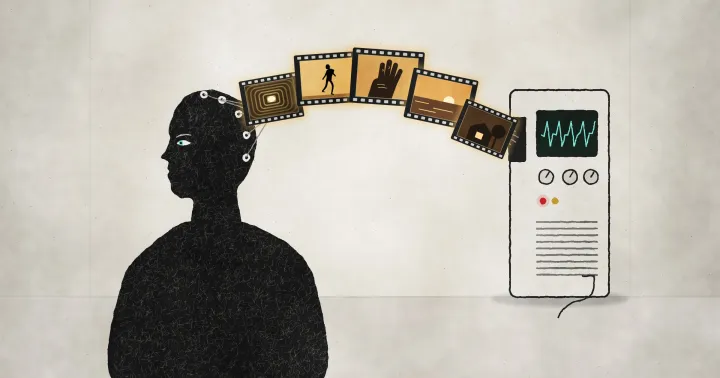
In a 2009 brain-imaging study, Vasily Klucharev and colleagues had people rate faces for attractiveness and then learn how a group had rated them. When a person’s judgment clashed with the group’s, two brain regions, the rostral cingulate zone and the ventral striatum, produced a signal resembling the “prediction error” that learning models use to flag mistakes. The bigger that signal, the more people later shifted toward the group. Being out of step registered, roughly, like getting something wrong.
An earlier study led by Gregory Berns, published in 2005, moved Asch’s design into an MRI scanner, swapping the lines for a harder task: judging whether pairs of abstract 3D shapes could be rotated to match. Even with no outside input, participants got 13.8 percent wrong. When a group of four peers gave wrong answers, errors rose to 41 percent, compared with 32 percent when computers gave the same wrong answers. Conforming was linked to changes in visual and spatial brain areas, and the researchers didn’t detect matching changes in frontal areas associated with deliberate decisions. That hints the group may shift what people perceive, not just what they say. Going against the group was linked to activity in the amygdala, a region tied to emotion, but the authors called that result tentative and listed real limits to the study. Treat it as a clue, not a verdict.
Do people still conform? Replications, culture and change over time
The Asch effect has been tested for about seventy years, and it bends with time and place.
Some commentators suggested that the high 1950s numbers were partly a product of the McCarthy era. In 1980 the British psychologists Perrin and Spencer could not reproduce the effect with university students and called Asch’s result “a child of its time.” Yet other studies of students in Britain, Belgium, the Netherlands and Portugal found conformity comparable to Asch’s.
The best overview is Bond and Smith’s 1996 meta-analysis of 133 Asch-style studies from 17 countries. Its main findings:
- The average error rate across studies was 29 percent, ranging from 0 to 60 percent. Strict replications using Asch’s own materials averaged 25 percent, a little below his 37 percent.
- In the United States, conformity had declined steadily since the early 1950s.
- Countries that score as more collectivist tended to show more conformity than individualist ones, and cultural values predicted conformity better than any other factor the authors tested.
Bond and Smith added a thoughtful caveat. Where harmony is prized, agreeing in public while disagreeing in private can be good manners, so the word “conformity” carries Western assumptions. They suggested the same behavior might be described as “tactfulness” or “social sensitivity.”
The effect hasn’t gone away. In a 2023 replication with 210 participants recruited at the University of Bern, Axel Franzen and Sebastian Mader found a 33 percent error rate on the line task, close to Asch’s. Paying one Swiss franc per correct answer cut it to about 25 percent, and when the confederates gave set answers to political statements, conformity reached 38 percent. Of the personality traits they measured, only openness was linked to less conformity.
Milgram and the Stanford Prison Experiment: a quick reality check
Asch’s work is often lumped together with two other famous studies. They tested different things, and both deserve a caveat.
Stanley Milgram’s experiments studied obedience to an authority figure, not conformity to peers. In his best-known baseline condition, 26 of 40 participants (65 percent) kept giving what they believed were electric shocks up to the 450-volt maximum. But that was one condition among many. Pulling together 21 of Milgram’s conditions with 740 participants, Nick Haslam and Gina Perry report that obedience ranged from 0 to 92.5 percent and averaged 43 percent, so most participants across those conditions disobeyed. A 2019 reanalysis by Perry and colleagues of 656 post-experiment questionnaires found that people who believed the learner was really in pain were about two and a half times as likely to defy the experimenter. And when two fellow participants, secretly actors, refused to go on, obedience fell below 20 percent.
The Stanford Prison Experiment of 1971, in which 24 young male volunteers were assigned to play guards or prisoners, was planned to run for two weeks and was called off by day six. It is often cited as proof that roles corrupt people. But archival research by Thibault Le Texier, published in American Psychologist in 2019, supported older criticisms such as demand characteristics and found biased, incomplete data collection; his sources show that guards were coached beforehand. At least one prisoner’s breakdown appears to have been faked. It is better treated as a dramatic demonstration than as evidence about human nature.
How to resist conformity when it matters
Conformity isn’t always bad. Following the crowd is often a sensible shortcut, and it keeps social life running smoothly. The trick is noticing when the shortcut is taking you somewhere you would never go alone. The research points to a few habits that help:
- Find one ally, or be one. Nothing in Asch’s work cut the pressure like a single other dissenter. If you disagree, you may not be the only one, and speaking up can give a quieter doubter cover.
- Commit before you hear the room. Write your judgment down first, or use anonymous input, which is the logic of the secret ballot. Privacy tends to reduce conformity, though not in every study.
- Make accuracy matter. In the Bern study, a small reward for correct answers cut the error rate from 33 to about 25 percent.
- Ask which pull you’re feeling. Is the group better informed than you, or are you just uncomfortable standing out? If it’s the first, changing your mind is learning. If it’s the second, take another look.
- Clear the fog first. The more ambiguous the question, the more people lean on the group, so get the facts straight before you poll the room.
- Remember the real base rate. Nearly two thirds of the answers given under pressure in Asch’s studies were correct, in a room full of strangers. Independence is common. It’s just less famous.
What would you forget to feel safe?
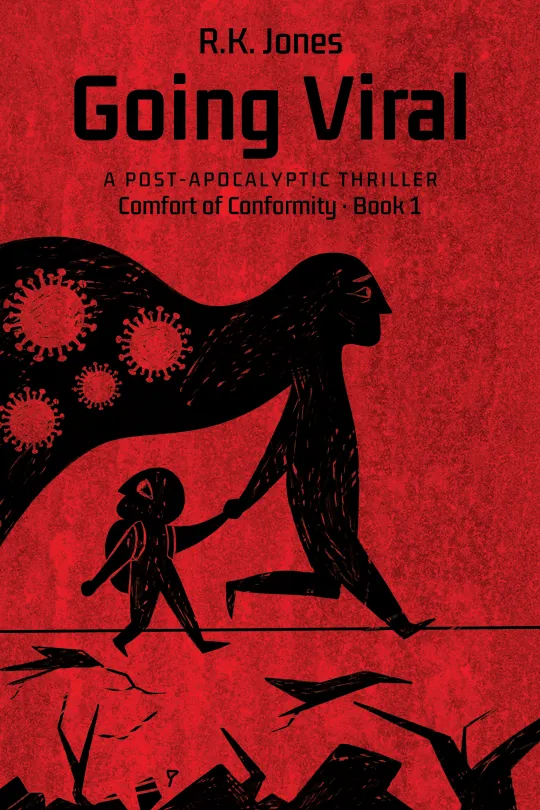
Asch’s participants risked nothing worse than a few awkward minutes, and still most of them named the wrong line at least once. It’s worth wondering what happens when the stakes are not embarrassment but safety. That question sits at the heart of R.K. Jones’s Comfort of Conformity series: seven novels and an origins story asking what you would forget to feel safe.
In 2055 a virus no database can identify sweeps the world in a day. The survivors are offered safety, order and an end to fear by the Founders, and all they have to give up is the past. It begins with Going Viral, as virologist Dr. Abigail Swanson and her daughter Sapphire head south for a forest in Alabama. In The Thirtieth of February, set in a New Australia where every date before Transition Day has been declared void, Dr. Matt Harris is called to chip a boy in open court, and the boy shouts the one thing nobody is allowed to say: what year it really is. Asch would have recognized that moment. His experiments showed that one dissenting voice can make it easier for everyone else in the room to say what they see.
Sources
- Opinions and Social Pressure (Solomon E. Asch, 1955), Scientific American
- 1951: Psychologist Solomon Asch’s Famous Experiments, Swarthmore College
- A study of normative and informational social influences upon individual judgment (Deutsch and Gerard, 1955), Journal of Abnormal and Social Psychology
- Culture and Conformity: A Meta-Analysis of Studies Using Asch’s Line Judgment Task (Bond and Smith, 1996), Psychological Bulletin
- The power of social influence: A replication and extension of the Asch experiment (Franzen and Mader, 2023), PLOS ONE
- The line between conformity and resistance (Jetten and Hornsey, 2014), The Psychologist
- Textbook coverage of a classic social psychology study has become increasingly biased, BPS Research Digest
- Neurobiological correlates of social conformity and independence during mental rotation (Berns et al., 2005), Biological Psychiatry
- Reinforcement learning signal predicts social conformity (Klucharev et al., 2009), Neuron
- The need to belong (Baumeister and Leary, 1995), Psychological Bulletin
- Culture of Shock (Reicher and Haslam, 2011), Scientific American
- Revisiting Milgram’s shocking obedience experiments (Haslam and Perry, 2014), The Conversation
- Unpublished data from Stanley Milgram’s experiments casts doubt on his claims about obedience, PsyPost
- Debunking the Stanford Prison Experiment (Le Texier, 2019), American Psychologist
- The infamous Stanford prison experiment was flawed (Gina Perry, 2025), University of Melbourne
Questions people ask
What was the Asch conformity experiment?
A series of studies by the psychologist Solomon Asch, first reported in 1951, in which college students matched line lengths after a group of actors gave the same wrong answer on 12 of 18 trials. In his 1955 account, participants went along on 36.8 percent of those trials; about 75 percent conformed at least once, and about a quarter never did.
Why do people conform?
Morton Deutsch and Harold Gerard (1955) distinguished normative influence, going along to be accepted, from informational influence, treating other people’s answers as evidence of what is true. The two usually work together: ambiguous tasks increase reliance on the group, and answering in public adds social pressure.
Has the Asch experiment been replicated?
Many times. A 1996 meta-analysis of 133 studies from 17 countries found that conformity in the United States had declined since the 1950s and was higher in more collectivist countries. A 2023 replication in Switzerland found a 33 percent error rate, close to Asch’s original.
How can you resist conformity?
In Asch’s studies, a single ally who gave the correct answer cut errors to about a quarter of their level under a unanimous majority. Answering privately and rewarding accuracy also reduced conformity in later experiments, though neither removed it entirely.
Is the Asch experiment the same as the Milgram experiment?
No. Asch studied conformity to a group of peers on a simple visual judgment, while Stanley Milgram studied obedience to an authority figure who told participants to give what they believed were electric shocks. Milgram’s famous 65 percent figure comes from one condition; across 21 of his conditions, obedience averaged 43 percent.