Philosophy
Stoicism for Anxiety: 7 Ancient Exercises and What the Science Says
The Stoics wrote about worry nearly two thousand years ago, and the founders of CBT credited them. Here is what Epictetus, Seneca and Marcus Aurelius taught, seven exercises from their texts, and what the research says.

Stoicism for anxiety comes down to one old idea: we are troubled less by events than by our judgments about them, and only part of what worries us is ours to control. That idea later became a seed of cognitive behavioral therapy (CBT), and two of its founding figures, Albert Ellis and Aaron Beck, both credited the Stoics. The exercises the Stoics left behind may help with everyday worry. They are a philosophy rather than a treatment, though, and the research on Stoic practice itself is still small and early.
The key facts:
- The core idea: Epictetus taught that people are disturbed “not by the things which happen, but by the opinions about the things” (Enchiridion 5, translated by George Long).
- The core tool: Sort each worry into what is up to you (your judgments, choices and actions) and what is not (other people, your reputation, the outcome).
- The CBT link: Ellis in 1962 and Beck’s team in 1979 both traced their therapies’ philosophical roots to the Stoics.
- The evidence: CBT is well tested for anxiety disorders. Stoic training has only small trials and uncontrolled surveys so far, with modest, encouraging results.
- The limit: Stoic practice is not a treatment for an anxiety disorder. If anxiety is running your life, talk to a doctor or a licensed mental health professional.
What did the Stoics teach about anxiety?
Stoicism began in Athens around 300 BCE with Zeno of Citium, and takes its name from the Stoa Poikile, the “painted porch.” The Stoics most people read today wrote centuries later, under Rome: Seneca, Nero’s tutor and later his adviser; Epictetus, a former slave whose pupil Arrian recorded his Discourses; and Marcus Aurelius, emperor from 161 to 180 CE, who wrote his Meditations to and for himself.
All three wrote about worry with startling precision. Epictetus opened a whole discourse on it with a diagnosis:
“When I see a man anxious, I say, What does this man want?” (Epictetus, Discourses 2.13, translated by George Long)
If the man did not want “some thing which is not in his power,” Epictetus reasons, how could he be anxious? His example is a lute player, calm singing alone but anxious in the theater, because there “he not only wishes to sing well, but also to obtain applause: but this is not in his power.” The skill was his. The crowd never was. (Our piece on the spotlight effect looks at the modern psychology of feeling watched.)
Seneca, writing to Lucilius late in life, blamed the imagination:
“There are more things, Lucilius, likely to frighten us than there are to crush us; we suffer more often in imagination than in reality.” (Seneca, Letters 13, translated by Richard M. Gummere)
Marcus boiled it down to a rule: “If thou art pained by any external thing, it is not this thing that disturbs thee, but thy own judgement about it.” Then the hopeful part: “it is in thy power to wipe out this judgement now” (Meditations 8.47, translated by George Long).
Does Stoicism mean bottling up your feelings?
No. The Roman writer Aulus Gellius tells of a storm on the Ionian Sea that left an eminent Stoic philosopher, in John C. Rolfe’s 1927 translation, “frightened and ghastly pale.” Once the danger had passed, a rich Greek from Asia teased him for it. Later the Stoic produced from his bag the fifth book of Epictetus’s Discourses, one of the books now lost (only four of the original eight survive).
Its lesson: frightening first impressions strike even the wise, and they are involuntary. What counts is the next step. The wise person is shaken briefly, then “does not assent” to the impression (Attic Nights 19.1).
Seneca said much the same about grief: “We may weep, but we must not wail” (Letters 63). Capital-S Stoicism examines feelings rather than suppressing them. The everyday stiff upper lip is a different thing, and the research treats it differently too.
7 Stoic exercises for anxiety, from the original texts
Each exercise starts with its source passage, then a way to try it today.
1. Sort the worry: the dichotomy of control
Source: The Enchiridion, a short manual abridging Epictetus’s teaching, opens: “Of things some are in our power, and others are not.” In our power are our opinions, impulses, desires and aversions, in a word our own acts. Not in our power are the body, property and reputation.
How to do it: Write the worry at the top of a page and draw two columns, “up to me” and “not up to me.” For a job interview, your preparation and follow-up email go on the left; the interviewer’s mood and the decision go on the right. Put your effort into the left column. For the right, Epictetus advised being ready to say that it “does not concern you”: notice when you are rehearsing it, and steer back.
2. Catch the judgment: “You are an appearance”
Source: In the same chapter, Epictetus offers a phrase for every harsh impression: “You are an appearance, and in no manner what you appear to be.”
How to do it: When a frightening thought arrives (“I’m going to be fired”), restate it as a thought: “I’m having the thought that I’ll be fired.” Then separate the event (your manager asked for a meeting) from the story you added to it. Ask what you actually know, and what you are assuming.
3. Put the fear on trial
Source: Seneca’s thirteenth letter reads like a cross-examination. Is this a real evil, or merely ill report? “First of all, consider whether your proofs of future trouble are sure.” Even likely trouble “is not a present fact.” Marcus adds a time limit: “Do not disturb thyself by thinking of the whole of thy life” (Meditations 8.36). Ask instead, “What is there in this which is intolerable and past bearing?”
How to do it: Put the worry in the dock. Is it real, or a rumor or a feeling? Certain, or only possible? Happening now, or later? Then shrink your horizon to the next hour and ask Marcus’s question. Often the honest answer is “nothing yet.”
4. Rehearse the setback, then rehearse coping
Source: Modern writers call this premeditatio malorum (also spelled praemeditatio), the premeditation of adversity. After a fire destroyed the Roman colony at Lyon, Seneca wrote that “nothing ought to be unexpected by us,” and listed “Exile, the torture of disease, wars, shipwreck” as things to think about in advance (Letters 91). Marcus told himself to begin each morning expecting “the busybody, the ungrateful, arrogant, deceitful, envious, unsocial” (Meditations 2.1).
How to do it, carefully: An anxious mind already rehearses disasters all day, so the second half is what matters. Pick one specific setback, give it two or three minutes, and spend most of that time on your response: what you would do, who you would call, what would still be in your power. Donald Robertson and R. Trent Codd, writing in The Behavior Therapist, suggest that a better modern analogy than imaginal exposure is the mental rehearsal of coping strategies used in stress inoculation training. Then stop. Seneca’s rule is not to be “unhappy before the crisis comes.”
5. Take the view from above
Source: “Look down from above on the countless herds of men and their countless solemnities,” Marcus writes (Meditations 9.30), going on to picture voyages in calm and storm, births and deaths, and how soon names are forgotten. The French scholar Pierre Hadot later devoted an essay to this practice, “the view from above.”
How to do it: Picture yourself in your room, then rise above the roof, the city and the coastline until the earth is a ball in space. See how big the worry looks from there. Then come back down and choose one small action. The point is proportion, not indifference. A real problem stays real, but it stops filling the whole sky.
6. Practice the discomfort you fear
Source: Seneca told Lucilius to “Set aside a certain number of days” for “the scantiest and cheapest fare, with coarse and rough dress,” asking all the while, “Is this the condition that I feared?” (Letters 18). The time to toughen the mind, he argued, is when life is calm, the way a soldier drills in peacetime.
How to do it: Choose a small, safe dose of something your anxiety warns you about. Skip a comfort for a day, or make the awkward phone call. Then ask Seneca’s question. Build up gradually. The aim is evidence that you can cope, not punishment.
7. End the day with a review
Source: In On Anger (3.36, translated by Aubrey Stewart), Seneca describes the philosopher Sextius asking himself each night: “What bad habit of yours have you cured to-day? what vice have you checked? in what respect are you better?” Seneca did the same once the lamp was out: “I pass the whole day in review before myself.”
How to do it: Take five minutes before sleep. Note one moment when worry took over, what it said, and what was actually in your control. Then note one thing you handled well. Keep it more audit than trial, and use it to close the day rather than reopen it.
Stoicism and CBT: did therapy really borrow from the Stoics?
Yes, by the founders’ own account. Albert Ellis first set out what became rational emotive behavior therapy (REBT) in the mid-1950s. In Reason and Emotion in Psychotherapy (1962) he wrote that its central principle “was originally discovered and stated by the ancient Stoic philosophers.” His “ABC” model is the Stoic idea in modern dress: an adversity (A) does not produce the emotional consequence (C) on its own. The belief (B) about it does, and beliefs can be disputed and replaced.
Aaron Beck, who published his first article on cognitive therapy in 1963, agreed. In 1976 he wrote that its philosophical underpinnings “go back thousands of years, certainly to the time of the Stoics.” His team’s 1979 treatment manual, Cognitive Therapy of Depression, says it outright: “The philosophical origins of cognitive therapy can be traced back to the Stoic philosophers.”
That doesn’t make them the same thing. As Robertson and Codd put it in 2019, “CBT is a therapy; Stoicism is a philosophy of life.” CBT is a structured, clinically tested treatment. Stoicism is a whole way of living, and the same authors note that some people will disagree with its core values. Think of Stoicism as the ancestor, not the prescription.
Does Stoicism help with anxiety? What the research shows
The short answer: CBT, Stoicism’s descendant, has strong evidence, while Stoicism itself has only early evidence.
A 2018 meta-analysis of 41 randomized placebo-controlled trials, covering 2,835 patients, found moderate effects of CBT on the symptoms of anxiety and related disorders. The Stoic evidence is thinner:
- A small randomized trial (2021): Psychologists at Birkbeck, University of London, assigned 45 high worriers to Stoic training, Stoic plus working-memory training, or an active control, for eight sessions. Stoic training significantly improved rumination and self-efficacy compared with the control. Trait anxiety fell too, but not significantly more than in the control group, and the authors warn that differences between the groups at the start may explain some effects (MacLellan and Derakshan).
- Stoic Week 2024: In Modern Stoicism’s free yearly online course, the 354 people who answered questionnaires at both the start and the end reported 12.5 percent lower vulnerability to anxiety. There was no control group, and the report gives a completion rate of 26 percent (the 2024 report).
- A new measuring tool (2025): The Stoic Attitudes and Behaviours Scale, built with data from more than 8,000 people in 116 countries and published in Cognitive Therapy and Research in August 2025, linked Stoic attitudes with flourishing, resilience and positive emotion, and with less anger. The authors contrast this with everyday stiff-upper-lip “stoicism,” which they note correlates with poorer outcomes. These are correlations, not proof of cause.
As of late 2026, researchers at Royal Holloway’s Centre for the Study and Application of Stoicism say the research is still in its early days. The fair conclusion: Stoic exercises may ease rumination and help everyday worriers feel more capable, and their central ideas live on in a well-tested therapy. There is not yet good evidence that Stoicism on its own treats an anxiety disorder.
When Stoicism isn’t enough
Everyone worries. But as the US National Institute of Mental Health explains, anxiety disorders “involve more than occasional worry or fear.” The anxiety persists, can get worse over time, and can disrupt work, school and relationships. Stoic practice is not a treatment for an anxiety disorder. If anxiety is running your life, see a doctor or a licensed mental health professional. Effective treatments exist, and CBT is one of them. In Stoic terms, asking for help is squarely up to you.
Applied Stoicism: taking it further
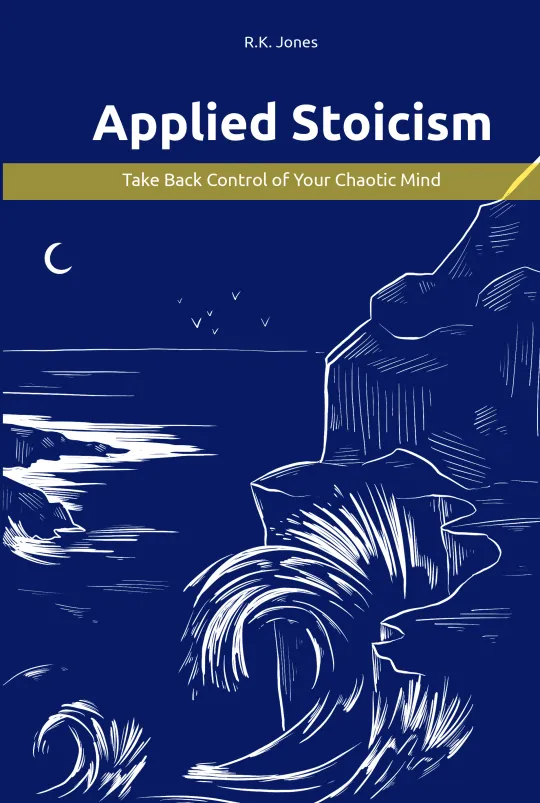
If you want to go deeper, R.K. Jones’s Applied Stoicism: Take Back Control of Your Chaotic Mind is available now. It is a personal guide to the same three Stoics quoted throughout this article, Epictetus, Seneca and Marcus Aurelius, and to how their ideas can quiet anxiety and help you take back control of a chaotic mind.
That is the spirit in which the Stoics are best read. Pierre Hadot argued that for the ancients, philosophy was a way of life, and the texts bear him out. The Enchiridion is a manual. The Meditations are reminders an emperor wrote to himself. Seneca’s letters keep giving Lucilius homework. So pick one exercise from the list above, try it for a week, and notice what changes. Then pick another.
Sources
- The Encheiridion or Manual (Epictetus, translated by George Long, 1877), Wikisource
- The Discourses of Epictetus 2.11 to 3.4, including 2.13 “Of Anxiety” (translated by George Long), Perseus Digital Library via Perseids
- Moral Letters to Lucilius (Seneca, translated by Richard M. Gummere, 1917-1925), Wikisource
- Of Anger, Book III (Seneca, translated by Aubrey Stewart), Wikisource
- Meditations (Marcus Aurelius, translated by George Long, 1862), Lexundria
- The Attic Nights 19.1 (Aulus Gellius, translated by John C. Rolfe, 1927), Perseus Digital Library via Perseids
- Stoic Philosophy as a Cognitive-Behavioral Therapy (Robertson and Codd, The Behavior Therapist, 2019), donaldrobertson.name
- Cognitive behavioral therapy for anxiety and related disorders: A meta-analysis of randomized placebo-controlled trials (Carpenter et al., 2018), Depression and Anxiety
- The Effects of Stoic Training and Adaptive Working Memory Training on Emotional Vulnerability in High Worriers (MacLellan and Derakshan, 2021), Cognitive Therapy and Research
- The Development and Validation of the Stoic Attitudes and Behaviours Scale (LeBon et al., 2025), Cognitive Therapy and Research
- Stoic Week 2024 Results and Report (Tim LeBon, 2024), Modern Stoicism
- Research, Centre for the Study and Application of Stoicism, Royal Holloway, University of London
- Anxiety Disorders, National Institute of Mental Health
- Stoicism, Internet Encyclopedia of Philosophy
- Pierre Hadot, Internet Encyclopedia of Philosophy
- Epictetus, Stanford Encyclopedia of Philosophy
- Seneca, Stanford Encyclopedia of Philosophy
- Marcus Aurelius, Stanford Encyclopedia of Philosophy
- Dr. Aaron T. Beck, Beck Institute
Questions people ask
Can Stoicism help with anxiety?
It may help with everyday worry. Its core techniques, separating what you can control from what you can’t and questioning your judgments about events, overlap with cognitive behavioral therapy, which has strong evidence for anxiety disorders, but research on Stoic training itself is still small and early. Stoicism is not a treatment for an anxiety disorder, so see a doctor or licensed mental health professional if anxiety is running your life.
What did Epictetus say about anxiety?
In Discourses 2.13, in George Long’s translation, he wrote: “When I see a man anxious, I say, What does this man want?” His point was that anxiety comes from wanting something outside our power, like a lute player who wants not only to sing well but also to win applause.
Is CBT based on Stoicism?
Partly, by its founders’ own account. Albert Ellis wrote in 1962 that the central principle of his rational emotive therapy was first stated by the ancient Stoics, and Aaron Beck’s 1979 treatment manual traced cognitive therapy’s philosophical origins to the Stoic philosophers. CBT is a clinically tested therapy, while Stoicism is a philosophy of life.
What is premeditatio malorum?
It is the Stoic practice of imagining setbacks in advance so they don’t catch you unprepared. Seneca urged it after a fire destroyed the colony at Lyon, writing that “nothing ought to be unexpected by us” (Letters 91, translated by Richard M. Gummere). For anxious people, the useful version is brief and focuses on how you would cope, not on the disaster itself.
Does Stoicism mean suppressing your emotions?
No. Philosophical Stoicism teaches examining your judgments, not hiding your feelings, and Seneca wrote, “We may weep, but we must not wail.” A 2025 study of more than 8,000 people linked Stoic attitudes with flourishing and resilience, and its authors note that everyday stiff-upper-lip “stoicism” correlates with poorer outcomes.