History
What Was MKUltra? The CIA’s Mind-Control Program, From the Records
From 1953 the CIA secretly funded drug, hypnosis and behavior-control research and dosed people without their knowledge. What the files and Senate hearings prove, from Frank Olson to Montreal, and what is still myth.
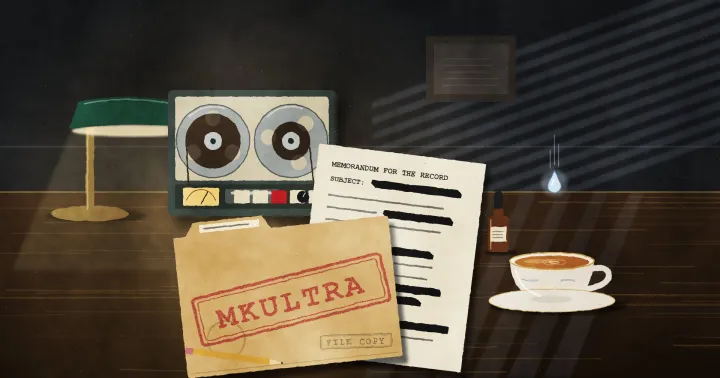
MKUltra was a secret CIA program, approved on 13 April 1953, that funded research into drugs, hypnosis and other ways to influence and control human behavior, including tests in which people were given LSD without their knowledge. Most of its files were destroyed in 1973, so what is known for certain comes from a cache of financial records found in 1977, a 1963 internal report and the Senate investigations that followed.
Here is what those records establish, and where the proof runs out.
- Approved in 1953: CIA Director Allen Dulles approved MKUltra on 13 April 1953, along lines proposed by a senior officer, Richard Helms.
- 149 subprojects: the surviving files list 149 subprojects and 80 institutions, including 44 colleges or universities, 12 hospitals or clinics and 3 penal institutions.
- Unwitting subjects: people were given LSD without consent, in CIA safehouses and at a 1953 retreat where the Army scientist Frank Olson was dosed. He died nine days later.
- Files destroyed: most records were destroyed in January 1973 on the order of Helms, by then the CIA’s director.
- Exposed in 1977: seven boxes of overlooked financial records surfaced after a Freedom of Information Act request, leading to a Senate hearing on 3 August 1977.
- Still in court: a class action over CIA-funded “depatterning” experiments in Montreal was authorized in Quebec in July 2025.
What was MKUltra?
MKUltra was a funding umbrella for the CIA’s most sensitive research. The agency’s inspector general described it in 1963 as research into materials “capable of employment in clandestine operations to control human behavior.”
It grew out of Cold War fear. American officials believed Communist countries were using drugs, physical duress, electric shock and possibly hypnosis against their enemies, and the CIA had received reports that the Soviets had tried to buy the world’s supply of LSD. One CIA officer later told Senate investigators, “we were literally terrified.” Two earlier programs, BLUEBIRD (1950) and ARTICHOKE (1951), had already tested interrogation with drugs and hypnosis.
In a memo of 3 April 1953, Helms proposed a special funding mechanism. The CIA would look for a substance that could help in “discrediting individuals, eliciting information, and implanting suggestions and other forms of mental control.” Dulles, who had taken over the agency shortly before, approved it ten days later. Six percent of the technical division’s research budget was to be spent without formal contracts, because contracts would reveal the government’s interest. Grants went out through foundations that hid the CIA’s role. The work was overseen by Sidney Gottlieb, chief of the Chemical Division of the CIA’s Technical Services Staff, later the subject of Stephen Kinzer’s 2019 biography Poisoner in Chief.
What did MKUltra actually do?
When CIA Director Stansfield Turner briefed the Senate in 1977, he sorted the 149 subprojects into 15 categories. More than 50 involved behavioral drugs or alcohol. Others covered hypnosis, sleep research, polygraphs, studies of defectors, “aspects of magicians’ art” useful for slipping someone a drug, and single projects on electroshock, harassment techniques and extrasensory perception.
The files named 185 non-government researchers and assistants, and many never knew who was paying. Turner told the senators that “most of the people and institutions involved are not aware of Agency sponsorship.”
Some tests took place inside institutions. At the federal Addiction Research Center in Lexington, Kentucky, prisoners serving drug sentences volunteered to take hallucinogens, and as a reward they were given the drug of their addiction, according to Senate investigators. Turner’s review also found unwitting testing on “criminal sexual psychopaths” held at a state hospital.
The MKUltra LSD experiments on unwitting people
The most notorious tests took place outside any lab. Undercover officers of the Federal Bureau of Narcotics, acting for the CIA, gave LSD to people in what Senate investigators called “normal life settings.” A subject might be met in a bar and invited to a safehouse, where the drug went into a drink or food. CIA personnel might watch through a one-way mirror. The safehouses were in San Francisco and New York, and the narcotics agent George Hunter White ran them. The San Francisco operation, which used sex workers to lure men in, is now known as Operation Midnight Climax.
No doctors were present, nobody consented and there was no follow-up. The 1963 report admitted that the subjects were “seldom accessible beyond the first hours of the test,” and that at least one had been hospitalized. The stated aim was to learn how the drugs worked on people “at all social levels, high and low, native American and foreign.” The CIA also used MKUltra materials abroad, under a procedure called MKDELTA, from 1953 and possibly as early as 1950.
Turner said the new files held enough evidence to confirm unwitting testing in 6 of the 149 subprojects, with other cases unclear.
Who was Frank Olson?
Frank Olson was a civilian Army scientist at Camp Detrick, Maryland, and the best-documented casualty of MKUltra. On 19 November 1953, at a meeting of Army and CIA scientists in a cabin at Deep Creek Lake, Maryland, the CIA officer Robert Lashbrook put LSD in a bottle of Cointreau as part of an experiment he and Gottlieb ran. Olson drank about 70 micrograms without knowing it.
Olson soon showed signs of paranoia and deep depression. The CIA took him to New York to see Harold Abramson, an allergist with no psychiatric degree whose LSD research the agency had funded indirectly. In the early hours of 28 November, according to Lashbrook, Olson crashed through the closed window of a tenth-floor room at the Statler Hotel and fell to his death.
The agency did not tell his family what had happened. Dulles sent letters faulting the officers’ “poor judgment,” but a note to Helms said “these are not reprimands,” and the episode had no apparent effect on anyone’s career. The truth came out only in 1975, during the Rockefeller Commission and Church Committee investigations. President Gerald Ford later apologized, and the government paid the family $750,000.
Olson’s sons have long argued that he was murdered. A 1994 exhumation found a head injury that most of the forensic team thought came before the fall, though one member disagreed. Manhattan prosecutors looked again and found no case to bring to a grand jury, and a federal judge dismissed the sons’ 2012 lawsuit in July 2013, partly because of the earlier settlement. The secret dosing and the cover-up are documented. Murder is not proven.
How did MKUltra end, and why were the files destroyed?
The program unraveled from the inside. In spring 1963, John Vance of the inspector general’s staff came across MKUltra and the unwitting LSD tests during a wide-ranging survey, and the testing was halted. Helms, now in charge of covert operations, pushed back. In December 1963 he argued that only unwitting subjects gave realistic results, and in November 1964 he conceded that “we have no answer to the moral issue.” There is no record that the testing restarted, and the CIA told the Senate that the program shrank each year until it ended in the late 1960s. Turner dated the project 1953 to 1964.
Then the evidence went. In January 1973, staff destroyed the MKUltra records on Gottlieb’s verbal orders, carrying out a verbal order from Helms, by then director of the CIA. Both men were about to retire. Helms later said the aim was to protect outside helpers, “so that anybody who assisted us in the past would not be subject to follow-up or questions, embarrassment, if you will.” At least one of Gottlieb’s assistants objected.
Senate investigators concluded that the destruction made it impossible to learn the program’s full extent, and that it kept the CIA from finding and helping the people it had tested. The record had been thin to begin with. The 1963 report warned that “a substantial portion of the MKULTRA record appears to rest in the memories of the principal officers.”
How MKUltra came to light: the Church Committee and the 1977 Senate hearing
The cryptonym became public in 1975, when the Rockefeller Commission and the Senate’s Church Committee investigated the CIA and the details of Olson’s death came out. The Church Committee’s 1976 report found that the drug programs “resulted in substantial violations of the rights of individuals within the United States.”
Everyone assumed the files were gone. Then a former State Department official, John Marks, filed a Freedom of Information Act request. A CIA employee answering such requests searched the agency’s Retired Records Center outside Washington and, in March 1977, found seven boxes that the budget and fiscal section had sent there in 1970. They had escaped both the 1973 destruction and the 1975 searches. They were finance folders, mostly vouchers and accountings, with scattered memos. Turner said he was convinced nobody had tried to hide them. Congress learned of them in July.
On 3 August 1977, the Senate Select Committee on Intelligence and Senator Edward Kennedy’s health subcommittee held a joint hearing on Project MKUltra. Kennedy summed it up:
“The Central Intelligence Agency drugged American citizens without their knowledge or consent.”
Turner said the agency was trying to identify people who had been dosed, but the records contained no names of test subjects. In 1981, Executive Order 12333 barred intelligence agencies from research on human subjects except under federal health guidelines, with documented informed consent.
MKUltra in Canada: Ewen Cameron and the Montreal experiments
In Montreal, Dr. D. Ewen Cameron, the founding director of the Allan Memorial Institute and a former president of the American Psychiatric Association, tried to treat mental illness by breaking down patients’ existing patterns of thought and rebuilding them. He called it “depatterning.”
Depatterning combined weeks of drug-induced sleep, intensive electroshock, LSD and other drugs, sensory deprivation and “psychic driving,” in which taped messages were played to patients over and over. From about 1957, the CIA funded part of this work as MKUltra Subproject 68, through a front called the Society for the Investigation of Human Ecology. The Canadian government funded Cameron too. The CIA’s role was reported in 1977.
Nine former patients sued the United States in 1980. In 1988 the case was settled for $750,000, with no admission of liability. A 1986 Canadian report found that Ottawa had no legal liability, but in 1992 the government made ex gratia payments of $100,000 each to surviving patients who had been depatterned. Seventy-seven people received them.
The fight continues. In 2019, relatives led by Julie Tanny filed a class action. Quebec’s courts ruled that the United States has state immunity there, and in May 2024 the Supreme Court of Canada declined to hear an appeal. On 31 July 2025, Justice Dominique Poulin of the Quebec Superior Court authorized the class action against the Government of Canada, McGill University and the Royal Victoria Hospital, covering patients treated under Cameron from 1948 to 1964 and their families. Authorization is not a verdict: as Éducaloi explained in January 2026, fault will be decided at trial.
MKUltra myths: what is proven and what isn’t
MKUltra is real, which makes it a magnet for stories that run far beyond the paper.
Documented: the program and its approval, the unwitting LSD tests, the safehouses, Olson’s dosing and the cover-up, the 1973 destruction and the CIA’s funding in Montreal. These rest on the CIA’s own records and sworn testimony.
Unknown: how many people were dosed, who most of them were and what happened to them afterward. The destruction of the files saw to that.
Unproven:
- Mind-controlled assassins. The CIA’s own review undercuts the idea of a working “Manchurian Candidate.” The 1963 report found that “as of 1960 no effective knockout pill, truth serum, aphrodisiac, or recruitment pill was known to exist.”
- Olson’s murder. Suspected by his family, never established.
- Famous “subjects.” The journalist Tom O’Neill’s book Chaos explores possible links between Charles Manson and the CIA’s programs. Reviewers called its theory speculative, and it remains unproven.
- Vaccines. A 1952 ARTICHOKE memo suggested that drugs could be hidden in “vaccinations, shots, etc.,” but the National Security Archive found nothing to show the CIA used real vaccines for mind control.
- Erasing memories on demand. Even today, as our look at whether scientists can read or erase memories explains, no pill erases a specific memory.
The story is still moving. In December 2024 the National Security Archive published more than 1,200 records, most from John Marks’s papers. On 30 June 2026, a House task force chaired by Representative Anna Paulina Luna held a hearing on MKUltra, with Kinzer and O’Neill among the witnesses, and Luna said the CIA was declassifying newly discovered MKUltra documents. Until such files are public, treat claims about their contents as unverified.
Ten Million Strangers: a drink that steals memories
MKUltra’s lasting lesson is about trust: officials who decided, in secret, that some people’s minds were acceptable test material, and then shredded the record. The fear that something in your cup could be taking your memory sits at the heart of R.K. Jones’s Ten Million Strangers, Book 3 of the Comfort of Conformity series, coming soon.
Two years after the world collapsed, the survivors live in City, a domed paradise where the dictums play from every building, every resident has a job and a place, and one cup of Caffeinquist each morning makes the day bearable. Grace wakes beside a stranger and can’t remember bringing him home. Nobody can, and that is normal here. Then she reads a note warning that the drink is stealing their memories, and the pieces that start coming back don’t fit the life she’s living. Across City, an inventory worker named Gabe is having the same trouble remembering who he used to be. And the Elders who run the dome are keeping a very careful count of City’s women.
Sources
- [Project MKULTRA, the CIA’s Program of Research in Behavioral Modification, joint hearing of the Senate Select Committee on Intelligence and the Subcommittee on Health and Scientific Research, 3 August 1977 (includes Turner’s statement and the Church Committee’s findings as Appendix A), copy hosted by Carnegie Mellon University](https://www.andrew.cmu.edu/user/rp3h/lansberry/mkultra.pdf)
- CIA Behavior Control Experiments Focus of New Scholarly Collection, National Security Archive (December 2024)
- MKUltra: Declassification Task Force Should Focus on Real Secrets, Not Conspiracy Theories, National Security Archive (June 2026)
- Mind Control and Accountability: Uncovering the Truth of the CIA’s MKULTRA Project, hearing page, House Committee on Oversight (30 June 2026)
- Hearing wrap-up, House Committee on Oversight (30 June 2026)
- Anna Paulina Luna says CIA declassifying newly discovered MKUltra documents, Washington Examiner (30 June 2026)
- Olson et al. v. United States, No. 12-1924, US District Court for the District of Columbia (2013), GovInfo
- Frank Olson, Wikipedia
- Operation Midnight Climax, Wikipedia
- Sidney Gottlieb, Wikipedia
- Executive Order 12333, United States Intelligence Activities (1981), National Archives
- Madness, Part 4: Pursuit of Justice, WBUR Endless Thread (2020)
- Families of Allan psychiatric experiments go to court, The Canadian Jewish News (2019)
- Julie Tanny class action news, Consumer Law Group (2019)
- Supreme Court won’t hear appeal in Montreal brainwashing experiments case, The Canadian Press via Global News (May 2024)
- A Class Action for Victims of the MKULTRA Program, Éducaloi (January 2026)
- Donald Ewen Cameron, Wikipedia
- Project MKUltra, Wikipedia
Questions people ask
Is MKUltra real?
Yes. MKUltra was a real CIA program, approved on 13 April 1953. It is documented in CIA records, the Church Committee’s 1976 report and a Senate hearing on 3 August 1977, where CIA Director Stansfield Turner described its 149 subprojects.
What did MKUltra do?
It funded research into drugs, hypnosis, sleep, polygraphs and other ways to influence behavior, often through universities and hospitals that did not know the CIA was paying. Some tests gave LSD to people without their knowledge, including in CIA safehouses in San Francisco and New York.
When did MKUltra end?
Testing of LSD on unwitting people was halted in 1963 after an inspector general’s review. The CIA dated the project 1953 to 1964 and told the Senate that the program shrank each year until it ended in the late 1960s.
Why were the MKUltra files destroyed?
In January 1973 CIA staff destroyed the records on Sidney Gottlieb’s orders, carrying out a verbal order from CIA Director Richard Helms, as both men were about to retire. Helms later said the aim was to spare outside collaborators questions and embarrassment. Seven boxes of financial records survived and were found in 1977.
What happened to the MKUltra victims in Montreal?
Patients of Dr. Ewen Cameron at the Allan Memorial Institute, whose work the CIA partly funded, were put through “depatterning.” Nine former patients sued the United States and settled in 1988 for $750,000, Canada paid $100,000 each to 77 survivors in 1992, and a class action against Canada, McGill University and the Royal Victoria Hospital was authorized in Quebec in July 2025.