Philosophy
The Trolley Problem Explained: Foot, Thomson and Self-Driving Cars
Five people on the track, one on the siding, and a lever in your hand. Where the trolley problem came from, what its famous variants test, and why self-driving cars made it news again.
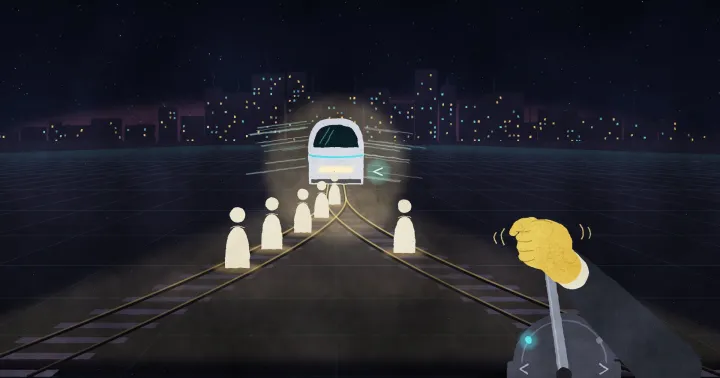
The trolley problem is a thought experiment in ethics: a runaway trolley is about to kill five people, and you can pull a lever that sends it onto a side track, where it will kill one person instead. Most people say they would pull the lever, yet most refuse to save the same five by pushing someone into the trolley’s path, and explaining that difference is the real problem.
The British philosopher Philippa Foot posed it in 1967, and the American philosopher Judith Jarvis Thomson named it in 1976. It has since grown into a whole literature, nicknamed “trolleyology,” and spread into psychology labs, brain scanners and the debate over self-driving cars.
- Origin: Philippa Foot’s 1967 essay “The Problem of Abortion and the Doctrine of the Double Effect,” featuring the driver of a runaway tram.
- Name: Judith Jarvis Thomson’s “Killing, Letting Die, and the Trolley Problem” (1976), followed by “The Trolley Problem” in the Yale Law Journal (1985).
- Classic variants: the bystander at the switch, the footbridge (the “fat man”), the loop and the transplant surgeon.
- Philosophers: in a 2009 survey of 931 philosophy faculty, 68.2% said switch and 7.6% said don’t.
- The public: in a 2020 study of 70,000 people in 42 countries, average support for sacrificing one person was 81% at the switch but 51% on the footbridge.
- Self-driving cars: the Moral Machine experiment (Nature, 2018) gathered 40 million decisions from 233 countries and territories.
What is the trolley problem?
A trolley is out of control. Five people are on the track ahead and can’t get away. A switch could send the trolley onto a side track, where one person stands. In the best-known version you aren’t the driver, just a bystander next to the switch. Do you throw it?
Most people say yes: five deaths are worse than one. The real puzzle appears when you set the switch beside cases with the same arithmetic where nearly everyone’s answer flips. If trading one life for five is right on the tracks, why does it feel monstrous elsewhere? Finding one principle that explains both answers has proved remarkably hard.
The scenario is older than its name. Around 1905, Frank Chapman Sharp, a philosophy professor at the University of Wisconsin, put a version into a moral questionnaire, published in 1908. A man finds that a careless switchman has left a switch open, a train carrying several hundred people is heading for disaster, and his only child is playing on the track. In Sharp’s words: “He had time only to turn the switch and save the train or else to save the child. Which was it his duty to do?”
Who invented the trolley problem? Foot’s tram and Thomson’s variants
The modern version began with Philippa Foot (1920-2010), a philosopher at Somerville College, Oxford, in a 1967 essay about abortion in the Oxford Review. In her British English, the trolley was a tram.
Her first case is a judge who could stop rioters taking bloody revenge only by framing and executing an innocent man. Beside it she placed the driver of a runaway tram who can steer only from one narrow track onto another, with five men working on one and one man on the other. The trade is the same, one life for five. Yet we say without hesitation that the driver should steer toward the one, while framing the innocent man appalls us. Foot wanted to know why. (Her essay even has a “fat man,” stuck in the mouth of a flooding cave, where the sensible course, she notes dryly, would be to “wait until the fat man grows thin.”)
Judith Jarvis Thomson (1929-2020), who taught at MIT for 40 years, turned Foot’s example into the standard puzzle. Her 1976 paper in The Monist named it “the trolley problem,” and she returned to it in a 1985 sequel in the Yale Law Journal. Her key moves:
- The bystander at the switch. Thomson replaced Foot’s driver with a passer-by who can throw a switch. That turns out to matter, as the next section shows.
- The footbridge. You stand on a bridge over the track beside a very large man. Push him off, and his body will stop the trolley and save the five. Most people who would throw the switch refuse to push.
- The loop. The side track curves back to rejoin the main line, so the diverted trolley would circle round and hit the five anyway, unless the one person’s body stops it. His being hit is now what saves the others.
A fourth case usually sits beside them: a surgeon who could save five transplant patients by killing one healthy visitor and sharing out his organs. Almost nobody approves.
What is the doctrine of double effect?
The doctrine of double effect is the oldest proposed answer, and it’s the doctrine in Foot’s title. The Stanford Encyclopedia of Philosophy traces it to Thomas Aquinas’s discussion of killing in self-defense: “Nothing hinders one act from having two effects, only one of which is intended.” The core idea is a line between what you intend, as an end or a means, and what you merely foresee as a side effect. A standard version sets four conditions:
- the act itself must be good, or at least morally neutral;
- the agent may permit the bad effect but must not positively will it;
- the good effect must come from the act itself, not from the bad effect;
- the good must be important enough to outweigh the bad.
The textbook illustration: a terror bomber aims to kill civilians to break the enemy’s will, while a tactical bomber hits a military target knowing civilians nearby will die. Apply the same test to the trolley. Throw the switch, and the one person’s death is a foreseen side effect: if he scrambled clear, you’d be delighted. Push the man off the footbridge, and his being struck is the very means of saving the five. Foot made a related point about her own cases: the tram driver doesn’t need the man on the side track to die, but the judge needs his scapegoat dead.
The loop is where the doctrine strains. Without the one person’s body, the diverted trolley would kill the five anyway, so his being hit looks like a means, just as on the footbridge. Yet most philosophers who have written about the loop judge turning the trolley there permissible. Frances Kamm proposed a revised “doctrine of triple effect” to handle such cases, and the argument goes on.
Foot herself leaned on a different distinction: what we owe people in the way of aid versus what we owe them in the way of non-interference. The duty not to harm is stricter than the duty to help, and her driver must choose between killing one and killing five, so he should kill fewer. Thomson’s bystander broke that tidy answer, as the Stanford Encyclopedia’s entry on doing and allowing harm explains, because he is choosing between killing one and letting five die, and most of us still think he may throw the switch.
What do people actually choose in the trolley problem?
Philosophers mostly lean one way. In the 2009 PhilPapers Survey by David Bourget and David Chalmers, 931 of 1,972 faculty members at 99 leading philosophy departments responded. On the switch case, 68.2% accepted or leaned toward switching, 7.6% toward not switching, and 24.2% gave another answer. When the survey was rerun in 2020 with nearly 1,800 philosophers, one of the notable shifts reported was a move toward not switching.
The public shows the same pattern. A 2020 study in PNAS by Edmond Awad and colleagues gave three trolley scenarios to 70,000 people in 42 countries. Support for sacrificing the one averaged 81% at the switch, 72% in the loop and 51% on the footbridge, and every country showed the same ordering. China and Japan were among the Eastern countries least willing to endorse sacrifice. The sample was self-selected and skewed young, male and college-educated, so treat the numbers as a snapshot.
Why the flip? In a 2001 Science study, Joshua Greene and colleagues found that personal dilemmas, like pushing someone, engaged emotion-related brain regions more than impersonal ones, like flipping a switch, and suggested that emotion helps explain the flip. It’s an influential account, not the last word.
There’s also a gap between saying and doing. In 2018, psychologists at Ghent University gave volunteers a real choice: let five live mice receive an electric shock, or shock one mouse instead (the device, unknown to them, was fake). Hypothetical answers didn’t predict real behavior, and people answering on paper were twice as likely to refrain from shocking the single mouse. That distance between what we think we’d do and what we do also sits at the heart of the Milgram experiment.
The trolley problem and self-driving cars: the Moral Machine
Self-driving cars seemed to turn the trolley problem into an engineering requirement. In 2016, Jean-François Bonnefon, Azim Shariff and Iyad Rahwan reported in Science that people approved of autonomous vehicles that would sacrifice their passengers for the greater good, but would rather ride in ones that protect their passengers at all costs.
Awad, Rahwan and colleagues also turned the question into the Moral Machine, a multilingual online game in which players choose between two grim outcomes for a driverless car. The results, published in Nature in October 2018, drew on 40 million decisions in ten languages from millions of people in 233 countries and territories. According to MIT News, the strongest preferences were to spare humans over animals, more lives over fewer, and the young over the old. Countries fell into three broad clusters, Western, Eastern and Southern, and the Southern cluster favored sparing the young more strongly than the Eastern one.
Policymakers drew the line somewhere else. In June 2017, Germany’s Ethics Commission on Automated and Connected Driving issued 20 ethical guidelines. One bans any classification of people by personal characteristics such as age, gender, or physical or mental condition in unavoidable accidents. That rules out exactly the “spare the young” preference the game’s players expressed.
The newest test subjects aren’t people. In 2024, Kazuhiro Takemoto ran the Moral Machine on large language models, including GPT-4, PaLM 2 and Llama 2. They broadly shared human priorities, such as people over pets and more lives over fewer, but might lean toward more uncompromising decisions than humans. A 2025 follow-up in PLOS ONE tested 52 models and found that many put excessive emphasis on particular ethical principles.
Why engineers say it’s the wrong question for cars
Many who build and regulate automated vehicles see the driverless trolley problem as a distraction. A 2021 paper in PNAS, by a Harvard psychologist, two ETH Zurich engineers, a law professor and industry researchers, argued that these “driverless dilemmas” are of limited use in the technical and legal spheres. Their main points:
- Real outcomes are uncertain. A trolley problem assumes you know who will die. A real car only has probabilities, so the job is weighing risk: the probability of a harm multiplied by its severity.
- True dilemmas are vanishingly rare. They are scarce edge cases that a car is unlikely to learn from driving data.
- Prevention beats choosing victims. The better goal is creating safer traffic situations, not only reacting to dangerous ones.
The authors proposed reworking the dilemmas into tests of a car’s driving common sense, run alongside the rules of the road. Germany’s commission made a related point: genuine dilemmas depend on the actual situation and, in its view, can’t be clearly standardized or programmed in advance.
Why philosophers still argue about the trolley problem
If the scenario is so unrealistic, why does it endure? Because it was never really about trolleys. Like a controlled experiment, it isolates one variable at a time: killing versus letting die, intending versus foreseeing, using a person versus harming him along the way. No principle yet explains every case to everyone’s satisfaction.
Even the problem’s chief architect changed her mind. Twenty-two years after putting forward the bystander case, Thomson argued in “Turning the Trolley” (2008) that the consensus that he may turn the trolley was mistaken. She added a third option: the bystander could turn the trolley onto himself. If you wouldn’t sacrifice yourself to save the five, she reasoned, you aren’t entitled to turn the trolley onto a stranger.
Critics push from other directions. Some psychologists argue that the scenarios are too extreme and remote from ordinary moral life, and that answers to them measure a willingness to cause harm more than concern for the greater good.
So there’s no agreed “right answer,” and as of late 2026 the debate is still open, because the problem exposes a real tension in human morality. We care about outcomes, and we also care about how outcomes come about. The trolley problem shows that those two commitments can pull apart.
Every choice costs something: moral dilemmas as science fiction
The trolley problem has the shape of a story: a clean setup, a terrible choice and a clock running down. Science fiction is a natural home for it, because the future keeps building machines that someone has to program in advance.
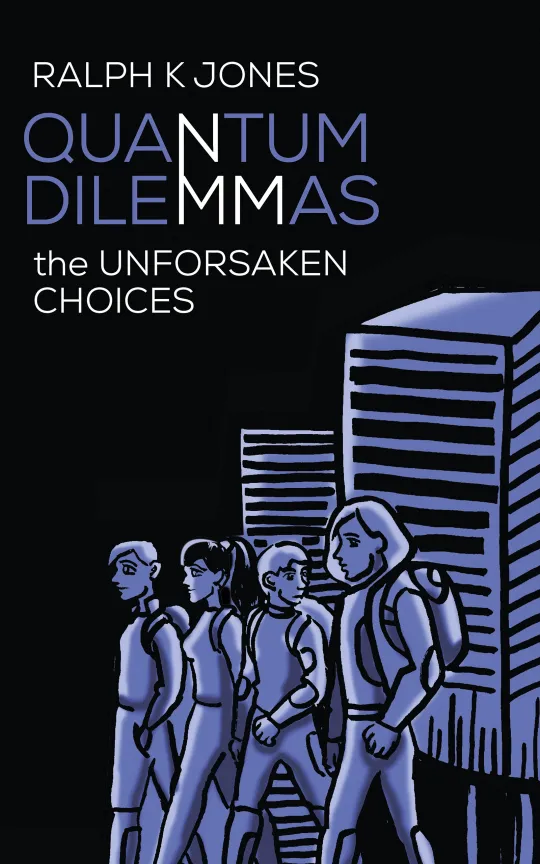
R.K. Jones takes that route in Quantum Dilemmas: The Unforsaken Choices, illustrated short stories available now on Kindle. The premise: classic moral dilemmas, set in the far future, where every choice costs something.
It belongs to the Unforsaken shelf, where Grimm, Aesop, the Panchatantra, the Arabian Nights and the Greek myths are retold as science fiction, across ten collections and 549 stories. Foot and Thomson built their puzzles out of trams and footbridges, the machines of their day. The question travels to any machine you like: when every option costs a life, who gets to pull the lever?
Sources
- A Study of the Influence of Custom on the Moral Judgment, Frank Chapman Sharp, Bulletin of the University of Wisconsin (1908), Internet Archive
- Philippa Foot and the Trolley Problem (excerpts from Foot’s 1967 essay), Women in Parenthesis
- Judith Jarvis Thomson, 1929-2020, MIT Philosophy
- Doctrine of Double Effect, Alison McIntyre, Stanford Encyclopedia of Philosophy
- Doing vs. Allowing Harm, Fiona Woollard, Frances Howard-Snyder and Charlotte Franziska Unruh, Stanford Encyclopedia of Philosophy
- Double Effect, Triple Effect and the Trolley Problem: Squaring the Circle in Looping Cases, Michael Otsuka, Utilitas (2008)
- What Do Philosophers Believe?, David Bourget and David J. Chalmers, Philosophical Studies (2014)
- Results from the 2020 PhilPapers Survey, Daily Nous (2021)
- Universals and variations in moral decisions made in 42 countries by 70,000 participants, Awad et al., PNAS (2020)
- An fMRI Investigation of Emotional Engagement in Moral Judgment, Greene et al., Science (2001)
- Of Mice, Men, and Trolleys: Hypothetical Judgment Versus Real-Life Behavior in Trolley-Style Moral Dilemmas, Bostyn, Sevenhant and Roets, Psychological Science (2018)
- The Social Dilemma of Autonomous Vehicles, Bonnefon, Shariff and Rahwan, Science (2016), arXiv
- The Moral Machine experiment, Awad et al., Nature (2018)
- How should autonomous vehicles be programmed?, Peter Dizikes, MIT News (2018)
- Germany Issues Ethics Report on Automated and Connected Cars, Hunton (2017)
- The moral machine experiment on large language models, Kazuhiro Takemoto, Royal Society Open Science (2024)
- Large-scale moral machine experiment on large language models, Zaim bin Ahmad and Takemoto, PLOS ONE (2025)
- From driverless dilemmas to more practical commonsense tests for automated vehicles, De Freitas et al., PNAS (2021)
- Trolley problem, Wikipedia
Questions people ask
What is the trolley problem?
It is a thought experiment in ethics: a runaway trolley will kill five people unless you divert it onto a side track, where it will kill one. The puzzle is why most people would divert the trolley but refuse to save the same five by pushing someone into its path.
Who came up with the trolley problem?
The philosopher Philippa Foot introduced the case in 1967, as a runaway tram whose driver must choose a track, in an essay on abortion and the doctrine of double effect. Judith Jarvis Thomson named it “the trolley problem” in 1976 and added famous variants such as the bystander at the switch and the footbridge.
What is the fat man version of the trolley problem?
In the footbridge or “fat man” variant, you can stop the trolley only by pushing a very large man off a bridge onto the track, killing him but saving the five. Most people who would throw the switch refuse to push, even though the numbers are the same; in a 2020 study of 70,000 people in 42 countries, average support was 81% for the switch but 51% for the footbridge.
What is the right answer to the trolley problem?
There is no agreed answer. In a 2009 survey of philosophy faculty, 68.2% favored switching and 7.6% did not, and Thomson herself later argued that a bystander may not turn the trolley. The problem endures because it exposes a conflict between caring about outcomes and caring about how they come about.
Do self-driving cars have to solve the trolley problem?
Not in its classic form, many engineers argue. A 2021 PNAS paper said real cars deal with uncertain risks rather than certain deaths and that true dilemmas are extremely rare, so the priority is avoiding dangerous situations; Germany’s 2017 ethics guidelines also ban sorting accident victims by age, gender or other personal characteristics.