Space & science
The Fermi Paradox: Where Is Everybody, and Why Is the Sky So Quiet?
If the galaxy is ancient and full of planets, why is the sky so quiet? The real story of Fermi’s 1950 question, the Drake equation, the leading answers and what today’s searches have found.
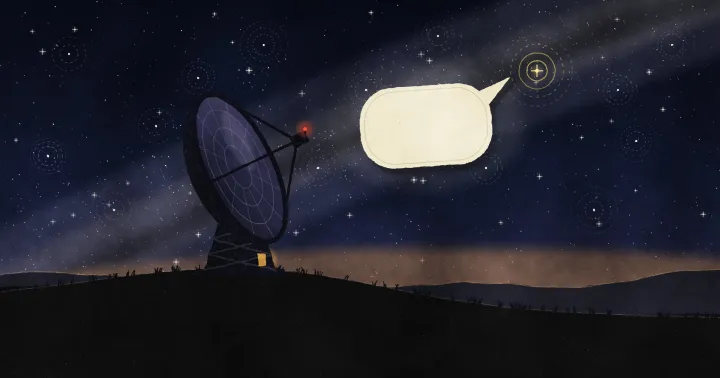
The Fermi paradox is the puzzle of why, in a galaxy that is billions of years old and crowded with planets, we have found no sign of anyone else. It is named for the physicist Enrico Fermi, who asked “Where is everybody?” over lunch at Los Alamos in 1950, and more than 75 years later nobody has a confirmed answer.
Here is where the question came from, the math behind it, the leading answers (every one a hypothesis) and what the searches have found as of late 2026.
- The question: Fermi asked “Where is everybody?” in the summer of 1950, at lunch with Edward Teller, Herbert York and Emil Konopinski.
- The argument: most estimates say a spacefaring civilization could settle the galaxy in about 10 million years, and parts of the Milky Way are 13 billion years old. So why is nobody here?
- The math: the Drake equation (1961) splits the number of detectable civilizations into seven factors. Only the first few have been measured.
- The planets: NASA counts more than 6,000 confirmed exoplanets and says our galaxy has more planets than stars.
- The answers: from Rare Earth to the dark forest, all are unproven hypotheses.
- The evidence: no technosignature, meaning a sign of alien technology, has ever been confirmed.
What is the Fermi paradox?
The Fermi paradox puts two things side by side. First, the numbers. The Milky Way holds hundreds of billions of stars, and NASA says it has more planets than stars. Many of those worlds had a head start of billions of years: ESA’s Gaia mission found that the galaxy’s thick disc began forming about 13 billion years ago. Published estimates of how long a civilization would need to settle the whole galaxy run from under a million years to ten billion, with most, according to a 2018 Oxford study, around 10 million. Even a slow species would have had time to do it about a thousand times over.
Second, the evidence: no visitors, no probes, no signals and no giant engineering anywhere in the sky.
The hard-edged version of the argument came in 1975, when the astrophysicist Michael Hart argued in the Quarterly Journal of the Royal Astronomical Society that the best explanation for the absence of extraterrestrials on Earth is that there aren’t any. In 1980 the cosmologist Frank Tipler went further, in a paper titled “Extraterrestrial intelligent beings do not exist.” The label “Fermi paradox” appeared in print two years after Hart’s paper, and it stuck.
It is a slightly unfair label. In a 2015 Astrobiology paper titled “The Fermi Paradox Is Neither Fermi’s Nor a Paradox”, Robert H. Gray pointed out that Fermi never published on the subject. The reasoning “they are not here, so they do not exist” is Hart’s, Gray argued, and it was even cited in the US Congress as a reason to end NASA’s program to search for extraterrestrial intelligence (SETI).
“Where is everybody?” Fermi’s 1950 lunch at Los Alamos
The story was pinned down in 1985, when Eric Jones of Los Alamos National Laboratory gathered written accounts from Fermi’s three lunch companions and published them in a short report, “Where is everybody?” An account of Fermi’s question. His conclusion: it most likely happened in the summer of 1950.
Fermi was walking to lunch at Fuller Lodge with Teller, York and Konopinski. The talk turned to flying saucers, and Konopinski mentioned an Alan Dunn cartoon in the May 20, 1950, issue of The New Yorker, which blamed the public trash cans vanishing from New York City’s streets on little green men from a saucer. Fermi remarked that it was a very reasonable theory, since it accounted for two separate phenomena.
Then, at the table, Fermi suddenly asked the question. The three men remembered the words slightly differently: Teller recalled “Where is everybody?”, Konopinski “But where is everybody?” and York “Don’t you ever wonder where everybody is?” Teller remembered “general laughter.”
York’s letter holds the substance. He recalled Fermi following up with a quick run of estimates, on the odds of Earth-like planets, of life, of humans and of how long high technology lasts, and concluding that “we ought to have been visited long ago and many times over.” He thought Fermi then floated three reasons it hadn’t happened: interstellar flight might be impossible, or not worth the effort, or technological civilizations might not last long enough.
So Fermi seems to have been wondering whether interstellar travel is feasible, not proving that nobody is out there. That is Gray’s reading too.
The Drake equation: how many civilizations should there be?
In November 1961, about a dozen scientists, among them Carl Sagan and Philip Morrison, gathered at Green Bank, West Virginia, for an informal meeting on SETI. As the agenda, the astronomer Frank Drake wrote down what became the Drake equation. It multiplies seven factors to estimate N, the number of civilizations in the Milky Way whose signals we could detect:
- R (R-star): the rate at which suitable stars form in the galaxy each year
- fp: the fraction of those stars with planets
- ne: the number of planets per system with an environment suitable for life
- fl: the fraction of those planets where life appears
- fi: the fraction of life-bearing planets where intelligence evolves
- fc: the fraction of intelligent species that give off detectable signs of technology
- L: how many years such a civilization keeps giving off those signs
So N = R × fp × ne × fl × fi × fc × L. Drake later suggested N might be about 10,000, assuming civilizations last about 10,000 years.
The equation was built to organize ignorance, and it still does. Planets turned out to be everywhere, and a 2020 analysis of Kepler data led by Steve Bryson estimated about 0.37 to 0.60 rocky, habitable-zone planets per Sun-like star, with wide error bars. Everything after that (life, intelligence, technology and lifetime) is still guesswork.
In “Dissolving the Fermi Paradox” (2018), Anders Sandberg, Eric Drexler and Toby Ord of Oxford’s Future of Humanity Institute showed the trap in multiplying single best guesses. In their toy example, nine factors with a best guess of 0.1 each multiply to one in a billion. Across 100 billion stars, that predicts about 100 civilizations, and an empty galaxy looks almost impossible. But if each factor really could lie anywhere in its range, a simulation produces an empty galaxy about 21 percent of the time. Using the real spread of published estimates, they found a median of 100 civilizations but a pessimistic tail spanning more than 30 orders of magnitude: roughly a one-in-three chance that we are alone in the galaxy.
Possible solutions to the Fermi paradox
Every answer below is a hypothesis. None has evidence that settles it, and some can’t yet be tested at all.
Rare Earth: microbes common, complex life rare
In their 2000 book Rare Earth, the University of Washington paleontologist Peter Ward and astronomer Donald Brownlee argued that microbes may be widespread, but complex animal life needs a long run of luck: liquid water, plate tectonics, a large moon steadying Earth’s tilt, a Jupiter-sized neighbor deflecting impacts, and a quiet spot in the galaxy. “We know of no other body that is even remotely like Earth,” Brownlee said in the university’s announcement. Critics, including the planetary scientist James Kasting, argue that habitable zones are wider than the book assumes.
The Great Filter
In a 1996 essay, Robin Hanson of George Mason University argued that somewhere between dead matter and a civilization spreading through the stars there must be at least one step that almost nothing gets past. His candidate steps run from the right star system through simple cells, complex cells, sex, multicellular life and big-brained tool users to the leap into space. The urgent question is whether the filter is behind us or ahead.
“The easier it was for life to evolve to our stage, the bleaker our future chances probably are.” (Robin Hanson)
That is why Nick Bostrom wrote in MIT Technology Review in 2008 that he hoped Mars probes would find nothing: “Dead rocks and lifeless sands would lift my spirit.”
The zoo hypothesis
In 1973, John Ball of MIT’s Haystack Observatory proposed in the journal Icarus that advanced civilizations know we are here and deliberately leave us alone, the way people watch animals in a zoo. The weakness, shared by most “they’re hiding” answers, is that every civilization must obey the same rule for millions of years. As Sandberg’s team noted of self-destruction theories, a mechanism that works for 99 percent of civilizations does little to resolve the paradox.
The dark forest
The grimmest answer was popularized by the science fiction writer Liu Cixin in his 2008 novel The Dark Forest (translated into English by Joel Martinsen in 2015), part of his Three-Body series. Its logic: survival comes first, resources are finite, and nobody can be sure of a stranger’s intentions. So anyone who reveals themselves risks destruction, and the safe strategy is silence. It’s a gripping idea, but it comes from fiction and faces the same reliability problem.
We’re early
Maybe nobody is here because the party hasn’t started. In 2016, Avi Loeb of Harvard, with Rafael Batista and David Sloan of Oxford, calculated that if small red dwarfs can host life, life is most likely to exist near stars of about a tenth of the Sun’s mass some ten trillion years from now. By that measure, we are premature. In 2021, Hanson and colleagues argued in The Astrophysical Journal that expanding “loud” civilizations (popularly, “grabby aliens”) would explain our earliness, because they eventually fill the space where new civilizations could arise. Their model puts a meeting roughly 200 million to 2 billion years away.
We’ve barely looked
The most modest answer may be the strongest. In 2018, Jason Wright and two colleagues tried to measure how much of the cosmic haystack has been searched, across frequencies, sky positions, sensitivities and signal types. Their verdict: all of SETI so far amounts to a large hot tub or small swimming pool of water, compared with Earth’s oceans. Not finding a fish in a hot tub tells you little about the sea.
Maybe we really are alone
The Oxford team went further. Once the silent sky is counted as evidence, their model put the chance that we are alone in the Milky Way at 53 to 99.6 percent, depending on which evidence is used, and 39 to 85 percent for the observable universe. It is a preprint built on very uncertain numbers, but its point is fair: an empty sky may need no special explanation.
How scientists are searching for alien life now
As of late 2026, no search has confirmed a sign of alien technology, but the searches are getting much bigger.
- Radio, at scale: Breakthrough Listen’s BLUSE system rides along on the MeerKAT radio telescope while other astronomers use it, scanning the same data for artificial signals. Its Oxford team reports more than 1.2 million pointings processed since 2022, and “no confirmed detection of a technosignature.”
- Machine learning: in 2023, Peter Ma, then a University of Toronto undergraduate, led a deep-learning search of 480 hours of Green Bank Telescope data on 820 nearby stars that had already been judged empty. It flagged eight signals of interest, but the SETI Institute reported at the time that re-observations had not found them again.
- Waste heat: in 2024, Project Hephaistos screened about five million objects for the infrared glow of a partial Dyson sphere, a hypothetical swarm of light-harvesting structures, and flagged seven red dwarfs. Within weeks, Tongtian Ren, Michael Garrett and Andrew Siemion proposed a natural culprit: distant, dust-shrouded galaxies with active black holes lying behind them. They found strong radio sources very close to three of the seven.
- Interstellar visitors: when the interstellar comet 3I/ATLAS was discovered on July 1, 2025, Breakthrough Listen turned four radio telescopes on it, ending with Green Bank on December 18, 2025. MeerKAT could have caught a transmitter of about 0.17 watts, roughly a mobile phone. None of the searches found a technosignature.
And the most famous candidate of all, the Wow! signal of 1977, was never heard again.
So, has the Fermi paradox been solved?
No. Almost any answer can be made to fit a silent sky, which is exactly why the silence can’t choose between them. Some can be tested in part. Finding even microbes on Mars would, by Hanson’s and Bostrom’s logic, make a filter ahead of us look more likely. More searching tests “we’ve barely looked.” The zoo and the dark forest are much harder to test, because both predict exactly what we see.
One thing would end the debate overnight: a single confirmed signal from someone else. Until then, Fermi’s lunchtime question stands, still unanswered more than 75 years on.
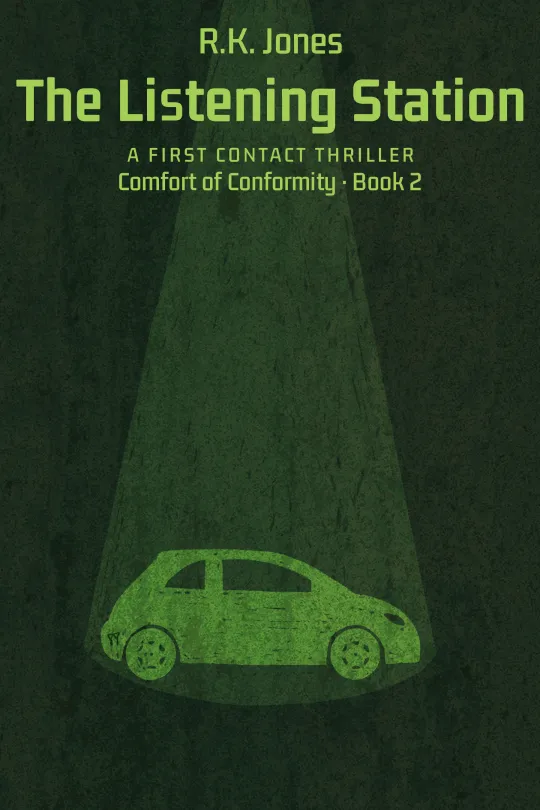
The Listening Station: a thriller about the day the silence breaks
Real SETI waits decades for one signal. Fiction can skip to the day it arrives.
R.K. Jones’s first-contact thriller The Listening Station, Book 2 of the Comfort of Conformity series, turns on a message from deep space: You are not alone. It is March 2055, three months before the outbreak. Davey Olfane comes back from vacation to find a new fence around the Texas branch of the Global Space Agency, and every antenna on the roof turned to a different part of the sky. Davey decodes signals for a living. The closer he looks at this one, the less sure he is where it really came from, and the more certain he is that whoever sent it has plans for him.
Fermi asked where everybody is. The novel asks a colder question: what if somebody answers, and what do they want? The Listening Station is coming soon.
Sources
- “Where is everybody?” An account of Fermi’s question, Eric M. Jones, Los Alamos National Laboratory report LA-10311-MS (1985), OSTI record
- Text of the Jones report, hosted by the University of Nevada, Las Vegas physics department
- The Fermi Paradox Is Neither Fermi’s Nor a Paradox, Robert H. Gray, Astrobiology (2015), arXiv version
- Beyond “Fermi’s Paradox” I: A Lunchtime Conversation, Universe Today
- The Drake Equation, SETI Institute
- Exoplanets, NASA Science
- Gaia finds parts of the Milky Way much older than expected, European Space Agency
- The Occurrence of Rocky Habitable Zone Planets Around Solar-Like Stars from Kepler Data, Bryson et al., The Astronomical Journal, arXiv version (2020)
- Dissolving the Fermi Paradox, Sandberg, Drexler and Ord, arXiv (2018)
- We are not alone, or are we?, University of Washington News (2000)
- Rare Earth hypothesis, Wikipedia
- The Great Filter: Are We Almost Past It?, Robin Hanson
- Where Are They?, Nick Bostrom, MIT Technology Review (2008)
- Zoo hypothesis, Wikipedia
- Dark forest hypothesis, Wikipedia
- The Dark Forest, Wikipedia
- Relative Likelihood for Life as a Function of Cosmic Time, Loeb, Batista and Sloan, JCAP (2016), arXiv version
- If Loud Aliens Explain Human Earliness, Quiet Aliens Are Also Rare, Hanson et al., The Astrophysical Journal (2021), arXiv version
- How Much SETI Has Been Done? Finding Needles in the n-Dimensional Cosmic Haystack, Wright, Kanodia and Lubar, The Astronomical Journal (2018), arXiv version
- Scaling Up the Search with MeerKAT, Breakthrough Listen, University of Oxford
- A deep-learning search for technosignatures of 820 nearby stars, Ma et al., Nature Astronomy (2023), arXiv version
- Will Machine Learning Help Us Find Extraterrestrial Life?, SETI Institute (2023)
- Project Hephaistos II: Dyson sphere candidates from Gaia DR3, 2MASS, and WISE, Suazo et al., MNRAS (2024), arXiv version
- Are dusty quasars masquerading as Dyson sphere candidates?, Physics World (2024)
- Breakthrough Listen observations of interstellar object 3I/ATLAS, Berkeley SETI Research Center
Questions people ask
What is the Fermi paradox in simple terms?
It is the clash between the high odds that intelligent life exists somewhere in our ancient, planet-rich galaxy and the complete lack of evidence for it. If civilizations are common, some should have spread or signaled by now, so why haven’t we seen anyone?
What did Enrico Fermi actually say?
Over lunch at Los Alamos in the summer of 1950, Fermi asked something like “Where is everybody?” His three companions remembered the exact words differently. According to Herbert York, Fermi then estimated that Earth should have been visited long ago and wondered whether interstellar travel was impossible or not worth it, or whether civilizations don’t last.
What is the Great Filter?
An idea set out by Robin Hanson in 1996: somewhere between lifeless matter and a civilization spreading through space, there must be at least one step that almost nothing gets past. If that step is behind us, we are rare and lucky; if it lies ahead, our own future may be at risk.
What is the dark forest theory?
An answer to the Fermi paradox popularized by Liu Cixin’s 2008 novel The Dark Forest. Because no civilization can be sure another is friendly, revealing yourself risks destruction, so everyone stays silent. It is an unproven hypothesis that comes from fiction.
Has the Fermi paradox been solved?
No. As of late 2026 no sign of alien technology has been confirmed, and the leading answers remain hypotheses. A 2018 Oxford analysis argued that, given how uncertain the Drake equation’s factors are, an empty galaxy should not surprise us.