Space & science
The Wow! Signal Explained: The 72-Second Mystery of 1977
In 1977 a radio telescope in Ohio caught 72 seconds of exactly what it was built to find. Here is what the Wow! signal was, what 6EQUJ5 means, and what the latest research says.
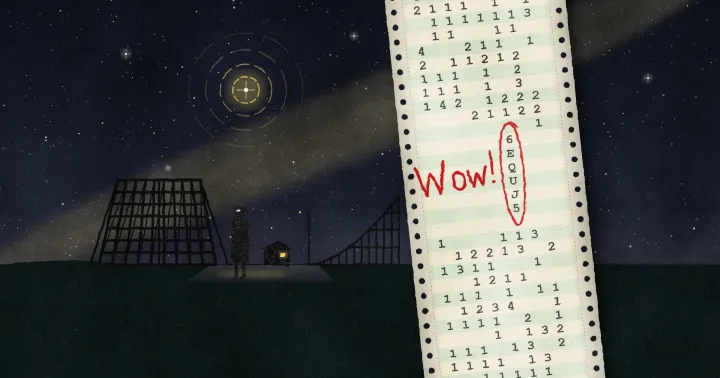
The Wow! signal was a powerful, narrowband radio signal picked up by Ohio State University’s Big Ear radio telescope on the night of August 15, 1977. It lasted 72 seconds, sat close to the natural radio frequency of hydrogen, seemed to come from the direction of the constellation Sagittarius, and matched what SETI astronomers hoped an alien beacon would look like. An astronomer reading the computer printout a few days later circled the code “6EQUJ5” and wrote “Wow!” in the margin. The signal has never been detected again.
Has it been explained? Not conclusively. A 2017 comet theory won few converts. The most detailed natural explanation so far, first posted as a preprint in 2024, suggests that a cold cloud of hydrogen gas briefly flared like a natural maser, the radio-wave cousin of a laser, after being hit by a burst of radiation from something like a magnetar. It is serious, testable and still unconfirmed. Here is what was recorded, what 6EQUJ5 means, and what humanity’s real search for a message from space looks like now.
What was the Wow! signal?
Big Ear was a large radio telescope near Delaware, Ohio, about 30 miles north of Columbus. It couldn’t steer; it let Earth’s rotation sweep its view across the sky. From 1973 it served Ohio State’s SETI program (SETI is the search for extraterrestrial intelligence), and its researchers call it the world’s first full-time dedicated SETI observatory. A computer watched 50 radio channels, each 10 kHz wide, and printed a line of results roughly every 12 seconds.
According to Jerry Ehman’s detailed account, the signal entered the receiver at about 11:16 p.m. Eastern Daylight Time on August 15, 1977. Ehman, an astronomer working on the project, found it a few days later, probably on August 19, while reviewing the printouts. He highlighted six characters in red pen and wrote “Wow!” beside them. The telescope itself is gone, torn down in 1998 after its land was sold to developers, but the nickname stuck, and so did the mystery.
What does 6EQUJ5 mean?
6EQUJ5 is not a message. Each character records how strong the signal was in one channel compared with the background noise, over one 12-second step (about 10 seconds of listening plus 2 for computer processing). Each reading got a single character:
- A blank meant less than 1 times the noise level.
- The digits 1 through 9 meant 1 through 9 times the noise.
- From 10 upward it switched to letters: A = 10, B = 11, and so on up to Z = 35.
So 6EQUJ5 reads 6, 14, 26, 30, 19, 5. The U means the signal peaked at more than 30 times the background noise.
Six readings at 12 seconds each makes 72 seconds. That isn’t necessarily how long the transmission lasted; it is how long Big Ear could see any one point in the sky as Earth turned. The signal rose and fell almost exactly as the beam pattern predicts for a distant source drifting through the telescope’s view, which is a big reason it was taken seriously. It behaved like something among the stars, not something on the ground.
It was also narrowband, confined to a single 10 kHz channel. Natural sources usually spread across far more of the dial; a sharp spike is what transmitters make. And it fell near 1420 MHz, the natural frequency of neutral hydrogen, in a protected band where, as Ehman noted, no transmitter on Earth or in space should have been broadcasting.
Two loose ends remain. Big Ear had two feed horns aimed at slightly different patches of sky, so a steady source should have appeared twice, a few minutes apart. The Wow! signal appeared once, and the system didn’t record which horn heard it, leaving two possible positions, both in Sagittarius. And the frequency has moved: Ehman put it at about 1420.4556 MHz, but a 2025 reanalysis puts it at 1420.726 MHz after finding that the order of the receiver’s channels had been inverted.
Why SETI listens at the hydrogen line
The case for listening at hydrogen goes back to a 1959 paper in Nature by physicists Giuseppe Cocconi and Philip Morrison, “Searching for Interstellar Communications.” Hydrogen is the most common element in the universe, and its 1420 MHz line (21 centimeters in wavelength) is a landmark every radio astronomer would know. To be found, you would transmit where your audience was already listening. The paper ended with a line SETI researchers still quote: “if we never search, the chance of success is zero.”
In April 1960, Frank Drake aimed the 85-foot (26-meter) telescope at Green Bank, West Virginia, at two nearby Sun-like stars, Tau Ceti and Epsilon Eridani, and listened near the hydrogen line. Project Ozma, named for the princess of Oz, logged about 150 hours over four months and heard nothing but an early false alarm from a high-flying aircraft. SETI’s first “detection” was also its first false positive.
In 1971, during a NASA design study called Project Cyclops, engineer Bernard Oliver named the unusually quiet stretch of radio spectrum between the hydrogen line and the hydroxyl lines near 1660 MHz. Hydrogen plus hydroxyl makes water, so he called it the “water hole”:
“Where shall we meet our neighbors? At the water-hole, where species have always gathered.”
Humans have also tried talking. On November 16, 1974, at the dedication of the upgraded Arecibo telescope in Puerto Rico, astronomers beamed a 1,679-bit picture message, designed by Drake with help from Carl Sagan and others, toward the globular star cluster M13, about 25,000 light-years away. As Cornell later recalled, it was largely a symbolic show of the new transmitter. Any reply is at least 50,000 years off, so whatever the Wow! signal was three years later, it wasn’t an answer.
Why the Wow! signal was never confirmed
In science, one detection is a clue, not a discovery. Ehman wrote that Big Ear watched the same strip of sky for about 60 days afterward without seeing the signal again, and later rescans found nothing either.
Robert Gray spent decades on the hunt, using a homemade backyard dish, Harvard’s META system in Massachusetts (1987), the Very Large Array in New Mexico (1995 and 1996) and, with astronomer Simon Ellingsen, a 26-meter dish in Tasmania (1998 and 1999). No repeat. Gray, author of The Elusive Wow, still called the signal “a pretty strong tug on the cosmic fishing line.”
Using star data from ESA’s Gaia mission, amateur astronomer Alberto Caballero flagged a Sun-like star in the signal’s patch of sky, 2MASS 19281982-2640123, about 1,800 light-years away. In May 2022 the Green Bank Telescope and the SETI Institute’s Allen Telescope Array observed it together and found no sign of technology.
The comet theory, and why it didn’t hold up
The best-known earlier explanation came from astronomer Antonio Paris of St. Petersburg College, Florida. In 2016 he proposed that hydrogen clouds around two comets, 266P/Christensen and P/2008 Y2 (Gibbs), both discovered decades after 1977, had drifted through Big Ear’s view. In 2017 he reported 200 observations with a 10-meter dish that, he said, detected 1420 MHz emission from 266P/Christensen.
Critics were unconvinced. Robert Dixon, who directed the Ohio State SETI program, said the comets were in the wrong part of the sky in 1977: Big Ear would have passed them most of an hour before the signal arrived. Ehman noted that a slow-moving comet should have shown up in both feed horns. Others pointed out that hydrogen-line emission had never been detected from a comet, and comet expert Alan Fitzsimmons of Queen’s University Belfast called the conclusion “rubbish.” Space.com rounded up the objections, and the comet idea never won over the field.
The Wow! signal in 2024 and 2025: a flare in a hydrogen cloud?
The most serious recent attempt comes from the Arecibo Wow! project, led by astrobiologist Abel Méndez of the Planetary Habitability Laboratory at the University of Puerto Rico at Arecibo. In August 2024, Méndez, Kevin Ortiz Ceballos and Jorge Zuluaga posted Arecibo Wow! I. They searched Arecibo telescope drift scans made between February and May 2020, months before the telescope’s instrument platform collapsed that December, using a method like Big Ear’s but far more sensitive.
They found narrow signals, about 10 kHz wide, near the hydrogen line at several spots in the sky, roughly a hundred times fainter than the Wow! signal, and traced them to small, cold clouds of hydrogen gas. Their hypothesis is that in 1977 one such cloud suddenly brightened because a burst of radiation, perhaps a flare from a magnetar (a highly magnetized neutron star) or a soft gamma repeater, triggered stimulated emission: a natural maser. That would produce a bright, narrow, hydrogen-line signal that switched on once and never returned.
Méndez told Science News it was “probably the best explanation so far.” Others are more careful. The paper itself notes that hydrogen masers at this frequency have never been detected in space, and the scenario needs a trigger, a cloud and Earth lined up just right. Michael Garrett, chair of the International Academy of Astronautics’ SETI committee, told Scientific American the scenario “feels a bit contrived,” and even co-author Ortiz Ceballos called it “definitely a bit speculative.”
In August 2025, an expanded team posted Arecibo Wow! II, a reanalysis of recovered Ohio State records. It raised the peak brightness to more than 250 janskys (earlier estimates ran from 54 to 212), revised the frequency, narrowed the position to two adjacent patches of sky, and found no evidence that radio interference caused it. “This study doesn’t close the case,” Méndez told EarthSky. “It reopens it, but now with a much sharper map in hand.”
Both papers first appeared as preprints, not peer-reviewed articles. As of November 2026, the project’s website lists the first as accepted by The Astrophysical Journal, while the second was posted ahead of journal submission. No one has yet caught a hydrogen cloud flaring. The honest verdict: a plausible, testable natural candidate, and a case that isn’t closed.
How the real search for a message from space works now
On July 20, 2015, at the Royal Society in London, investor Yuri Milner launched Breakthrough Listen with $100 million over ten years, buying time on the Green Bank Telescope in West Virginia and the Parkes telescope in Australia, plus an optical search for laser flashes.
Finer searches also catch more interference. In 2020, an undergraduate combing Parkes data on Proxima Centauri, the closest star to the Sun, found a narrow signal near 982 MHz. The observations, made in 2019, split the spectrum into channels under 4 hertz wide; Big Ear’s were 10 kHz. The signal, dubbed BLC1 for Breakthrough Listen Candidate 1, seemed to appear only when the telescope pointed at the star, and it drifted slowly in frequency, as a transmitter on a moving planet might. News of it reached the press in December 2020, before the checks were done. In October 2021, two papers in Nature Astronomy concluded that it was human-made interference: the team found dozens of lookalike signals, at frequencies related to common electronic clock oscillators, that also appeared when the telescope looked elsewhere. The lesson, as astronomer Danny Price wrote in The Conversation, was verification: check every candidate against off-target data and hunt for lookalikes.
BLC1 is the Wow! story in reverse: a candidate that could be checked, and was.
What happens if a real signal turns up
There is a playbook. In 1989 the International Academy of Astronautics adopted a Declaration of Principles for activities after a detection: confirm alien technology is the most plausible explanation, let other observatories verify it independently, notify the International Astronomical Union and the UN Secretary-General, share the data, and send no reply without international consultation. It was streamlined in 2010, and in June 2026 the Academy announced it had ratified the first major overhaul in more than 15 years.
The new version says nothing should go public until independent organizations have authenticated a signal using different instruments. It also covers lasers, infrared heat from possible megastructures and other technosignatures, asks for verification data to be stored in at least two tamper-proof repositories in different places, and tackles deepfakes and harassment of researchers. Replies still require international consultation through the United Nations. As Garrett put it in the SETI Institute’s announcement, “We do not shout ‘alien’ the moment we see a strange blip.”
By that standard, the Wow! signal never got past step one. There was nothing left to confirm.
Where did it really come from? The question behind The Listening Station
Every signal analyst faces the question the Wow! signal has been asking for almost 50 years: where did it really come from? A distant star, a cloud of gas, a satellite, a glitch in the receiver. Get that wrong and everything after it is wrong too.
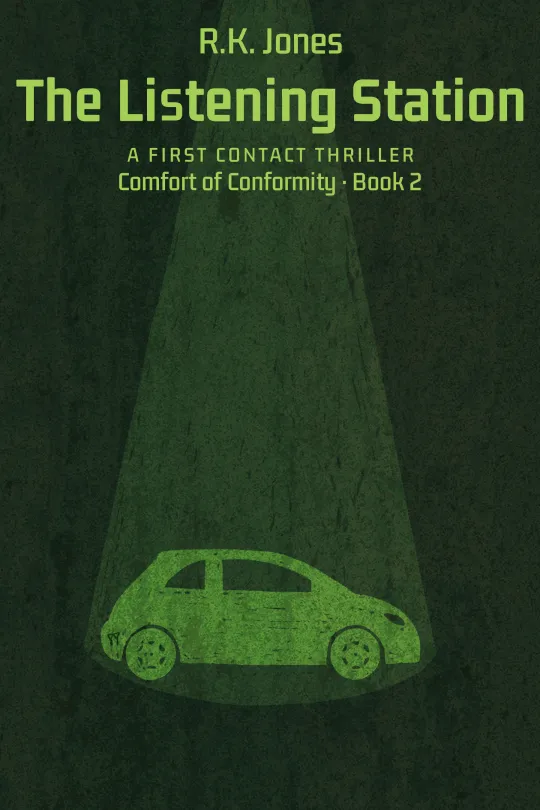
That question drives R.K. Jones’s first-contact thriller The Listening Station, Book 2 of the Comfort of Conformity series. The message comes from deep space: You are not alone. It is March 2055, three months before the outbreak. Davey Olfane comes back from vacation to find a new fence around the Texas branch of the Global Space Agency, and every antenna on the roof turned to a different part of the sky. Davey decodes signals for a living. The closer he looks at this one, the less sure he is where it really came from, and the more certain he is that whoever sent it has plans for him.
Real SETI teams can take years to rule out a satellite or a faulty amplifier. Davey may not get years. Want to test your own detective instincts? Try the site’s free games.
Sources
- Wow! Signal: 30th Anniversary Report, Jerry R. Ehman, Big Ear Radio Observatory
- Arecibo Wow! I: An Astrophysical Explanation for the Wow! Signal, Méndez, Ortiz Ceballos and Zuluaga, arXiv (2024)
- Arecibo Wow! II: Revised Properties of the Wow! Signal from Archival Ohio SETI Data, Méndez et al., arXiv (2025)
- Arecibo Wow! project, Planetary Habitability Laboratory, University of Puerto Rico at Arecibo
- The Ohio SETI Program: The Last Decades, Méndez, Dixon and Childers, arXiv (2026)
- The historic ‘Wow!’ signal may finally have a source. Sorry, it’s not aliens, Science News
- The Wow! Signal SETI Mystery Might at Last Be Solved, Scientific American
- The Wow! Signal: New analysis closes in on mysterious source, EarthSky
- Comet Likely Didn’t Cause Bizarre ‘Wow!’ Signal, Space.com
- Comet claim for mysterious Wow signal sparks controversy, Astronomy Now
- Hydrogen Line Observations of Cometary Spectra at 1420 MHz, Antonio Paris, arXiv (2017)
- One Man’s Quest for SETI’s Most Promising Signal, The Planetary Society
- 1st Coordinated Green Bank Telescope/Allen Telescope Array Observes Possible Source of the WOW! Signal, SETI Institute
- Scientist of the Day: Giuseppe Cocconi, Linda Hall Library
- April 8, 1960: Frank Drake begins Project Ozma, Astronomy
- What Is the Water-Hole?, The SETI League
- It’s the 25th anniversary of Earth’s first attempt to phone E.T., Cornell Chronicle
- Internet investor Yuri Milner joins with Berkeley in $100 million search for extraterrestrial intelligence, UC Berkeley News
- Analysis of the Breakthrough Listen signal of interest blc1, Sheikh et al., Nature Astronomy (2021), arXiv version
- A mysterious signal looked like a sign of alien technology, but it turned out to be radio interference, The Conversation
- Declaration of Principles Concerning Activities Following the Detection of Extraterrestrial Intelligence (1989), copy hosted by UCLA SETI
- Beyond Disclosure Day: The Real-World Protocols, SETI Institute
- SETI Panel Revises Recommendations for Dealing With ‘Disclosure Day’, Universe Today
Questions people ask
What was the Wow! signal?
It was a strong, narrowband radio signal detected by Ohio State University’s Big Ear radio telescope on August 15, 1977. It lasted the full 72 seconds the telescope could watch one spot in the sky, sat near the 1420 MHz hydrogen line, came from the direction of Sagittarius, and has never been detected again.
What does 6EQUJ5 mean?
It is a record of signal strength, not a message. Each character shows how many times stronger than the background noise the signal was during one 12-second reading, using digits for 1 to 9 and letters from A = 10 to Z = 35, so 6EQUJ5 means 6, 14, 26, 30, 19 and 5.
Has the Wow! signal been explained?
Not conclusively. A 2017 theory blaming comets was widely rejected. Since 2024, a team led by Abel Méndez has proposed that a magnetar flare or similar burst made a cold hydrogen cloud briefly brighten like a natural maser, a plausible and testable idea that has not been confirmed.
Did the Wow! signal ever repeat?
No. Big Ear watched the same strip of sky for about 60 days afterward, and later searches, including the Very Large Array in the 1990s and the Green Bank Telescope with the Allen Telescope Array in 2022, found nothing matching it.
Was the Wow! signal from aliens?
There is no evidence that it was. Because it was seen only once, it could never be independently verified, so an artificial origin remains one unconfirmed possibility alongside natural and human-made explanations.