Philosophy
Memento Mori Meaning: The Real Origin of ‘Remember You Must Die’
Memento mori means “remember that you must die.” The famous Roman triumph story is shakier than you think, but the Stoic practice behind it is real. Here is the history, the quotes, the art and how to use it.
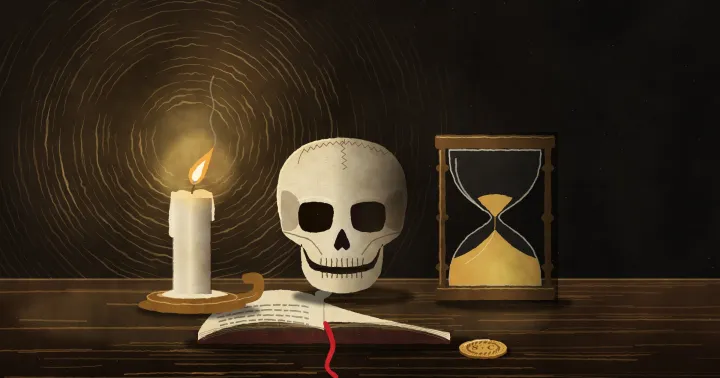
Memento mori means “remember that you must die” in Latin, and the phrase names both the reminder and any object that delivers it, such as a skull on a desk or in a painting. The idea is ancient and the Stoics practiced it daily, but the famous story of a slave whispering those words to a Roman general is shaky: the one ancient writer who quotes the whisper gives different words.
None of it was meant to be gloomy. For Seneca, Epictetus and Marcus Aurelius, remembering death was a way of paying closer attention to life.
The key facts:
- The meaning: Memento is the Latin command “remember!” and mori means “to die.” Tate’s glossary of art terms renders the phrase “remember you must die.”
- The legend: No surviving ancient source has a slave say “memento mori” to a triumphant general. Tertullian, writing around 197 CE, gives the words as “Look behind thee; remember thou art but a man” (translated by S. Thelwall).
- The Stoics: Epictetus, Seneca and Marcus Aurelius all urged a daily thought of death, as a tool for living well rather than a source of dread.
- The art: Christian Europe made it a visual genre, from the Dance of Death to Holbein’s hidden skull (1533) and the vanitas still lifes of the 1600s.
- The evidence: A few small studies suggest that guided reflection on death can deepen appreciation of life, but the research is early and mixed.
What does memento mori mean?
Memento is the future imperative of the Latin verb meminī, “to remember,” so it works as a command. Mori is the infinitive of morior, “to die.” The literal sense, “remember to die,” is usually smoothed into “remember that you will die.”
In English the phrase does double duty. It is the idea, and it is also a thing: Tate defines a memento mori as “an artwork designed to remind the viewer of their mortality,” usually through symbols such as skulls and hourglasses.
It has close cousins. Tertullian’s “remember thou art but a man” (in Latin, hominem te memento) is about humility more than death. The Book of Sirach gives a moral version, in the Douay-Rheims translation: “In all thy works remember thy last end, and thou shalt never sin” (7:40). On Ash Wednesday, ashes are traditionally given with words drawn from Genesis 3:19: you are dust, and to dust you shall return.
As a greeting, the phrase had one real home: the Hermits of St. Paul of France (1620-1633), nicknamed the Brothers of Death. The often-repeated claim that Trappist monks greet each other with it appears to be a myth.
Where does memento mori come from? The Roman triumph story
The story usually runs like this. A victorious general rides through Rome in a chariot, the crowd roaring, and a slave behind him leans in to whisper, “Memento mori.” It fits the evidence only loosely.
What the old sources actually say, from earliest to latest:
- Epictetus, early second century CE. In the Discourses, written down by his pupil Arrian around 108 CE, Epictetus tells students to rein in their feelings even when kissing a child or friend, “as those who stand behind men in their triumphs and remind them that they are mortal” (Discourses 3.24, translated by George Long). It is a passing comparison, with no speaker named and no words given.
- Tertullian, about 197 CE. In his Apology, written in Carthage, the Christian writer refuses to call the emperor a god and cites the triumph as proof that even Rome reminded him he was human: “A voice at his back keeps whispering in his ear, ‘Look behind thee; remember thou art but a man’” (Apology 33, translated by S. Thelwall). The Latin is Respice post te! Hominem te memento! Tertullian names no slave, and the word is “man,” not “die.”
- Byzantine excerpts, twelfth century. The Roman historian Cassius Dio’s early books survive only in fragments, many of them in the chronicle of Joannes Zonaras. These describe a public slave in the chariot holding a jeweled crown over the general and telling him to look behind, or to see what comes after. A bell and a whip hung from the chariot as signs that misfortune could still find him.
The classicist Mary Beard pulled these threads apart in The Roman Triumph (2007). The accounts are few, late and inconsistent. In her words, “there is nothing to prove that he was the original, permanent, and unchanging fixture” of the ceremony (quoted in Frank Wilson’s 2008 review for the Philadelphia Inquirer), and different versions of his words were in circulation.
The fair verdict: a reminder of mortality may well have been part of some triumphs. But nobody in the ancient record whispers “memento mori,” and the best-documented reminder is the one philosophers gave themselves.
Memento mori and Stoicism: what the Stoics said about death
The Stoic practice stands on firmer ground. The three Roman Stoics most read today returned to death again and again, as a teacher rather than a terror. (For their wider toolkit against worry, see our guide to Stoicism for anxiety.)
Epictetus: keep death in view
The Enchiridion, the short handbook of Epictetus’s teaching, is blunt: “Let death and exile and every other thing which appears dreadful be daily before your eyes” (chapter 21, translated by George Long). The payoff: “you will never think of any thing mean nor will you desire any thing extravagantly.”
He also separated death from the fear of it: “the opinion about death, that it is terrible, is the terrible thing” (chapter 5).
His hardest advice concerns the people we love. In Discourses 3.24 he asks: “What harm is it while you are kissing your child to say with a lisping voice, To-morrow you will die.” It sounds cruel. His point is that love is real but on loan. Remind yourself “that he whom you love is mortal,” he says, given to you for the present, like a fig or a bunch of grapes in its season.
Seneca: we make life short
Seneca’s essay On the Shortness of Life turns the usual complaint around: “we do not receive a short life, but we make it a short one” (chapter 1, translated by Aubrey Stewart, 1889). His diagnosis comes in chapter 3: “It is that people live as though they would live for ever,” though “that day which you devote to some man or to some thing is perhaps your last.”
His cure is to stop deferring. In chapter 9 he writes that “postponement is the greatest waste of life,” and gives an order: “everything future is uncertain: live now straightway.”
In his letters, Seneca also borrowed a two-word command from Epicurus: meditare mortem, roughly “practice dying.” Whoever says this, Seneca adds, is really telling us to practice freedom (Letters 26).
Marcus Aurelius: the olive that falls when ripe
The emperor’s private notebook, written in Greek, is full of death, and it is never morbid for long. “Since it is possible that thou mayest depart from life this very moment, regulate every act and thought accordingly,” he writes (Meditations 2.11, translated by George Long). And in 4.17: “Do not act as if thou wert going to live ten thousand years.” Then comes the instruction: “While thou livest, while it is in thy power, be good.”
He used death to cut status down to size. “Alexander the Macedonian and his groom by death were brought to the same state” (6.24). In 4.48 he lists physicians who died after frowning over the sick and tyrants who behaved “as if they were immortal,” then closes with one of the gentlest images in ancient philosophy. End your journey content, he says, “just as an olive falls off when it is ripe, blessing nature who produced it, and thanking the tree on which it grew.”
The Stoic lesson in one line: death is natural, and the present is all anyone can lose, so use it well.
Memento mori art: the Dance of Death, Holbein’s skull and vanitas
Christianity took up the reminder and gave it a new job. Where the Stoics used death to sharpen life, Christian writers turned it toward the soul’s fate. Plague added urgency, and the Dance of Death, or danse macabre, became a signature image: Death leading people of every rank, from pope to laborer, to the grave. Its earliest known painted version, a mural at the Cemetery of the Holy Innocents in Paris, dates from 1424-25 and is now lost.
Hans Holbein the Younger painted one of the most famous hidden skulls in art. In The Ambassadors (1533), now in London’s National Gallery, two men stand side by side, and between their feet hovers a distorted, stretched shape that becomes a skull only when you look up from the bottom right, a trick called anamorphosis. The gallery notes that Renaissance portraits were often commissioned as a memento mori.
What is vanitas?
Vanitas is the still-life branch of the family. Tate calls these paintings “closely related to memento mori still lifes,” with added objects, such as musical instruments, wine and books, that stress the emptiness of worldly pleasure. The name comes from Ecclesiastes: “Vanity of vanities, saith the Preacher, vanity of vanities, all is vanity.” The genre flourished in the 17th century, especially in Holland.
A classic example is Harmen Steenwyck’s Still Life: An Allegory of the Vanities of Human Life (about 1640), also in the National Gallery. It holds a skull, books, a lamp just gone out, a chronometer, an exotic shell, a costly Japanese sword, musical instruments and a flask of wine. The gallery’s own summary: “We are staring death in the face.”
How to read the symbols:
- Skull: death itself.
- Hourglass, clock or watch: time running out.
- Candle or lamp, just snuffed: a life extinguished.
- Flowers and fruit: beauty that wilts and rots.
- Books, instruments, wine, shells and swords: learning, pleasure, wealth and power, none of which you take with you.
How to practice memento mori without being morbid
Does thinking about death help or hurt? It seems to depend on how you do it.
Research in terror management theory found that brief reminders of death, called mortality salience, can make people more defensive, and in some studies greedier. Even that classic finding has wobbled: in the Many Labs 4 project, 21 US labs with more than 2,200 participants could not replicate a well-known mortality salience effect, which “certainly raises doubts about the robustness of the effect,” as the Center for Open Science put it.
Slow, deliberate reflection may work differently. In small 2004 experiments by Cozzolino and colleagues, participants imagined dying in a fire and then wrote about the life they had led. Strongly money-and-fame-minded people who did this behaved less greedily in a raffle-ticket task, while a standard death reminder made them greedier. A field experiment published in November 2024, with 229 people, tested an art installation that turned the Buddhist Nine Cemetery Contemplations into a guided audio meditation. Two weeks later, the installation group reported more lingering reflection than the controls, and that reflection was linked to greater appreciation of life (Das, Fransen and Oliver, Frontiers in Psychiatry). But the study’s key test of change over time was not significant, and more than half the participants missed the follow-up. Promising, then, but far from settled.
Six ways to practice it, each rooted in the sources above:
- Ask Marcus’s question once a day. Each morning, ask what you would stop putting off if today were your last. Then do one small thing about it.
- Run Seneca’s postponement audit. Write down three things you keep deferring “until later.” Schedule one this week.
- Hold people gratefully. Skip Epictetus’s whisper. When you hug someone you love, notice that this exact moment won’t come again, and let that make you kinder, not sadder.
- Take the long view of status. When a rivalry or a slight eats at you, remember Alexander and his groom.
- Keep a reminder in sight. A postcard of a vanitas painting or an hourglass on the desk does the work of a skull without the décor problem.
- Talk about it. At a Death Cafe, people drink tea, eat cake and discuss death, aiming “to increase awareness of death with a view to helping people make the most of their (finite) lives.” As of late 2026, the Death Cafe site counts more than 25,000 held in 100 countries. It is a discussion group, not grief counseling.
Keep it short: a minute or two, ending with something to do. If the practice leaves you more anxious or low instead of more awake, drop it.
Memento mori is a philosophical practice, not a treatment. If thoughts about death are frequent, frightening or hard to switch off, talk to a doctor or a licensed mental health professional. If you are thinking about ending your life, in the US call or text the 988 Suicide & Crisis Lifeline, free and confidential around the clock, or contact your local emergency number.
Go deeper with Applied Stoicism
None of the three Stoics quoted here treated death as a mood. They treated it as practice, something to rehearse until it changed the day.
If you want to go further with the same three teachers, R.K. Jones’s Applied Stoicism: Take Back Control of Your Chaotic Mind is available now. It is a personal guide to the Stoics, Epictetus, Seneca and Marcus Aurelius, and to how their ideas can quiet anxiety and help you take back control of a chaotic mind.
Read the Stoics the way they wrote: a line at a time, then live with it for a day. Start with Marcus’s olive, which falls when it is ripe and thanks the tree it grew on. It is hard to think of a better picture of a life well used.
Sources
- Apology, chapter 33 (Tertullian, translated by S. Thelwall), Ante-Nicene Fathers vol. III, tertullian.org
- The Discourses of Epictetus 3.24 (translated by George Long), Perseus Digital Library via Perseids
- The Encheiridion or Manual (Epictetus, translated by George Long, 1877), Wikisource
- Minor Dialogues, including Of the Shortness of Life (Seneca, translated by Aubrey Stewart, George Bell and Sons, 1889), Internet Archive
- Seneca, Epistulae Morales, Letters 23-29 (Latin text), The Latin Library
- Meditations 4.48 (Marcus Aurelius, translated by George Long), Lexundria
- Meditations, Book 2 (Marcus Aurelius, translated by George Long), MIT Internet Classics Archive
- Cassius Dio, Roman History, Book 6 fragments (Loeb, 1914), LacusCurtius, University of Chicago
- A tradition not so well understood after all (Frank Wilson, review of Mary Beard’s The Roman Triumph), Philadelphia Inquirer, 2008
- Memento mori, art term, Tate
- Vanitas, art term, Tate
- Harmen Steenwyck, Still Life: An Allegory of the Vanities of Human Life, The National Gallery, London
- Hans Holbein the Younger, The Ambassadors, The National Gallery, London
- Sirach 7:40, Douay-Rheims 1899 American Edition, Bible Gateway
- Genesis 3:19, King James Version, Bible Gateway
- Greed, Death, and Values: From Terror Management to Transcendence Management Theory (Cozzolino, Staples, Meyers and Samboceti, 2004), Personality and Social Psychology Bulletin
- Many Labs 4: Failure to Replicate Mortality Salience Effect With and Without Original Author Involvement (Klein et al., 2022), Collabra: Psychology
- Many Labs 4 summary, Center for Open Science
- Beyond the denial of death: death meditation increases a sense of connectedness and appreciation of life (Das, Fransen and Oliver, 2024), Frontiers in Psychiatry
- Death Cafe (home page, running totals)
- What is Death Cafe?, Death Cafe
- 988 Suicide & Crisis Lifeline
- Memento mori, Wikipedia
- Danse Macabre, Wikipedia
- Roman triumph, Wikipedia
- Apologeticus, Wikipedia
Questions people ask
What does memento mori mean?
Memento mori is Latin for “remember that you must die” (literally “remember to die”). It names both the practice of reflecting on your own mortality and any object or artwork, such as a skull or an hourglass, that serves as a reminder.
Did a slave really whisper “memento mori” to Roman generals?
Not in those words. A few sources describe someone in the triumphal chariot reminding the general that he was mortal or telling him to look behind, but the only ancient writer to quote the words, Tertullian (about 197 CE), gives “Look behind thee; remember thou art but a man” in S. Thelwall’s translation. The historian Mary Beard argues that the evidence for the custom is thin and inconsistent.
Is memento mori a Stoic idea?
The practice is. Epictetus told students to keep death “daily before your eyes” (Enchiridion 21, translated by George Long), Seneca argued that we make life short by wasting it, and Marcus Aurelius wrote, “Do not act as if thou wert going to live ten thousand years” (Meditations 4.17, translated by George Long).
What is the difference between memento mori and vanitas?
A memento mori is any artwork or object meant to remind you of death, typically with a skull, an hourglass or a guttering candle. Vanitas is a closely related kind of still life, popular in the 17th century, that adds objects like books, musical instruments and wine to stress the emptiness of worldly pleasures; its name comes from the “Vanity of vanities” of Ecclesiastes.
Is practicing memento mori morbid or unhealthy?
Done briefly and with a purpose, such as clarifying priorities, it is meant to sharpen life rather than darken it, and small studies hint that guided reflection on death can increase appreciation of life, though the evidence is early. It is not a treatment: if thoughts of death are distressing or persistent, talk to a doctor or mental health professional, and in the US you can call or text 988.