History
What Happened at Biosphere 2? The Sealed World That Ran Short of Air
In 1991 eight people sealed themselves inside a glass world in the Arizona desert for two years. Here is what really happened at Biosphere 2: the vanishing oxygen, the hunger, the feuds and the 1994 chaos.
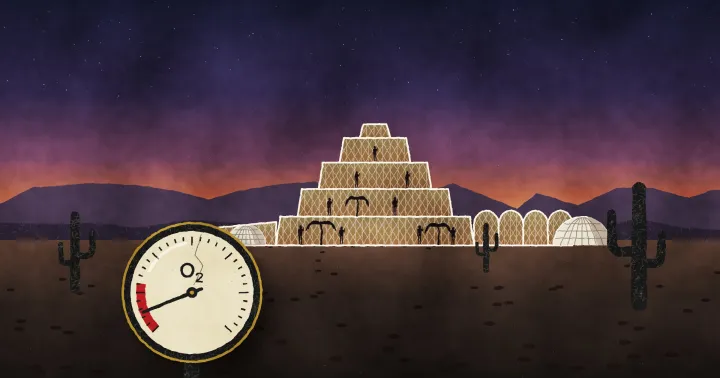
Biosphere 2 was a sealed, 3.14-acre glass world in the Arizona desert where eight people lived from September 26, 1991, to September 26, 1993, trying to grow all their own food and recycle all their own air and water. They survived the full two years, but what happened at Biosphere 2 was messier than the plan: the oxygen fell to dangerous levels, the crew went hungry, the group split into two hostile camps, and revelations about smuggled supplies, a hidden food store and pumped-in oxygen turned a bold experiment into a national punchline.
The full story is stranger than the joke: a scientific mystery solved in the walls, a 1994 takeover involving federal marshals and Steve Bannon, and a building that is now a busy University of Arizona lab. Here is what went wrong, what went right, and what it teaches.
- Where: Oracle, Arizona, north of Tucson: 3.14 acres under 6,500 windows, built for about $150 million.
- Who: four men and four women, the “biospherians,” sealed in for two years on September 26, 1991.
- Oxygen: fell from 20.9 percent to about 14 percent in 16 months; oxygen was pumped in starting in January 1993.
- Food: the crew grew about 83 percent of what it ate and lost an average of 17 percent of body weight.
- Mission 2: a crew of seven went in on March 6, 1994; the mission ended early that September amid a management takeover.
- Today: owned by the University of Arizona since July 2011, open to visitors, and used for climate, ecology and space research.
What was Biosphere 2?
Earth is Biosphere 1. Biosphere 2 was meant to be a second one in miniature: a materially closed world where air, water and nutrients would cycle as they do on the planet, with humans inside as part of the loop. It was built by Space Biospheres Ventures, a company formed by a counterculture group led by John Allen together with business partners, and bankrolled by the Texas oil heir Ed Bass. The company hoped the work would lead to self-sustaining colonies in space, and talked of putting a biosphere in orbit and, one day, on the Moon and Mars.
Under the glass sat a planet in pieces: a rainforest, an ocean with a coral reef, mangrove wetlands, a savanna, a fog desert, an intensive farm and a human habitat with apartments, labs and a kitchen. A 500-ton stainless steel liner sealed it from the ground, and two expandable “lungs” let the air swell and shrink with the day’s heat. The designers deliberately packed in more species than they expected to survive.
The crew was five Americans, two Britons and a Belgian: Roy Walford (the crew’s physician), Jane Poynter, Taber MacCallum, Mark Nelson, Sally Silverstone, Abigail Alling, Mark Van Thillo and Linda Leigh. On September 26, 1991, they stepped through the airlock and it was sealed behind them.
What happened at Biosphere 2 during the first mission?
The short version: they lived, they worked, and for much of the time they were hungry and short of breath.
None of the eight were farmers. Mark Nelson later wrote, in an account for Dartmouth Alumni Magazine, that farming took about a quarter of their waking hours and that over two years they grew about 83 percent of their food. Cloudy weather early on stunted the crops, and the glass itself blocked more than half of the incoming sunlight.
Walford, a researcher of calorie restriction, turned the shortfall into data. In a 1992 paper in the Proceedings of the National Academy of Sciences, he and two colleagues reported a diet averaging about 1,780 calories a day, only about 10 percent of them from fat. In the first six months the men’s average weight fell from 74 to 62 kilograms (about 163 to 137 pounds). A 2002 follow-up put the average loss at 17 percent of body weight, mostly in the first eight months. Blood pressure, cholesterol and blood sugar dropped sharply, and the authors reported that all eight stayed healthy and active. This is not a diet plan: severe calorie restriction carries real risks, so talk to a doctor before trying anything like it.
The wild biomes drifted too. By the time the seal was broken, according to a 2007 Mongabay summary, 19 of the 25 vertebrate species had died out, along with all the pollinators. A stowaway took over the insect world. A 1999 study led by entomologist James Wetterer found that the longhorn crazy ant, not seen in 1990-91 surveys, had reached “extremely high levels” by 1993. By 1996, more than 99.9 percent of the ants that came to bait were that one species.
Where did the oxygen go in Biosphere 2?
The air started at 20.9 percent oxygen, the same as outside, and several months in it began to fall. After 16 months it was down to about 14 percent, which Nelson compared to living at roughly 15,000 feet. Half the crew showed symptoms of altitude sickness, including sleep apnea, and at one point the crew’s doctor couldn’t add up a column of numbers. Carbon dioxide rose to between 2,000 and 4,000 parts per million, against about 350 outside.
The prime suspect was the soil. It had been loaded with compost and peat, which fed vast numbers of microbes, and microbes breathe much as we do: they take in oxygen and give off carbon dioxide. Under glass that cut the sunlight by more than half, the plants couldn’t turn that carbon dioxide back into oxygen fast enough.
That raised a second puzzle. If the microbes had turned the missing oxygen into carbon dioxide, the air should have been even thicker with it, and chemical scrubbers accounted for only part of the gap.
The answer came from Columbia University geochemist Wally Broecker and his graduate student Jeff Severinghaus, working with colleagues including crew member Taber MacCallum. In a 1994 paper in Eos, they reported that the carbon dioxide was reacting with the building’s exposed concrete to form calcium carbonate. Concrete cores from inside the structure showed far more chemical change than cores from outside, reaching much deeper into the walls. The microbes turned oxygen into carbon dioxide, the concrete swallowed the carbon dioxide, and that oxygen never came back to the air. The building had been quietly breathing alongside its crew.
Secrets, feuds and the injected oxygen
The experiment’s credibility leaked faster than its air. About two weeks in, Jane Poynter cut off a fingertip in a rice-threshing machine and left for surgery. She came back with a duffel bag of supplies, which reporters found out about months later. It also emerged that the crew had dipped into a three-month food reserve stored inside before the doors closed, and a former employee revealed that engineers had installed a carbon dioxide scrubber to manage the atmosphere by machine.
Then came the oxygen. At first the crew chose to study the decline rather than fix it, Nelson wrote, but they eventually agreed it had become dangerous. In January 1993, about 16 months in, tanker trucks delivered liquid oxygen, at least 10 tons of it, to be pumped into the sealed world. Time ran the headline “Biosphere or Biostunt?”
The outside experts brought in to restore the project’s credibility had had enough. On February 5, 1993, the scientific advisory committee voted to disband. Its chairman, the Smithsonian biologist Thomas Lovejoy, said he was “frustrated by the lack of progress,” while Bass blamed personality conflicts with the management team. The ecologist Eugene Odum, a panel member, offered a verdict that still fits: “What we’ve seen is not a scientific failure; it’s a failure of human relationships.”
Inside, the eight had split into two camps of four over the project’s direction. Broadly, one side wanted more outside science and collaboration, and the other stood with management. The crew turned to group therapy sessions to cope, and Nelson has insisted the rift never stopped the work. On September 26, 1993, exactly two years after going in, all eight walked out.
What happened at Biosphere 2 in 1994?
A second crew of seven went in on March 6, 1994, expecting to stay for several months to a year. Within weeks, the company behind them came apart.
Bass had gone to federal court in Fort Worth to dissolve his partnership with the managing side, run by Margaret Augustine and John Allen, citing “threatening and irrational” behavior by some managers. On Good Friday, April 1, 1994, court-appointed receivers and federal marshals barred Augustine, Allen and three other top managers from the site. Bass had brought in Steve Bannon, an investment banker and later a key adviser to Donald Trump, to rein in costs, and Bannon became Biosphere 2’s acting chief executive.
Days later, before dawn, two of the original crew, Abigail Alling and Mark Van Thillo, came back. Four of the five sealed doors were breached and several glass panes smashed, letting outside air into the dome. Alling denied it was sabotage: “I’ve acted for the safety of the Biosphere,” she said. Both were charged with burglary, trespassing and criminal damage. At a 1996 civil trial over the affair, Bannon acknowledged that he had vowed, in cruder words, to kick Alling’s backside.
The second crew stayed on, but the mission ended early, in September 1994, about six months in. Space Biospheres Ventures was dissolved, and no crew has been sealed inside the main glass structure for a mission since.
Biosphere 2 today
After the drama, Biosphere 2 became a lab. In November 1995, Columbia University announced a five-year agreement for its Lamont-Doherty Earth Observatory to run the science, and Columbia managed the site from 1996 to 2003. A team led by Chris Langdon found that corals struggled in the miniature reef’s more acidic water, early evidence of what ocean acidification can do.
The University of Arizona took over research in 2007 under a lease and became the owner on July 1, 2011, with $20 million from Bass’s Philecology Foundation. It calls Biosphere 2 the world’s largest controlled environment dedicated to Earth science, and as of late 2026 the work is busy:
- Landscape Evolution Observatory: three artificial hillslopes built from about a million pounds of crushed basalt, each wired with more than 1,800 sensors and samplers to study how life turns barren ground habitable.
- Ocean: on February 4, 2026, researchers placed 108 living corals on two “Coral Arks,” the first corals in the ocean habitat in more than 30 years, to test how they cope with future heat.
- Space: the original 1987 Test Module has been rebuilt as SAM, the Space Analog for the Moon and Mars. In October 2025 one person spent two weeks sealed inside with 144 dwarf pea plants to measure how well they recycle air, and tests of 20 or more crops run through 2026.
- Rainforest: used to study how tropical forests handle heat and drought.
Hydrologist Laura Condon became interim director on July 6, 2026, after director Joaquin Ruiz retired. The public can visit daily, and more than 3 million people have come since 1991. The original saga found a new audience through Matt Wolf’s 2020 documentary Spaceship Earth.
What Biosphere 2 teaches about sealed, managed societies
Time later put Biosphere 2 on a list of the 100 worst ideas of the 20th century. But its sharpest lessons are about people as much as plants.
Every closed world has hidden variables. Nobody planned for the concrete. In a 1996 review in Science, the ecologists Joel Cohen and David Tilman concluded that no one yet knew how to engineer life support the way natural ecosystems provide it. Biosphere 2’s deputy director, John Adams, put it plainly to NPR in 2025: “No matter how smart we think we are, you’re never going to re-create Earth in its entirety.”
Secrecy costs more than failure. The falling oxygen was a real discovery. What did the lasting damage was the hidden food, the duffel bag and the undisclosed scrubber; Biosphere 2’s own staff told Scientific American in 2021 that the real failure was the lack of transparency.
Small sealed groups split. Eight people with a shared mission, hungry and short of oxygen, divided into two camps, while Walford described the management outside as “hierarchical and authoritarian.” The Asch conformity experiments showed how hard it is to hold out against a group even for a few minutes. Inside a dome, there is no leaving the room.
Whoever holds the valves holds the story. At Biosphere 2, the people outside could open the airlock, pump in oxygen and decide what the public heard. In any managed society, the real question is who controls the air, the food and the record.
Life under another dome: Ten Million Strangers
Biosphere 2 was built to keep its people alive. Fiction can ask what happens when a dome is built to keep its people in line.
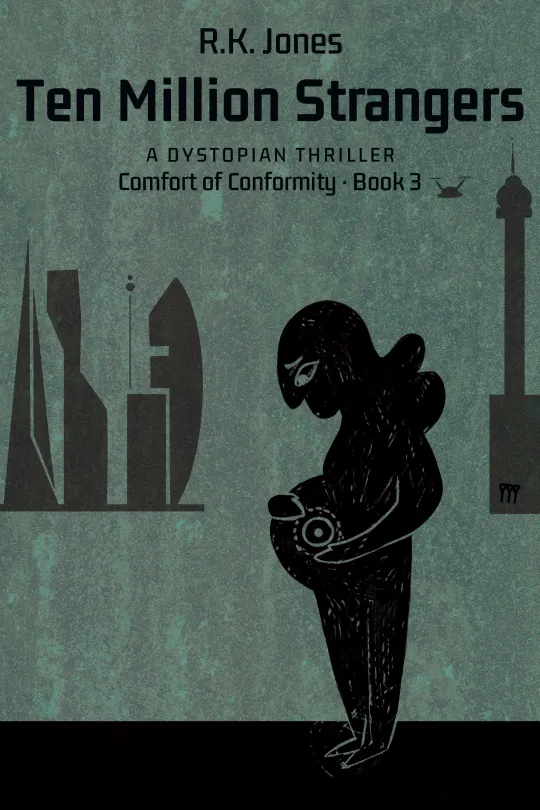
That is the world of R.K. Jones’s Ten Million Strangers, Book 3 of the Comfort of Conformity series, coming soon. Two years after the world collapsed, the survivors live in City, a domed paradise where the dictums play from every building, every resident has a job and a place, and a morning cup of Caffeinquist makes each day bearable. Grace wakes beside a stranger with no memory of bringing him home. Nobody can remember, and that is normal here. Then she reads a note warning that the drink is stealing their memories, and the pieces that come back don’t fit the life she’s living. Across City, an inventory worker named Gabe is struggling to remember who he used to be. And the Elders who run the dome are keeping a very careful count of City’s women.
Biosphere 2’s crew could at least trust their own memories of the world outside the glass. In City, even that is in question.
Sources
- Oxygen loss in Biosphere 2, Severinghaus, Broecker, Dempster, MacCallum and Wahlen, Eos (1994)
- The calorically restricted low-fat nutrient-dense diet in Biosphere 2, Walford, Harris and Gunion, PNAS (1992)
- Calorie restriction in Biosphere 2: alterations in physiologic, hematologic, hormonal, and biochemical parameters, Walford et al., Journals of Gerontology (2002), PubMed
- Ecological dominance by Paratrechina longicornis, an invasive tramp ant, in Biosphere 2, Wetterer et al., Florida Entomologist (1999), University of Arizona
- Biosphere 2: What Really Happened, Mark Nelson, Dartmouth Alumni Magazine (2018)
- Lessons from Biosphere 2, Mark Nelson, The Scientist (2018)
- The Lost History of One of the World’s Strangest Science Experiments, Carl Zimmer, The New York Times (2019), author’s copy
- Benchmarks: September 26, 1991: Crew sealed inside Biosphere 2, Earth Magazine
- Life Under the Bubble, Discover (2010)
- Biosphere advisory panel disbands in frustration, Associated Press via Deseret News (1993)
- Biosphere or Biostunt?, Time (1993)
- Big Trouble Under Glass, Newsweek (1994)
- The Strange History of Steve Bannon and the Biosphere 2 Experiment, Vice
- Biosphere 2 and Columbia University five-year agreement, Columbia University press release (1995)
- Biosphere 2’s humbling failure hints at nature’s mysteries, Deseret News (1996)
- Biosphere 2 lives on, Mongabay (2007)
- Biosphere 2, Version 3.0, BioScience (2007)
- Biosphere 2 to Have a Permanent Home With the UA, University of Arizona (2011)
- About Biosphere 2, University of Arizona
- Biosphere 2, the Once-Infamous Live-In Terrarium, Is Transforming Climate Research, Scientific American (2021)
- Inside the evolution of Biosphere 2, from ‘90s punchline to scientific playground, NPR (2025)
- Corals in Biosphere 2’s Ocean Habitat may help save reefs around the world, University of Arizona (2026)
- Biosphere 2’s SAM to become testing ground for next-generation space habitats, University of Arizona (2026)
- Biosphere 2 poised to become launchpad for landscape terraformation science, University of Arizona (2026)
- Laura Condon named interim director of Biosphere 2, University of Arizona (2026)
- MrBeast takes over Biosphere 2, from rooftop to rainforest, University of Arizona (2026)
- Biosphere 2: Spaceship Earth, History.com
- ‘Spaceship Earth,’ a wild new doc about Biosphere 2 habitat, launches May 8, Space.com (2020)
- Biosphere 2, Wikipedia (secondary)
Questions people ask
What happened at Biosphere 2?
From September 26, 1991, to September 26, 1993, eight people lived sealed inside Biosphere 2, a 3.14-acre glass ecosystem in Oracle, Arizona. They survived and grew about 83 percent of their food, but oxygen fell to about 14 percent, oxygen had to be pumped in from January 1993, and revelations about hidden food and supplies damaged the project’s credibility.
Why did the oxygen drop in Biosphere 2?
Microbes in the compost-rich soil consumed oxygen and released carbon dioxide faster than the plants could recycle it. A 1994 study by Columbia University geochemists found that much of that carbon dioxide reacted with exposed concrete inside the building to form calcium carbonate, so the oxygen never returned to the air.
Was Biosphere 2 a failure?
Partly. The crew survived two years and grew most of its own food, and the oxygen loss became a genuine scientific finding, but outside oxygen had to be added, and undisclosed food, supplies and a carbon dioxide scrubber undermined the experiment’s credibility. The building has since become a working research facility.
What did Steve Bannon have to do with Biosphere 2?
Investment banker Steve Bannon was brought in by the project’s backer, Ed Bass, to rein in costs, and he became Biosphere 2’s acting chief executive after court-appointed receivers and federal marshals removed the original managers on April 1, 1994. The second mission, which had begun that March, ended early in September 1994.
Is Biosphere 2 still open today?
Yes. The University of Arizona has owned Biosphere 2 since July 1, 2011, and uses it for climate, ecology and space research, including coral, rainforest and Mars-habitat experiments. It is open to visitors daily.