Philosophy
Zhuangzi’s Butterfly Dream: What It Means and Why It Still Haunts Us
Zhuangzi dreamed he was a butterfly and woke unsure which of them was real. Here is the passage itself, what scholars think it means, and how it leads to Descartes and the simulation hypothesis.
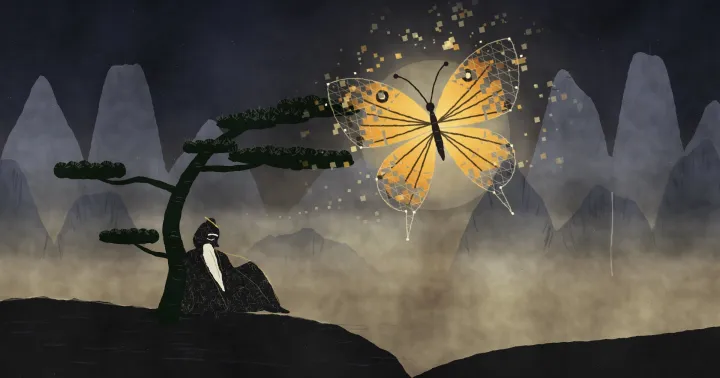
Zhuangzi’s butterfly dream is a short passage from the ancient Chinese Daoist classic the Zhuangzi, in which the philosopher Zhuang Zhou dreams he is a butterfly, wakes up, and cannot tell whether he is a man who dreamed he was a butterfly or a butterfly now dreaming it is a man. Its meaning, put simply: the line between dreaming and waking, and between “me” and “not me,” is far less solid than it feels, and the passage itself calls the shift from one to the other “the transformation of things.”
That closing phrase is where the arguments begin. For more than two thousand years, readers have taken the butterfly as a lesson in doubt, as a meditation on change and death, and as a case for treating every point of view as equal. It has a lively modern afterlife too. It anticipates Descartes’s dream argument, and it turns up whenever philosophers ask whether we could be living in a computer simulation.
- Source: the closing lines of chapter 2 of the Zhuangzi, the “Qiwulun” (齊物論), one of the seven “Inner Chapters” traditionally credited to Zhuangzi himself.
- Author: Zhuang Zhou, better known as Zhuangzi (“Master Zhuang”), a Daoist thinker of the fourth century BCE.
- Length: 62 Chinese characters, fewer than 100 words in English.
- Key phrase: 物化 (wùhuà), “the Transformation of Things” in James Legge’s 1891 translation.
- In English since: the 1880s, in translations by Frederic Balfour (1881), Herbert Giles (1889) and James Legge (1891).
- Modern echoes: Descartes’s dream argument (1641) and Nick Bostrom’s simulation argument (2003).
What does the butterfly dream passage say?
The dream arrives straight after a strange little dialogue in which a penumbra, the faint fringe around a shadow, asks the shadow why it can never keep still. The shadow answers that it depends on something else, which depends in turn on something else again. Then, with no transition, Zhuangzi tells his own story. Here it is in the 1889 translation by Herbert A. Giles, then the British consul at Tamsui, which is free to read on Wikisource (“Chuang Tzŭ” is the older spelling of Zhuangzi):
Once upon a time, I, Chuang Tzŭ, dreamt I was a butterfly, fluttering hither and thither, to all intents and purposes a butterfly. I was conscious only of following my fancies as a butterfly, and was unconscious of my individuality as a man. Suddenly, I awaked, and there I lay, myself again. Now I do not know whether I was then a man dreaming I was a butterfly, or whether I am now a butterfly dreaming I am a man. Between a man and a butterfly there is necessarily a barrier. The transition is called Metempsychosis.
Read the last two sentences closely, because this is where translations part ways. “Metempsychosis” is a word of Greek origin for the transmigration of souls, which is not what the Chinese says. The original ends 此之謂物化, which James Legge’s 1891 translation for the Sacred Books of the East series renders more literally: “This is a case of what is called the Transformation of Things.” Where Giles has a “barrier,” the Chinese has 分 (fēn), a division or distinction; Legge gives “there must be a difference.”
So the story doesn’t end with a shrug. It ends with two claims that seem to pull against each other: the dreamer can’t say which state is the real one, and yet there must be a difference between a man and a butterfly.
Who was Zhuangzi, and what is the Qiwulun?
Zhuangzi lived during China’s Warring States period. The Stanford Encyclopedia of Philosophy places him in the latter half of the fourth century BCE, and the Internet Encyclopedia of Philosophy gives 369 to 298 BCE. Han-era biographers recorded his personal name as Zhou, but little about his life can be confirmed outside the book that carries his name.
That book is an anthology. The commentator Guo Xiang, who died in 312 CE, cut an older 52-chapter version down to the 33 chapters that survive: seven Inner Chapters, 15 Outer and 11 Miscellaneous. Tradition credits only the Inner Chapters to Zhuangzi himself, and some modern scholars question even that. The rest is usually attributed to his followers and to kindred schools.
The butterfly closes chapter 2, the Qiwulun, a title nobody translates the same way twice. Giles called it “The Identity of Contraries,” Legge “The Adjustment of Controversies,” and modern versions include “On the Equality of Things.” The chapter is a long, playful attack on certainty. It asks, for instance, who could ever settle an argument between two people, since any referee will side with one of them, or with both, or with neither.
A few paragraphs before the butterfly, the chapter also sets up the dream theme. In Giles’s version: “While they dream, they do not know that they dream.” Then: “By and by comes the Great Awakening, and then we find out that this life is really a great dream.” The speaker even admits that he is “but a dream” himself.
What does Zhuangzi’s butterfly dream mean? Three main readings
The text never explains itself. Like many of Zhuangzi’s parables, it ends on a question and a riddle. What follows are interpretations by commentators and scholars, not settled fact, and they often overlap.
The skeptical reading: can you prove you’re awake?
Read beside the “great dream” passage, the butterfly looks like a lesson in doubt. Inside a dream you don’t know it’s a dream, so how can you be sure you aren’t in one now? But the doubt is gentle. Chad Hansen, author of the Stanford Encyclopedia’s entry, calls Zhuangzi’s skepticism mild. Waking up feels like a real step toward a wider view, yet the story “seems to suggest that the gestalt sense of liberation from error may go both ways.” A final awakening, Hansen writes, “remains a possible, but distant hope.” On this reading, the lesson is humility, not despair.
The transformation of things: change, and death
The last line points somewhere else. Zhuangzi doesn’t conclude that man and butterfly are the same, or that nothing is real. He insists there must be a difference, and names the passage between them the transformation of things. Legge’s footnote quotes the Chinese commentator Xuan Ying: “all traces of that and this may pass away, as they come under the influence of transformations.” On this reading, the story is about change. You are Zhuang Zhou now and were a butterfly then, and each is fully real while it lasts.
That links the dream to death, which the Zhuangzi treats as one more transformation. In the same chapter, a speaker asks, “How do I know that love of life is not a delusion after all?” And in chapter 18, one of the Outer Chapters, Zhuangzi is found drumming on a bowl and singing after his wife dies. She has simply passed, he explains, “from one phase to another like the sequence of spring, summer, autumn, and winter.”
Equality of perspectives: the butterfly is happy being a butterfly
The chapter’s title suggests a third reading. Guo Xiang took it to mean the “equalization of all viewpoints,” and his relativist interpretation has been influential ever since. In the dream, the butterfly isn’t a lesser, confused version of Zhuang Zhou. It is a butterfly “feeling that it was enjoying itself,” in Legge’s words, with no idea that Zhou exists. Neither viewpoint gets to rank the other.
Chinese tradition has mostly read the story this happy way. In an essay for the Australian National University’s China Story Yearbook, Jingjing Chen traces how the carefree butterfly became a stock image of delight for writers such as Su Shi, while a gloomier “life is but a dream” strand ran alongside it. The Tang poet Li Shangyin wove it into his famously cryptic poem “Jin Se” (錦瑟): 莊生曉夢迷蝴蝶, Master Zhuang, in his dawn dream, bewildered by a butterfly.
The Victorian translators saw their own worlds in it. Giles reached for Greek metempsychosis. Legge felt the Daoism here “can hardly be distinguished from the Buddhism” that treats all experience as illusion, and in his introduction he doubted that Zhuangzi had ever truly lost his sense of who he was in a dream: “I do not think so.”
Zhuangzi and Descartes: the dream argument
Zhuangzi wasn’t alone. In Plato’s Theaetetus, by a near-contemporary on the other side of the world, Socrates raises a question he says people often ask: “How can you determine whether at this moment we are sleeping, and all our thoughts are a dream” (Benjamin Jowett’s 1871 translation). Scholars have compared the two texts directly, among them Lisa Raphals in the journal Philosophy East and West in 1994.
The most famous Western version came in 1641, in René Descartes’s Meditations on First Philosophy. In the First Meditation, Descartes pictures himself seated by the fire in his dressing gown, then remembers dreaming exactly that scene while lying undressed in bed. In the 1911 translation by Elizabeth Haldane and G. R. T. Ross, he decides “there are no certain indications by which we may clearly distinguish wakefulness from sleep.” Then he goes further, imagining an “evil genius” devoting all its energy to deceiving him, a doubt meant to reach even simple arithmetic.
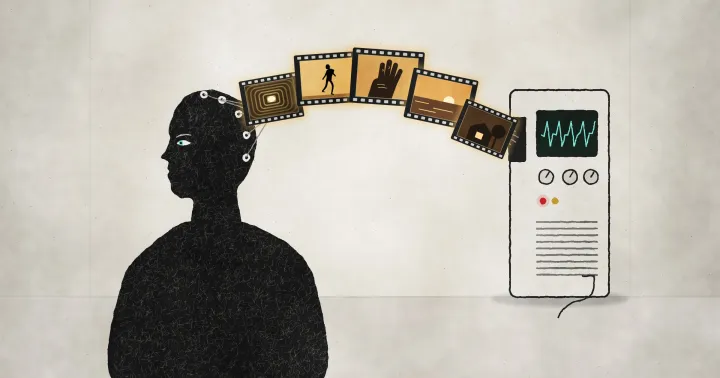
The difference lies in what each man does next. Descartes doubts in order to stop doubting. By the Sixth Meditation he dismisses the dream worry as “hyperbolical and ridiculous,” because “our memory can never connect our dreams one with the other, or with the whole course of our lives,” and because God is no deceiver. Zhuangzi never tries to escape. He ends with a difference he can’t pin down and a transformation he accepts. Descartes’s way out leans on memory. Whether memory itself can be read or rewritten is its own story: see can scientists read your memories?
There’s no evidence that Descartes knew Zhuangzi’s work. When Giles published in 1889, he noted only one earlier attempt to put Zhuangzi into English, Balfour’s of 1881. Yet one line at the close of the First Meditation could be the motto of every virtual-reality story since: Descartes compares himself to “a captive who in sleep enjoys an imaginary liberty” and who, once he suspects it’s a dream, “fears to awaken.”
Is the butterfly dream the first simulation hypothesis?
Not literally. Zhuangzi had no computers, and there’s no machine in his story. But the shape is the same: an experience so complete that the person inside it can’t check it from outside. The modern version came from the Oxford philosopher Nick Bostrom, whose paper “Are You Living in a Computer Simulation?” appeared in Philosophical Quarterly in 2003. He argued that at least one of three things is true:
- humanity is very likely to go extinct before reaching a “posthuman” stage;
- posthuman civilizations are extremely unlikely to run many simulations of their own history (Bostrom’s “ancestor-simulations”);
- we are almost certainly living in a computer simulation.
Bostrom didn’t claim to know which. Given our ignorance, he wrote, it seems sensible to “apportion one’s credence roughly evenly” among the three.
The philosopher David Chalmers draws the line straight back to the butterfly. His 2022 book Reality+ revisits Zhuangzi’s dream alongside Descartes’s demon and Plato’s cave, and in a Carnegie Council interview he called a dream “in a way an antecedent of the simulation idea.” His central thesis, that “virtual reality is genuine reality,” sounds a lot like the third reading above: each world is real on its own terms.
What recent research says
The debate is still live. In October 2025, UBC Okanagan announced a study by Mir Faizal, Lawrence Krauss, Arshid Shabir and Francesco Marino, published in the Journal of Holography Applications in Physics, under the headline that it debunks the idea that the universe is a computer simulation. Drawing on Gödel’s incompleteness theorems, the authors argue that a complete description of reality needs “non-algorithmic understanding,” which no simulation could supply. That conclusion is disputed: a comment posted to arXiv in late 2025 argues that undecidability limits what can be proven, not what can be computed.
In December 2025, the Santa Fe Institute’s David Wolpert published a mathematical framework for the question in the Journal of Physics: Complexity. It neither proves nor rules out the hypothesis, but one result is a curious echo of the butterfly: under certain assumptions, if one universe can simulate ours, ours can simulate it in return, which muddies the idea of a “higher” and a “lower” reality. As of late 2026, no experiment has settled the question either way. When a Georgia Tech physicist answered a 13-year-old’s question about it for The Conversation in February 2026, Zhuangzi’s butterfly was still part of the answer.
The butterfly dream as a virtual-reality trap
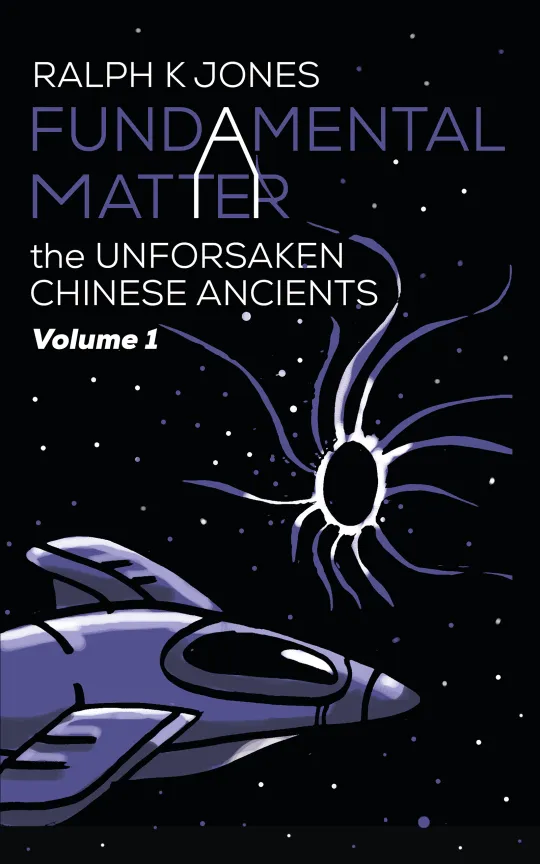
Put Zhuangzi’s butterfly beside Descartes’s captive and you get a very modern fear: a dream so convincing, and so pleasant, that you might not want to leave it, or might not be able to. That is the turn R.K. Jones gives the old story in Fundamental Matter: The Unforsaken Chinese Ancients, illustrated short stories available now on Kindle. The premise: ancient Chinese tales reimagined, with Zhuangzi’s butterfly dream becoming a virtual-reality trap.
It belongs to the Unforsaken shelf, where Grimm, Aesop, the Panchatantra, the Arabian Nights and the Greek myths are retold as science fiction, across ten collections and 549 stories. Zhuangzi left his question open more than two thousand years ago. Science fiction is a good place to keep asking it: if you can’t tell the dream from the waking, who decides when you wake up?
Sources
- Chuang Tzŭ: Mystic, Moralist, and Social Reformer, trans. Herbert A. Giles (London: Quaritch, 1889), chapter 2, Wikisource
- Chuang Tzŭ, trans. Herbert A. Giles (1889), chapter 18, Wikisource
- The Sacred Books of China: The Texts of Taoism, Part I, trans. James Legge (1891), Internet Archive
- 莊子·齊物論 (Zhuangzi, chapter 2, Chinese text), Wikisource
- Zhuangzi, Chad Hansen, Stanford Encyclopedia of Philosophy (revised 2024)
- Zhuangzi, Steve Coutinho, Internet Encyclopedia of Philosophy
- Zhuangzi and his butterfly dream: the etymology of meng 夢, Jingjing Chen, China Story Yearbook 2019 (Australian National University)
- 錦瑟 (Jin Se), Li Shangyin, Wikisource
- Theaetetus, Plato, trans. Benjamin Jowett (1871), Wikisource
- Meditations on First Philosophy, René Descartes, trans. Elizabeth S. Haldane and G. R. T. Ross (1911), Meditation I, Wikisource
- Meditations on First Philosophy, Meditation VI, trans. Haldane and Ross (1911), Wikisource
- Descartes’ Epistemology, Stanford Encyclopedia of Philosophy
- Are You Living in a Computer Simulation?, Nick Bostrom, Philosophical Quarterly (2003)
- How Real Is Virtual Reality? with David Chalmers, Carnegie Council
- A Philosopher Visits the Metaverse (review of Reality+), Tricycle
- UBCO study debunks the idea that the universe is a computer simulation, UBC Okanagan News
- Consequences of Undecidability in Physics on the Theory of Everything, Faizal, Krauss, Shabir and Marino, arXiv
- Provability vs. Execution: A Comment on “Consequences of Undecidability in Physics on the Theory of Everything”, Evan Redden, arXiv
- New mathematical framework reshapes debate over simulation hypothesis, Santa Fe Institute
- Is the whole universe just a simulation?, Zeb Rocklin, Georgia Tech Research (from The Conversation)
Questions people ask
What is the meaning of Zhuangzi’s butterfly dream?
Zhuangzi dreams he is a butterfly, wakes, and cannot tell whether he is a man who dreamed he was a butterfly or a butterfly now dreaming it is a man. Scholars read it as gentle skepticism about telling dreams from waking, as a lesson about constant change (the “transformation of things”), or as a case for treating every point of view as equal.
Where does the butterfly dream come from?
It closes chapter 2, the “Qiwulun,” of the Zhuangzi, a Daoist classic named after Zhuang Zhou, a thinker of the fourth century BCE. Chapter 2 is one of the seven Inner Chapters that tradition credits to Zhuangzi himself.
What does “the transformation of things” mean in the butterfly dream?
It translates wuhua (物化), the last words of the passage, as James Legge rendered them in 1891. It names the change from one state of being to another, here from man to butterfly and back, and the Zhuangzi applies the same idea of transformation to life and death.
Who said “Am I a man dreaming I am a butterfly, or a butterfly dreaming I am a man?”
It is a popular paraphrase of the Chinese philosopher Zhuangzi (Zhuang Zhou). In Herbert Giles’s 1889 translation he says he does not know “whether I was then a man dreaming I was a butterfly, or whether I am now a butterfly dreaming I am a man.”
How is the butterfly dream related to Descartes and the simulation hypothesis?
All three ask whether we can tell experience from illusion. Descartes argued in 1641 that there are no certain signs to tell waking from sleep, then set the doubt aside, and Nick Bostrom argued in 2003 that one of three possibilities must be true, one being that we almost certainly live in a computer simulation. Zhuangzi, unlike Descartes, never tries to escape the doubt.