The future
Sydney in 2050: What the Official Forecasts Really Say
About 7.4 million people, a 24-hour airport in the west, more 35°C days and a higher sea at Fort Denison. What the official forecasts really say about Sydney in 2050, the bleak and the hopeful.
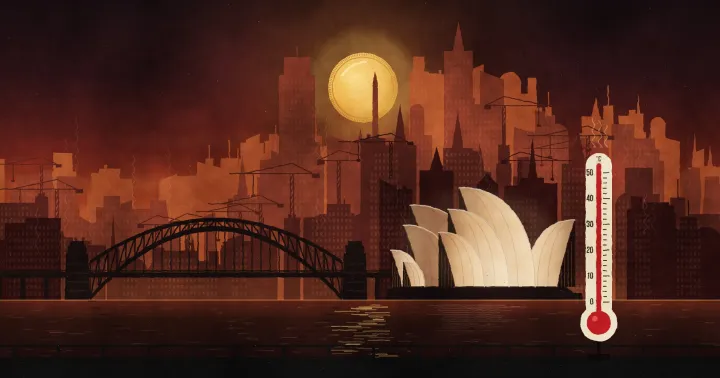
If you draw a line between the federal government’s official projections for the mid-2030s and the mid-2060s, Sydney is on track to hold roughly 7.3 to 7.5 million people by 2050, up from about 5.6 million in 2025. Sydney in 2050 will also be hotter, especially in the west, still one of the hardest places on Earth to buy a home unless something changes, and more reliant on water that doesn’t fall as rain, while a new 24-hour airport pulls the city’s center of gravity west.
None of that is fixed. Forecasts are built on assumptions about migration, births, interest rates and emissions, and they move whenever the assumptions do. Here is what the official numbers say as of late 2026, where they come from, and what governments are doing about each one.
- Population: 5.64 million people lived in Greater Sydney in June 2025. The federal Centre for Population projects about 6.5 million by 2035–36 and 8.5 million by 2065–66.
- Growth: the biggest gains are on the north-western and south-western fringes, in suburbs such as Box Hill, Marsden Park and Austral.
- Airport: Western Sydney International opened to passengers on October 25, 2026. Its metro rail link isn’t expected before late 2027.
- Heat: by 2050, metropolitan Sydney is projected to get about 6 to 10 more days a year of 35°C (95°F) or hotter, and the west is expected to see the biggest jump.
- Housing: even after falling more than 10% in 2026, Sydney’s median dwelling value was about A$1.18 million in October.
- Sea level: at Fort Denison in Sydney Harbour, the sea is projected to be 12 to 29 cm (about 5 to 11 inches) higher by 2050 than in 1995–2014.
What will Sydney’s population be in 2050?
No official body publishes a single “Sydney 2050” number, which is why the figures quoted online vary so much. The best long-range series comes from the federal Centre for Population. Its 2025 Population Statement, released in January 2026, projects Greater Sydney at about 6.47 million in 2035–36 and 8.5 million in 2065–66, and warns that everything after 2035–36 is experimental. Join those two points and Sydney passes 7 million in the early-to-mid 2040s and sits at roughly 7.3 to 7.5 million around 2050. That’s an interpolation, not an official forecast, but it’s the most honest answer available.
The starting point is firmer. The Australian Bureau of Statistics counted 5,638,830 people in Greater Sydney on June 30, 2025, after a year of growth of about 75,200 (1.4%). The ABS draws Greater Sydney broadly, as the city’s whole labor market. The state’s planners use their own boundaries and assumptions, and their numbers run lower: the NSW 2024 projections add 1.4 million people between 2021 and 2041 to reach 6.3 million, and the state’s new metropolitan plan expects “more than 6.6 million” by 2046.
Three forces shape the curve:
- Overseas migration does most of the work. The Centre for Population expects Sydney to have the largest net inflow of overseas migrants of any Australian city over the next decade.
- Sydneysiders keep leaving. In 2023–24, about 41,000 more people moved from Greater Sydney to elsewhere in Australia than moved in.
- The city is aging. Sydney’s median age is projected to rise from about 37 to almost 41 by 2065–66, though it should remain the second-youngest capital city after Darwin.
And yes, Melbourne is catching up. The ABS’s 2023 projections have Melbourne overtaking Sydney sometime between 2032 and 2046, and the federal statement puts Melbourne at 9.1 million to Sydney’s 8.5 million by 2065–66.
Where will Sydney grow? The west, the new airport and Bradfield
The growth is already happening at the edges. In 2024–25, the three parts of Greater Sydney that added the most people were Box Hill–Nelson, Marsden Park–Shanes Park and Austral–Greendale, all on the north-western or south-western fringe. The state’s projections put Camden (3.5% a year) and Wollondilly (3.3%) at the top of its growth table to 2041.
For years the outer west and south-west, home to councils such as Penrith, Liverpool and Campbelltown, has been planned as the “Western Parkland City”. In August 2026 the state replaced its 2018 strategy, A Metropolis of Three Cities, with The Sydney Plan, which treats Sydney as “one interconnected global city” and sets housing and jobs guidance out to 2046.
The anchor of the west is Western Sydney International (Nancy-Bird Walton) Airport, at Luddenham near Badgerys Creek, about 45 km from the CBD. It opened to passengers on October 25, 2026, when a Jetstar flight left for the Gold Coast, and its first international service, Air New Zealand’s link with Auckland, began the next day. Unlike Kingsford Smith, it has no curfew. It can handle up to 10 million passengers a year to start, and aims eventually to serve more than 80 million. The Prime Minister’s office puts government investment in the airport, the rail link and western roads at close to A$18 billion.
The catch is transport. The six-station metro line from St Marys through the airport to Bradfield is not expected to carry passengers until late 2027 at the earliest, and Premier Chris Minns told parliament in June that it may not open until mid-2028. Until then, a free shuttle bus runs between the terminal and St Marys station.
Bradfield is the state’s showpiece: billed as “Australia’s first new city in 100 years”, with targets of 10,000 homes and 20,000 jobs, and, according to its developer, five minutes by metro from the airport. In December 2025 the state signed a development deal worth more than A$1 billion for the first 1,400 homes, at least 10% of them affordable, and by February 2026 about a third of the 114-hectare site was serviced and ready to build on. Closer in, Sydney Metro West, a 24 km underground line between Parramatta and the CBD, is targeting a 2032 opening.
How hot will Sydney get by 2050?
On January 4, 2020, Penrith Lakes recorded 48.9°C (about 120°F), the highest temperature ever recorded in the Sydney basin, according to the Bureau of Meteorology. It beat the 47.8°C set at Richmond in 1939, a record that had stood for 81 years.
That is the west in a nutshell. Western Sydney sits inland and gets less of the sea breeze that cools the coast, with the Blue Mountains trapping hot air to the west, and much of it is covered in concrete, dark roofs and driveways with little green space. A University of Technology Sydney team found that one summer day in ten reaches 35.4°C or more at Richmond, against 30.4°C at Observatory Hill near the harbor. Comparing 1962–1991 with 1992–2021, very hot days became far more common in the west while they declined near the coast. Western Sydney University researchers say heatwaves can run 8 to 10°C hotter in the west than in the eastern suburbs.
The state’s NARCliM2.0 climate projections put metropolitan Sydney’s average temperature 1.0°C to 1.8°C above the 1990–2009 baseline by 2050, depending on emissions, with about 6 to 10 extra days a year at 35°C or above. Those are region-wide averages. Because the west starts with more hot days, the state expects it to see the biggest overall increase; Western Sydney University puts the west’s current average at 15.4 days a year above 35°C.
The plan: The Sydney Plan sets a target of 40% tree canopy cover by 2046, noting that health and cooling benefits begin when canopy reaches about 30%. Heat is a health risk, not only a comfort problem: check on older neighbors in a heatwave, and if you or someone you care for feels unwell, see a doctor, or call 000 in an emergency.
Sydney’s housing crisis: will it ever be affordable?
Sydney is one of the least affordable cities in the world. The 2026 edition of the Demographia International Housing Affordability report put Sydney’s median house price at about 14 times the median household income, second only to Hong Kong among 96 markets. Demographia calls a ratio of 3 or less “affordable” and 9 or more “impossibly unaffordable”.
Prices can fall, and in 2026 they did. Sydney’s median dwelling value dropped 1.6% in October alone, to A$1,178,959, more than 10% below its February peak, as rising interest rates and higher taxes weighed on demand, CommBank’s newsroom reported, citing Cotality’s index. That still leaves a typical Sydney home well above a million dollars.
High prices push people out. NSW loses residents to other states year after year, a flow the Centre for Population says is “mainly driven by residents moving out of Sydney.”
The plan: Under the National Housing Accord, NSW has committed to 377,000 new homes in the five years to June 2029. In its October 2026 update, the state counted 92,270 homes completed since July 1, 2024, roughly a quarter of the target about two years in. To speed things up, it now allows terraces, townhouses and apartments of about three to six stories within 800 meters of nominated stations and town centers, a change it expects to deliver up to 112,000 homes across NSW over five years. Its Transport Oriented Development program has nearly 18,000 more homes in the planning system near stations. Whether Sydney is affordable by 2050 will depend on how much actually gets built, and on interest rates, migration and incomes, which no plan controls.
Will Sydney have enough water?
Sydney still drinks mostly rain. According to the NSW Government, about 85% of the city’s supply depends on rainfall, and Warragamba Dam can go from full to empty in five years of drought. NARCliM2.0 projects winter rainfall across metropolitan Sydney to drop by roughly 17% to 33% on average by 2050, depending on emissions, with the biggest winter declines inland, in Western Sydney and the Blue Mountains.
The insurance policy is the desalination plant at Kurnell, which turns seawater into drinking water and can supply up to 15% of Greater Sydney’s needs. In October 2023 the state began investigating whether to double it, from 250 to 500 million liters a day, or about 30% of supply. As of late 2026, the plant’s operator still describes the expansion as a future option rather than a project under way, while noting that its seawater tunnels and delivery pipeline are already built and planning approvals are in place. The Greater Sydney Water Strategy commits to planning new rainfall-independent supply, and the state said a revised plan for delivering it would be published in 2026.
The west is getting a plant of its own. At Kemps Creek, near the airport, Sydney Water’s Badu Yarragul Water Resource Recovery Facility (formerly Upper South Creek) is built to treat up to 70 million liters of wastewater a day and turn it into recycled water for non-drinking uses, from households and industry to farms and parks. Sydney Water says it is now operational and will serve about 400,000 people by 2056.
Will Sydney be underwater by 2050? Sea-level rise and the coast
No. But the sea is rising, and the coast will feel it. CSIRO’s State of the Climate 2024 reports that global mean sea level has risen by more than 22 cm since 1900, and that from 1993 to 2023 the rate was approaching 4 cm a decade.
For Sydney, NSW Government projections based on the IPCC’s latest assessment put sea level at Fort Denison 12 to 25 cm higher by 2050 under low emissions and 16 to 29 cm higher under high emissions, relative to 1995–2014. The paths split after that: by 2100 the range is 25 to 58 cm under low emissions and 51 to 92 cm under high. The state expects rising exposure to coastal erosion, estuary flooding and overwash, where waves push over dunes and into the land behind them.
The beaches have already shown what a big storm can do. In early June 2016, severe storms battered Collaroy on the Northern Beaches, and a strip of beachfront houses lost their backyards and were left in danger of collapse. UNSW’s Water Research Laboratory has surveyed the Narrabeen–Collaroy beach every month since April 1976, a long record that helps researchers understand how the shoreline responds to storms as the water comes up.
Two versions of Sydney in 2050
Put the hopeful plans together and Sydney in 2050 is a city of about 7.4 million with a 24-hour airport and a new city in the west, metro lines to Parramatta and the airport, 40% tree canopy, more water from the sea and from recycling, and more homes near stations. Put the risks together and it’s a hotter, more crowded, more expensive city that people keep leaving, where the west bakes. Both are still possible.
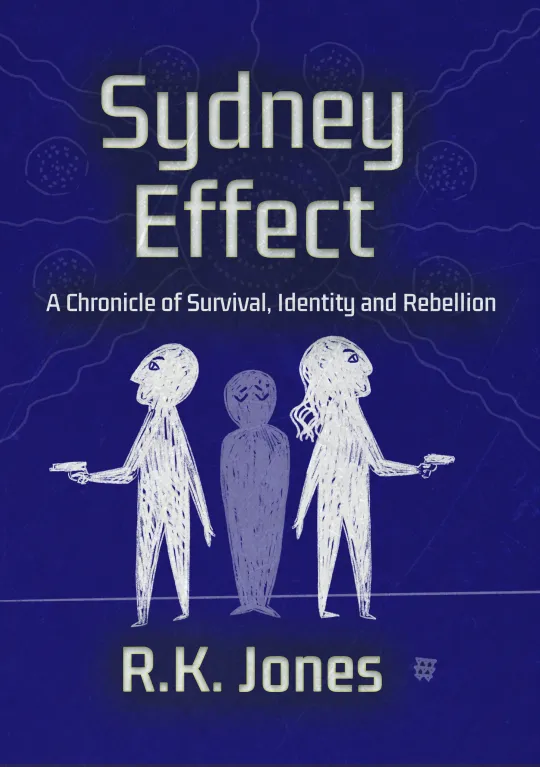
Fiction is good at the second version. R.K. Jones’s thriller Sydney Effect, available now, goes straight to the dark mirror: a near-future Sydney bloated with overpopulation and rampant crime, where two hardened veterans, Maali and Noah, work both sides of the law in a city haunted by memories of a once-glorious civilization in decline. Their latest mission, a dangerous foray into the black market for D.TEM, a substance of unparalleled power, spirals into chaos. Then a mysterious alien vessel appears over Sydney’s skyline and upends everything they have known.
The forecasts above are the real city, with real choices still to be made. The novel is what Sydney looks like when every warning comes true at once and then the sky opens. If you’d like a break from the numbers, the site’s free games are a click away.
Sources
- 2025 Population Statement: New South Wales snapshot, Centre for Population, Australian Government
- 2025 Population Statement released, the Treasurer, Australian Government (January 2026)
- Regional population, 2024-25, Australian Bureau of Statistics
- Population Projections, Australia, 2022 (base) - 2071, Australian Bureau of Statistics
- Greater Capital City Statistical Areas, Australian Bureau of Statistics
- Highlights of the 2024 NSW population projections, NSW Department of Planning
- The Sydney Plan, NSW Department of Planning
- The Sydney Plan: frequently asked questions, NSW Department of Planning
- Biggest Aussie cities to host eight million by 2050s, AAP
- It’s official: Western Sydney to open to passengers on 25 October and freight on 26 July 2026, Prime Minister of Australia
- Western Sydney International Airport’s first commercial flight takes off, SBS News
- Western Sydney Airport transport: bus, train and the delayed metro line, SBS News
- Outer Western Sydney Alliance: local government partners in the Western Parkland City
- First land release development partner appointed, Bradfield City
- First civil works delivered for Australia’s newest city, NSW Government
- Sydney Metro West project overview, Sydney Metro
- Monthly climate summary for Greater Sydney, January 2020, Bureau of Meteorology
- Extreme heat is getting worse in the west, University of Technology Sydney
- Western Sydney is among Australia’s worst overheating urban regions, Western Sydney University (2026)
- Metropolitan Sydney climate change projections, AdaptNSW, NSW Government
- NARCliM2.0 Metropolitan Sydney regional infographic (2025), NSW Government
- Sydney home prices fall more than 10% from peak, CommBank Newsroom
- Housing downturn broadens as Brisbane and Perth lead the decline, Cotality
- Demographia 2026 affordability rankings summarized, Canstar
- Housing supply data, NSW Department of Planning
- Low and mid-rise housing policy, NSW Department of Planning
- Transport Oriented Development program, NSW Department of Planning
- Doubling down on desalination, NSW Government (October 2023)
- Desalination, Sydney Water
- Expansion, Sydney Desalination Plant
- About the Greater Sydney Water Strategy, NSW Department of Climate Change, Energy, the Environment and Water
- Badu Yarragul Water Resource Recovery Facility (formerly Upper South Creek), Sydney Water
- State of the Climate 2024: Oceans, CSIRO
- Narrabeen-Collaroy Beach Survey Program, UNSW Water Research Laboratory
- Collaroy, New South Wales, Wikipedia
Questions people ask
What will Sydney’s population be in 2050?
No agency publishes an official 2050 figure. The federal Centre for Population projects Greater Sydney at about 6.5 million in 2035–36 and 8.5 million in 2065–66 (the later figure is experimental), which puts Sydney at roughly 7.3 to 7.5 million around 2050.
Will Melbourne overtake Sydney as Australia’s biggest city?
The projections say yes. The ABS’s 2023 projections have Melbourne passing Sydney sometime between 2032 and 2046, and the federal 2025 Population Statement projects Melbourne at 9.1 million and Sydney at 8.5 million by 2065–66.
When did Western Sydney International Airport open?
It opened to passengers on October 25, 2026, with a Jetstar flight to the Gold Coast, and its first international service, Air New Zealand’s link with Auckland, began the next day. The metro rail link from St Marys is not expected before late 2027 and may not open until mid-2028.
Will Sydney be underwater by 2050?
No. NSW Government projections put sea level at Fort Denison 12 to 29 cm higher by 2050 than in 1995–2014, depending on emissions, and 51 to 92 cm higher by 2100 under high emissions. Even modest rises increase the risk of coastal erosion and flooding in low-lying areas.
Why is Western Sydney hotter than the eastern suburbs?
It sits inland and gets less of the cooling sea breeze, the Blue Mountains trap hot air to the west, and much of it is covered in concrete and dark roofs. UTS researchers found that one summer day in ten reaches 35.4°C or more at Richmond, compared with 30.4°C at Observatory Hill.