Folklore
The Original Grimm Fairy Tales: What the 1812 Edition Really Says
In 1812, Snow White’s would-be killer was her own mother and Rapunzel’s dress gave her away. Here’s what the original Grimm fairy tales said, and when the brothers changed them.
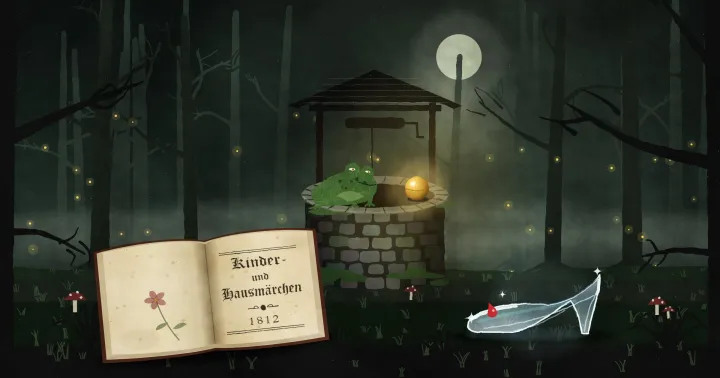
The original Grimm fairy tales are the 156 stories Jacob and Wilhelm Grimm published in the first edition of Children’s and Household Tales (Kinder- und Hausmärchen): 86 in December 1812 and 70 more in 1815. They are shorter, blunter and often stranger than the versions most people know, because Wilhelm Grimm rewrote them edition after edition until 1857, and English translators and Disney softened them again.
In the 1812 text, the queen who wants Snow White dead is her own mother. Rapunzel gives herself away by complaining that her clothes no longer fit. Cinderella’s stepsisters carve pieces off their feet, and the Frog King becomes a prince only after the princess hurls him at a wall. Several of those details changed in the second edition of 1819, not in 1857 as many pages claim. And one of the best-known “softenings,” the kiss, appears in no Grimm edition at all.
The key facts:
- First edition: volume one appeared on 20 December 1812 with 86 tales; volume two followed in 1815 with 70.
- Final edition: the seventh, in 1857, held 210 stories. Wilhelm Grimm did most of the rewriting.
- Snow White: the villain is her biological mother in 1812 and a stepmother from 1819.
- Rapunzel: the “tight clothes” hint of pregnancy was cut in 1819, but her twins appear in every edition.
- Cinderella: the stepsisters cut their feet in 1812; the doves peck out their eyes from 1819.
- The Frog King: no Grimm edition has a kiss. She throws him against the wall.
What are the original Grimm fairy tales?
Jacob Grimm (1785-1863) and his younger brother Wilhelm (1786-1859) began collecting tales in 1806, according to GRIMMWELT, the museum devoted to them in Kassel. The first volume of Children’s and Household Tales appeared on 20 December 1812, just before Christmas. Despite the title, it was not quite a children’s book. It came with scholarly notes, and the fairy-tale scholar Jack Zipes argues that the brothers never meant that first edition to be read by children.
Nor did the stories come from peasants around the fire. That is a myth, according to Ann Schmiesing, a professor of German whose biography The Brothers Grimm was described in 2025 as the first English-language life of the pair in 50 years. The brothers, she says, “mostly heard them from upper- and middle-class German women” (UW Magazine). Key sources included Dorothea Viehmann, a tailor’s wife, and Marie Hassenpflug, an educated young woman of French Huguenot ancestry.
Then the brothers kept editing. The full collection went through seven editions, in 1812/15, 1819, 1837, 1840, 1843, 1850 and 1857, and a “small edition” of 50 tales for children, first published in 1825, ran to ten more. From 1815 Wilhelm took sole charge of the rewriting.
You can still read the originals. The German text of the 1812 volume is free on Wikisource, and Zipes translated all 156 first-edition stories into English as The Original Folk and Fairy Tales of the Brothers Grimm (Princeton University Press, 2014). The brothers’ own annotated copies of the first edition were added to UNESCO’s Memory of the World register in 2005.
Grimm 1812 vs 1857: what changed, and when?
Zipes calls the first edition “totally unlike the final or so-called definitive edition of 1857” (The Public Domain Review). But “1812 vs 1857” hides the real turning point. As the folklorist D. L. Ashliman notes in his comparison of the Rapunzel texts at the University of Pittsburgh, most of the significant changes were already in the second edition, published in 1819. The edits follow clear patterns:
- Sex went out. Rapunzel’s pregnancy clue was rewritten in 1819. The same edition made the Frog King’s prince the princess’s husband, with her father’s consent, before the two fall asleep together.
- Mothers became stepmothers. Snow White’s mother in 1819, Hansel and Gretel’s in 1840.
- The fairies left. In 1812 Rapunzel’s keeper is a Fee, a fairy. From 1819 she is a Zauberin, a sorceress, and the thirteen fairies at Sleeping Beauty’s birth feast became “wise women.”
- Punishments got harsher. In 1812 Rumpelstiltskin, hearing his name, runs off in a rage and never comes back. From 1819 he drives his right foot into the ground up to his waist, seizes his left foot with both hands and tears himself in two.
- The prose grew longer and more pious. The 1819 edition added a set of religious “children’s legends,” and by 1857 the Frog King opened with its famous line about olden times “when wishing still helped.”
Why? Early readers thought the first edition unsuitable for children, in both its scholarship and its subject matter. The illustrated small edition of 1825, in GRIMMWELT’s words, is what “brought the Brothers world renown.” Zipes has also suggested that the stepmothers arrived partly because the brothers held motherhood sacred.
How did the famous Grimm tales originally go?
Snow White: the mother who wanted her dead
The 1812 tale opens with a queen sewing at an ebony-framed window. She pricks her finger and wishes for a child as white as snow, as red as blood and as black as the frame. She gets her wish, and she is the one with the mirror. When Snow White is seven and outshines her, the queen orders a huntsman to kill the girl and bring back her lungs and liver, which she means to cook with salt and eat. He brings a young boar’s instead, and she eats them, a detail that survives in every edition.
From 1819, as Ashliman’s notes on the 1812 Snow White point out, the text adds that the queen died in childbirth and that the king remarried. The revival changed too. In 1812 the prince’s servants are fed up with carrying a glass coffin around. One of them opens it, hauls her upright, grumbles (in Ashliman’s translation) “We are plagued the whole day long, just because of such a dead girl,” and hits her in the back. Out pops the bite of apple. From 1819 the servants simply stumble over a shrub. The ending never softened: in every edition the wicked queen is forced into red-hot iron shoes and dances until she drops dead.
Cinderella: the knife, the toes and the doves
The mutilation people remember is original. In 1812 the stepmother hands her daughters a knife. One slices off part of her heel, the other a large piece of her toes, and the doves call out that there is blood in the shoe. That first version ends as the prince lifts Cinderella into his carriage and the stepfamily turns pale.
The eye-pecking came later. The 1819 text adds a wedding. As the procession goes into the church, the doves on the bride’s shoulders peck out one eye from each sister, and on the way out, the other. The sisters, it concludes, were punished with blindness for the rest of their lives for their malice and falseness.
Rapunzel: the dress that no longer fits
In 1812 Rapunzel’s keeper is a fairy, Frau Gothel, and the prince’s secret visits come out in the most innocent way. “Tell me, Frau Gothel,” Rapunzel says, “my little dresses are getting so tight, they won’t fit me anymore.” The fairy cuts off her hair and banishes her to a wilderness, where after some time she gives birth to twins, a boy and a girl.
The 1819 edition replaced the dress line. Now Rapunzel asks why Frau Gothel is so much heavier to pull up than the young king (by 1857, “the young prince”). Here’s what many retellings miss: the 1819 text still says she gave birth to twins in the wilderness. By 1857 that sentence had been cut, but the twins are still with her when the blinded prince finds her. The Grimms hid how the pregnancy was discovered. They never removed the children.
The Frog King: a wall, not a kiss
“The Frog King, or Iron Henry” is tale number one, and it has never had a kiss. In 1812 the frog demands to share the princess’s bed: “Take me to your room, make your bed, so that we can lie in it together,” in Ashliman’s translation. She throws him against the wall instead. He lands on the bed as a handsome young prince, and they fall asleep together. From 1819 the text adds that he became her husband with her father’s consent.
The kiss arrived later, apparently in English-language retellings. The first English translation, in 1823, had the frog sleep on the princess’s pillow for three nights instead.
Hansel and Gretel: their own mother
In 1812 the woman who persuades the woodcutter to abandon his children in the forest is their mother, and she is still “the mother” in the editions of 1819 and 1837. The fourth edition, of 1840, is the first to call her a stepmother. Mother or stepmother, she is dead by the time the children come home.
Which Grimm fairy tales were cut?
Some stories didn’t survive the first edition. The most notorious is “How Some Children Played at Slaughtering,” tale 22 in 1812. In its first part, children in the Frisian town of Franeker play butcher and one cuts another’s throat. A wise old councilman proposes a test: offer the child an apple or a gold coin. The child laughs, takes the apple and goes free. In the second part, a boy copies his father’s pig-slaughtering on his little brother, and by the end of the story the whole family is dead.
“Puss in Boots” (tale 33) and “Bluebeard” (tale 62) went too, judged by the brothers to be “too French,” in Zipes’s account. All three were gone by the second edition of 1819.
The cuts were not a cleanup of horror, though. “The Juniper Tree” (tale 47), sent to the brothers in Low German by the painter Philipp Otto Runge, stayed in. A stepmother beheads her stepson with the lid of an apple chest and serves him to his father in a stew. The father eats heartily. The boy’s half-sister lays his bones under a juniper, and he returns as a bird who drops a millstone on the stepmother’s head.
Why did the Victorians and Disney soften the tales?
The English softening began before Victoria took the throne. Edgar Taylor’s German Popular Stories (1823) was the first English translation, illustrated with etchings by George Cruikshank. The historian of children’s books David Blamires calls Taylor “an inveterate softener of harsh details” (Telling Tales, Open Book Publishers). His princess never throws the frog. Cinderella’s sisters keep their eyes. Rumpelstiltskin just gets his foot stuck in the floor while everyone laughs at him. Ashliman suspects Taylor thought English readers of the 1820s “would not accept a heroine who throws her frisky bed companion against the wall.”
Blamires credits Cruikshank’s pictures with the book’s early success, and even with prompting a German small edition. And not every Victorian translator was a censor: Blamires judges Margaret Hunt’s 1884 translation the most faithful English rendering of the century.
Disney took the next step. Snow White and the Seven Dwarfs premiered on 21 December 1937. Its queen asks the huntsman for Snow White’s heart in a jeweled box, the spell breaks with “love’s first kiss,” and the queen dies falling from a cliff when lightning strikes, not dancing in hot iron shoes. Cinderella (1950) skipped the Grimms for Charles Perrault’s French version of 1697, with its fairy godmother, pumpkin and glass slippers, in which Cinderella forgives her stepsisters and marries them off to noblemen. By 2009, The Princess and the Frog could play with the kiss itself, which turns its heroine into a frog too.
The kiss is still winning. Disney’s live-action Snow White, released in March 2025 with Rachel Zegler, remade the 1937 film rather than the Grimms, woke its heroine with a kiss, and was judged a box-office bomb after taking about $206 million worldwide.
The logic isn’t hard to see. A family film wants a romantic climax, not wedding guests watching birds blind the bride’s sisters.
Why do the dark versions still matter?
First, they show that fairy tales were edited, not simply handed down. The changes between 1812 and 1857 are a record of what one editor, writing for nineteenth-century German families, thought children should hear. Sex vanished. Violence against villains grew. Mothers stopped being dangerous, and stepmothers took the blame.
Second, the originals are franker about where danger lives. In 1812 the threat to Snow White, and to Hansel and Gretel, comes from inside the family, from a mother. That is a harder story than one about a wicked outsider.
Third, the dark parts may do real work. Bruno Bettelheim argued in The Uses of Enchantment (1976) that frightening tales help children face fears they already have. The book has since faced plagiarism charges, and his claimed credentials turned out to be false, so treat it as one view, not settled science.
Finally, the originals are short, odd and full of gaps, which leaves room for new tellers. That is why the Grimms keep being rewritten: by Victorians, by Disney, and by writers who take the stories somewhere the brothers never imagined.
Grimm retold as science fiction: The Unforsaken Grimm
That last kind of retelling is the idea behind R.K. Jones’s The Unforsaken Grimm, available now as illustrated Kindle short stories. It retells Grimm’s fairy tales as science fiction. The Frog King, the unwelcome bed guest of 1812, becomes a hacker AI who manages an online idol, and the old stories grow into new serials of their own.
Like the first edition itself, it treats the old tales as raw material, not museum pieces.
It sits on a bigger shelf. The Unforsaken retells Grimm, Aesop, the Panchatantra, the Arabian Nights and the Greek myths as science fiction: ten collections and 549 stories in all. For another ancient story with a modern echo, see our look at Zhuangzi’s butterfly dream.
Sources
- Kinder- und Haus-Märchen, Band 1 (1812), German Wikisource
- Kinder- und Haus-Märchen, Band 1 (1819), German Wikisource
- Kinder- und Haus-Märchen, Band 2 (1819), German Wikisource
- Kinder- und Hausmärchen: all editions, German Wikisource
- Rapunzel: a comparison of the versions of 1812 and 1857, D. L. Ashliman, University of Pittsburgh
- Snow White folktales, with the Grimms’ 1812 “Little Snow-White”, D. L. Ashliman, University of Pittsburgh
- Frog Kings, with the Grimms’ 1812 text and Edgar Taylor’s 1823 version, D. L. Ashliman, University of Pittsburgh
- Aschenputtel (1812), German Wikisource
- Aschenputtel (1819), German Wikisource
- Sneewittchen (1819), German Wikisource
- Sneewittchen (1857), German Wikisource
- Rapunzel (1819), German Wikisource
- Hänsel und Grethel (1840), German Wikisource
- Rumpelstilzchen (1819), German Wikisource
- Der Froschkönig oder der eiserne Heinrich (1819), German Wikisource
- Wie Kinder Schlachtens mit einander gespielt haben (1812), German Wikisource
- Jack Zipes, The Forgotten Tales of the Brothers Grimm, The Public Domain Review (2012)
- Jack Zipes on those saucy Grimms’ fairy tales your mother never told you, The Irish Times (2014)
- The Original Folk and Fairy Tales of the Brothers Grimm, Princeton University Press
- The Children’s and Household Tales, GRIMMWELT Kassel
- Who were the Brothers Grimm? Ann Schmiesing explains, UW Magazine (2025)
- David Blamires, Telling Tales, ch. 10: The Fairytales of the Brothers Grimm, Open Book Publishers (2009)
- Reader beware: the nasty new edition of the Brothers Grimm, The Conversation (2014)
- Grimms’ Fairy Tales, Wikipedia
- Brothers Grimm, Wikipedia
- Snow White and the Seven Dwarfs (1937 film), Wikipedia
- Snow White (2025 film), Wikipedia
- Disney’s Snow White (2025), The Numbers
- The Frog Prince, Wikipedia
- The Uses of Enchantment, Wikipedia
Questions people ask
What are the original Grimm fairy tales?
They are the 156 stories in the first edition of the Brothers Grimm’s Children’s and Household Tales: 86 published in December 1812 and 70 in 1815. Wilhelm Grimm revised them heavily through seven editions, ending in 1857, so the familiar versions differ from the originals.
Was Snow White’s evil stepmother originally her real mother?
Yes. In the 1812 first edition, the queen who orders Snow White’s death is her own mother. From the second edition of 1819, the mother dies in childbirth and the king remarries, so the villain becomes a stepmother.
Was Rapunzel pregnant in the original story?
Yes. In 1812 Rapunzel innocently complains that her dresses are getting too tight, which gives the prince’s visits away. The 1819 edition replaced that line, but Rapunzel still gives birth to twins, a boy and a girl, in every edition.
What happens to Cinderella’s stepsisters in the Grimm version?
On their mother’s advice, one cuts off her toe and the other part of her heel to fit the slipper, and doves reveal the blood. From the 1819 edition onward, the doves also peck out both sisters’ eyes at Cinderella’s wedding.
Does the princess kiss the frog in the Grimm fairy tale?
No. In the Grimms’ Frog King she throws the frog against the wall, and he turns into a prince. The kiss comes from later retellings, apparently English-language ones; the first English translation, in 1823, had the frog sleep on her pillow for three nights instead.