History
February 30: The Date That Doesn’t Exist (Except When It Did)
February 30 has appeared on a real calendar once: in Sweden, in 1712. Here’s how it happened, why the famous Soviet February 30 is a myth, and what rulers gain when they rewrite time.
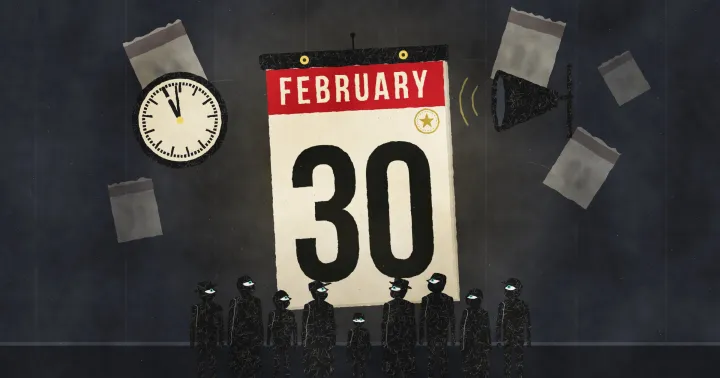
Yes, February 30 was once a real date. In 1712 the Kingdom of Sweden, which then included Finland, added a 30th day to February to dig itself out of a botched calendar reform, so the day after 29 February was 30 February. As far as anyone knows, it is the only time the date has appeared on a working civil calendar. You may also have read that the Soviet Union had a 30 February in 1930 and 1931. The evidence says it did not. That one is a myth with a surprisingly long life.
The real story is worth telling properly, because it isn’t just a piece of trivia. It’s about who gets to decide what day it is. From ancient Rome to revolutionary France to North Korea, rulers have bent the calendar to suit themselves, and some have tried to restart it altogether.
February 30, 1712: how Sweden’s calendar went wrong
Pope Gregory XIII introduced the Gregorian calendar in 1582 to fix the old Julian calendar, which added a leap day every four years without exception and so drifted slowly against the seasons. Italy, Spain, Portugal and Poland jumped straight from 4 October to 15 October 1582. Many Protestant countries, as Claus Tøndering’s Calendar FAQ notes, were reluctant to change. The reform, after all, had been decreed by a pope.
Sweden was one of them, and when it finally moved, it chose to move gently. Instead of deleting a block of days at once, it would skip every leap day from 1700 through 1740, eleven in all, and drift into line with the Gregorian calendar over forty years.
The first step went ahead, just about. 29 February 1700 was dropped, but the decision came so late that some almanacs for 1700 had already been printed with the day in them. According to the Danish national encyclopedia, people in Sweden’s Baltic provinces of Estonia and Livonia only learned in April that there had been no 29 February.
Then the plan fell apart. Sweden was busy fighting the Great Northern War, and in 1704 and 1708 the leap days were kept, apparently by mistake. The country now had a calendar all its own: one day ahead of the Julian calendar used by its neighbors and enemies, and ten days behind the Gregorian.
In 1711 King Charles XII, then stranded in the Ottoman Empire after his defeat at Poltava in 1709, ordered a return to the old Julian calendar. To get back in step, Sweden had to restore the day it had removed in 1700. So 1712 got two leap days. February ran to the 30th, and the Swedish year 1712 lasted 367 days.
That 30 February matched 29 February in the Julian calendar and 11 March in the Gregorian, which made it a Friday. Sweden finally gave up and adopted the Gregorian calendar in 1753, the quick way this time: 17 February was followed by 1 March.
Did the Soviet Union have a February 30?
The most repeated claim about February 30 is that the Soviet Union observed it in 1930 and 1931, under a “revolutionary calendar” of twelve 30-day months. It turns up in trivia lists, on date websites, and in calendar-reform journals going back to the 1930s. The best evidence says it never happened.
Here’s what is documented. Russia stayed on the Julian calendar until after the Bolsheviks took power. A decree signed by Lenin moved the country to the Gregorian calendar in 1918, when 31 January was followed by 14 February. That’s why the “October Revolution” of 1917 was celebrated in November.
From 1929 the Soviet government did tinker with time, but with the week, not the month. Under the nepreryvka, or “continuous working week,” the aim was for factories never to stop: workers were split into groups with staggered days off in a five-day cycle. As History.com explains, families often couldn’t rest together, and the system made churchgoing harder, which was partly the point. A six-day week followed in 1931, and the ordinary seven-day week came back in June 1940.
A calendar of 30-day months was proposed. In February 1930 a government commission suggested twelve 30-day months plus five holidays belonging to no month. It was rejected, reportedly because it would have put Soviet dates out of step with the rest of Europe. That rejected plan seems to be where the myth began.
The paper trail points the other way. Researchers who checked Pravda found it kept dating issues 31 January, 31 March, 31 May and so on right through the period, and surviving Soviet wall and pocket calendars from 1929 to 1940 show the normal, uneven Gregorian months. So far as anyone has shown, no Soviet newspaper or official calendar was ever dated 30 February. The fair verdict is that it was a proposal, never a date.
Where February 30 still exists today
Outside Sweden in 1712, February 30 is alive and well. It just isn’t on your wall calendar.
In finance. Bond markets have long counted interest as if every month had 30 days and every year 360, which made the arithmetic easy by hand. In the US, the industry rule for calculating accrued interest on municipal bonds, MSRB Rule G-33, generally works “on the basis of a thirty-day month” and a 360-day year. In some versions of this “30/360” convention, a date on the last day of a month counts as the 30th. Excel’s DAYS360 function does exactly that in its US method, so for the purposes of the sum, 28 February quietly becomes 30 February.
In climate science. Some climate models run on a tidy “360_day” calendar, a standard type in the conventions that climate data files follow. Britain’s Met Office says the core members of its UK Climate Projections ensemble (UKCP18) “use a 360-day year, consisting of 12 months each containing 30 days” (Met Office UKCP FAQ). So their output contains dates like 30 February, and analysts who need a normal calendar sometimes simply delete the 29th and 30th of February from the data.
In fiction. In Nikolai Gogol’s 1835 story “Diary of a Madman,” the narrator’s grip on time slips until he heads one entry “Madrid, February 30th,” not far from another dated “The year 2000: April 43rd.”
Who controls the calendar? Lessons from ancient Rome
Before Julius Caesar, Rome kept its calendar in line with the seasons by inserting an extra month now and then. The decision lay with the pontiffs, the city’s priestly college, whose members were often politicians too. Because officials served for a calendar year, a longer year could stretch an ally’s term in office and a shorter one could cut a rival’s. The priests, as Tøndering’s FAQ puts it, were sometimes “bribed to make certain years long and other years short.”
The result was chaos. By Caesar’s time the calendar was about three months out of step with the seasons. His biographer Suetonius noted that harvest festivals no longer fell in summer. Caesar’s fix stretched 46 BC to about 445 days, the “year of confusion,” and the new Julian calendar began on 1 January 45 BC.
Rome also supplies the most famous fake February 30. The 13th-century scholar Johannes de Sacrobosco claimed February once had 30 days in leap years, until Augustus took one away to make his own month, August, as long as July. It’s a good story, possibly Sacrobosco’s own invention. Calendar historians find nothing in the Roman evidence to support it.
Britain’s lost eleven days, and the riots that probably never happened
Britain held out against the Gregorian calendar until 1752. By then, as the Calendar (New Style) Act 1750 itself complained, the spring equinox had slipped from about 21 March to the 9th or 10th, and Britain’s reckoning no longer matched that of neighboring nations. The act did two things. The legal year, which had begun on 25 March, would now start on 1 January, so 1751 was cut to 282 days. And eleven days were dropped: Wednesday 2 September 1752 was followed by Thursday 14 September.
Then there’s the famous tale of mobs in the streets shouting “Give us our eleven days!”, convinced the government had stolen part of their lives. Historians now doubt it. The historian Robert Poole, who examined the episode in a 1995 article in Past & Present, found no trace of calendar protests in the riot records of the period. The story leans on satire instead. The slogan’s best-documented home is the bitter 1754 Oxfordshire election, where Tory opponents used the calendar, among many other issues, against the Whig candidate, son of the Earl of Macclesfield, who had supplied much of the act’s astronomy. William Hogarth then painted the slogan on a placard lying on a tavern floor in An Election Entertainment (c. 1755).
The historian Penelope Corfield is blunt: “there were no riots.” There was grumbling, and enough confusion about rents and feast days that Parliament passed a follow-up act in 1751 to settle them. The riots seem to have grown in the retelling.
One fossil of the change survives. Britain’s tax year still starts on 6 April: the old 25 March New Year, pushed back by the lost eleven days and one more adjustment in 1800.
Year One, Year Zero: why regimes restart the calendar
Most calendar reforms have practical reasons. Restarts are different. When a government renumbers the years, it is making a claim: history begins with us.
France’s Year I
In autumn 1793 the revolutionary National Convention adopted a new calendar and dated Year I from 22 September 1792, the day the Republic was proclaimed, according to the Fondation Napoléon. There were twelve months of 30 days, each split into three ten-day décades, plus five or six extra days at the end of the year. The poet Fabre d’Églantine supplied seasonal month names, and the days were named after plants, animals and farm tools instead of saints, part of an effort to strip religious and royal influence from daily life. Workers disliked getting one full rest day in ten instead of one in seven. Napoleon abolished the calendar from 1 January 1806, and the Paris Commune briefly revived it in May 1871.
Cambodia and the “Year Zero” label
When the Khmer Rouge took Phnom Penh on 17 April 1975, they drove the city’s population into the countryside: at least two million people, according to the UN-backed tribunal that later tried two of the regime’s surviving leaders. Pol Pot, in historian Thomas Clayton’s summary, declared an end to “over two thousand years of Cambodian history.” Schools, universities and hospitals were shut and religion was outlawed. Yale’s Cambodian Genocide Program estimates about 1.7 million people died, around 21 percent of the population.
That rupture is usually called “Year Zero.” But the phrase is best understood as a label applied from outside. It was popularized by the French priest François Ponchaud’s 1977 book Cambodge année zéro, scholars use it metaphorically, and there is little evidence the regime itself ever formally proclaimed a “Year Zero.”
Calendars built around a ruler
In 1976 the Shah’s Iran switched its year count from the Islamic era to one dated from Cyrus the Great, so 1355 became 2535 overnight. The change angered religious opponents, and in August 1978, with revolution building, a new prime minister restored the old calendar on his first day in office.
In 1997 North Korea adopted the Juche calendar, which counts 1912, the birth year of founder Kim Il Sung, as Juche 1. In October 2024 the Juche year began vanishing from state media, and the official calendars for 2025 read “2025” rather than “Juche 114,” a shift analysts link to Kim Jong Un building up his own legacy (NK News).
In 2002 Turkmenistan’s ruler Saparmurat Niyazov renamed the months. January became Turkmenbashi, his own title, April was named after his mother, and September after his book. After his death, the old names were restored in 2008.
The pattern is hard to miss. A calendar decides when you work, rest, pray, pay tax and leave office, so whoever controls it controls a slice of everyone’s life. Renumbering the years goes further. It tells people the past either doesn’t count or belongs to whoever is in charge.
A calendar that starts again: The Thirtieth of February
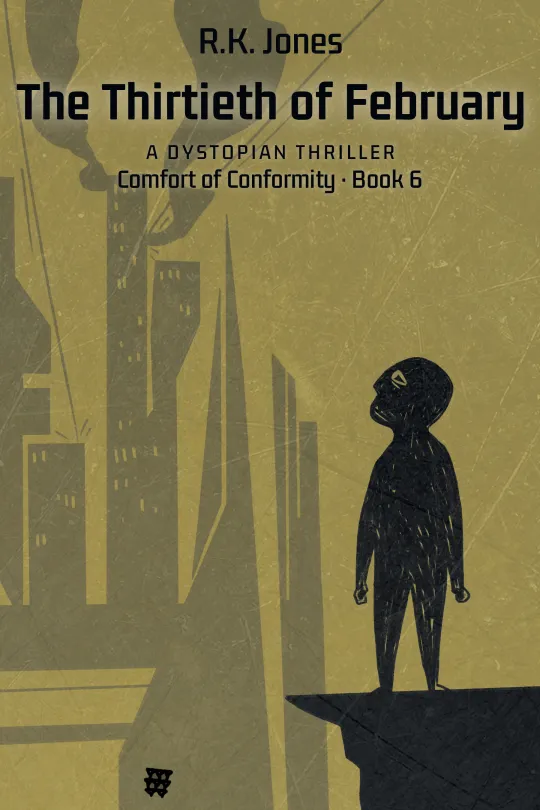
That idea, pushed to its limit, drives R.K. Jones’s dystopian thriller The Thirtieth of February, Book 6 of the Comfort of Conformity series.
It is the 30th of February, in the 7th year of the Founders. Nothing came before it.
In New Australia, every date before Transition Day has been declared void, citizens carry chips at the base of the skull, and the past is exactly what the Founders say it was. Dr. Matt Harris remembers serving as a surgeon in a war. Then he is called to chip a boy in open court, and the boy shouts the one thing nobody is allowed to say: what year it really is.
The real-world echoes are the point. France counted from Year I, Cambodia’s rupture became known as “Year Zero,” and North Korea dated its years from a leader’s birth. Sweden’s 30 February shows that even a date that “doesn’t exist” can appear when people in charge decide it should. If vanishing paper trails are your kind of mystery, try the free game The Empty Flat, about a neighbor erased from the records.
Sources
- February 30 Was a Real Date, timeanddate.com
- The Gregorian Calendar (Calendar FAQ), Claus Tøndering
- The Roman Calendar (Calendar FAQ), Claus Tøndering
- Svensk kalender i 1700-tallet, Den Store Danske / lex.dk
- Swedish calendar, Wikipedia
- Soviet calendar, Wikipedia
- For 11 Years, the Soviet Union Had No Weekends, History.com
- Rule G-33: Calculations, Municipal Securities Rulemaking Board
- DAYS360 function, Microsoft Support
- UKCP frequently asked questions, Met Office
- NetCDF Climate and Forecast (CF) Metadata Conventions 1.11, cfconventions.org
- Memoirs of a Madman, Nikolai Gogol, trans. Claud Field, Wikisource
- The Roman Calendar, Encyclopaedia Romana, University of Chicago
- Suetonius, The Life of Julius Caesar, LacusCurtius, University of Chicago
- Calendar (New Style) Act 1750, legislation.gov.uk
- Robert Poole, “Give us our eleven days!”: calendar reform in eighteenth-century England, Past & Present (1995)
- Penelope J. Corfield, Facts and Factoids in History (Monthly Blog 52, 2015)
- Why the UK tax year begins on April 6 (it’s a very strange tale), The Conversation
- The Republican Calendar, Fondation Napoléon
- French Republican calendar, Wikipedia
- Thomas Clayton, Building the New Cambodia, History of Education Quarterly (1998)
- The Conviction of Cambodian Khmer Rouge Leaders, EJIL: Talk!
- Cambodian Genocide Program, Yale University
- Shahanshahi calendar, Wikipedia
- North Korea drops Juche calendar in apparent bid to elevate Kim Jong Un’s legacy, NK News
- North Korea’s sparkling new 2025 calendars drop “juche” year, Radio Free Asia
- Turkmenistan: National Council Opens Session, RFE/RL (2002)
- Turkmen calendar name change axed, Al Jazeera (2008)
Questions people ask
Was there ever a February 30th?
Yes. Sweden, which then included Finland, had a 30 February in 1712, when it added a second leap day to return to the Julian calendar after a failed plan to switch gradually to the Gregorian. It is the only known use of the date on a working civil calendar.
Did the Soviet Union have February 30 in 1930 and 1931?
Almost certainly not. A calendar of twelve 30-day months was proposed in 1930 but rejected, and the Soviet reforms of 1929 to 1940 changed the working week, not the months. Pravda and surviving calendars from the period show normal Gregorian month lengths.
Why did Sweden have February 30, 1712?
Sweden planned to skip every leap day from 1700 to 1740 to reach the Gregorian calendar gradually, but it skipped only 1700 and kept 1704 and 1708. In 1711 King Charles XII ordered a return to the Julian calendar, so 1712 got two leap days and February ran to the 30th.
Is February 30 used anywhere today?
Not on civil calendars. But 30/360 day-count conventions in finance treat months as 30 days, and some climate models, including the core members of the Met Office’s UKCP18 projections, use a 360-day year of twelve 30-day months, so February has 30 days.
Did people riot over the 1752 calendar change in Britain?
Probably not. The historian Robert Poole found no calendar protests in the riot records of the period. The slogan “Give us our eleven days” is best documented from the 1754 Oxfordshire election and William Hogarth’s painting An Election Entertainment.