Space & science
Could Humans Live on Titan? The Honest Answer, by the Numbers
Titan is the one world beyond Earth where you could step outside without a pressure suit. Here is what living there would really take, from the cold and weak gravity to power, oxygen and NASA’s Dragonfly.
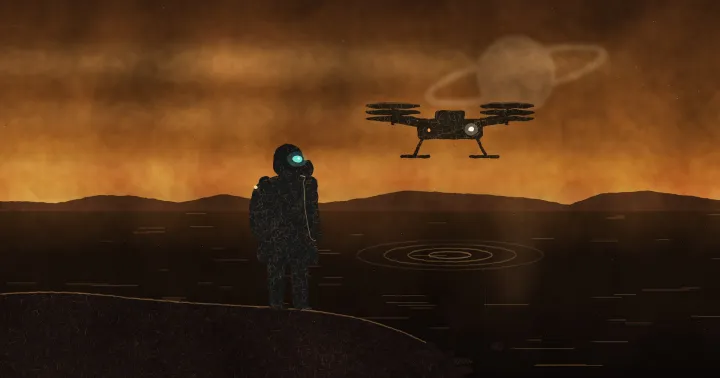
Could humans live on Titan? Not unaided, but Saturn’s largest moon is the one world beyond Earth where you could step outside without a pressure suit: the air is thick enough that you would need only a heavily insulated, heated suit and an oxygen supply. Living there for years is a much harder question, because Titan is ferociously cold, more than an hour away by radio, short on usable sunlight and light on gravity, and nobody knows what long stretches at about 14 percent of Earth’s gravity would do to a human body.
Even so, some planetary scientists argue it is the best place in the solar system for a human outpost. Here are the numbers.
- Air: about 95 percent nitrogen and 5 percent methane, at roughly 1.5 times Earth’s sea-level pressure. No oxygen.
- Temperature: about minus 179 degrees Celsius (minus 290 degrees Fahrenheit) at the surface.
- Gravity: about 14 percent of Earth’s, a little weaker than the Moon’s.
- Liquids: the only place besides Earth known to have liquid on its surface, with rain, rivers, lakes and seas of methane and ethane.
- Distance: a radio signal takes over an hour to reach Earth, and the Cassini spacecraft needed nearly seven years to get there.
- Next visitor: NASA’s Dragonfly rotorcraft, due to launch in July 2028 and arrive in 2034.
What is Titan like? Atmosphere, temperature and gravity
Titan is big. It is the second-largest moon in the solar system, behind Jupiter’s Ganymede, and NASA notes it is larger than the planet Mercury. It circles Saturn about 759,000 miles (1.2 million kilometers) out, once every 15 days and 22 hours. And it is the only moon in the solar system known to have a substantial atmosphere.
That atmosphere is the whole story. Near the ground it is about 95 percent nitrogen and 5 percent methane, according to NASA’s Titan facts page. When the European Space Agency’s Huygens probe landed in 2005, its instruments recorded a surface pressure of 1,467 hectopascals, about one and a half times sea-level pressure on Earth, and a temperature of 93.65 kelvin, roughly minus 179 degrees Celsius.
Titan’s gravity is weak, about 1.35 meters per second squared, or 14 percent of Earth’s. The Moon manages about 16.5 percent. To press down that hard with so little gravity, Titan needs an enormous amount of air. As planetary scientist Ralph Lorenz pointed out in Physics Today, a column of Titan’s atmosphere holds about 10 times as much mass per unit area as Earth’s. At ground level the air is about four times denser than ours, and NASA says the atmosphere reaches some 370 miles (600 kilometers) up, ten times higher than Earth’s.
All that haze swallows the light. Sunlight at Saturn is already about 100 times fainter than at Earth, and a 2026 review led by NASA’s Conor Nixon estimates that perhaps 0.1 percent as many photons reach Titan’s surface as reach Earth’s. The Planetary Society describes a Titan day as hundreds of times dimmer than daytime here, though brighter than a moonlit night, under an orange haze that hides both the Sun and Saturn.
The calendar is odd too. A full day-night cycle lasts almost 16 Earth days: about eight of dim light, then eight of darkness. A Titan year lasts about 29 Earth years, and each season more than seven.
Can you breathe on Titan? Why you’d need a mask but not a pressure suit
On the Moon and Mars, stepping outside means wearing a pressurized suit. On Titan, the air already supplies more pressure than you need. Amanda Hendrix, director of the Planetary Science Institute and president of the nonprofit Explore Titan, put it simply in a May 2026 interview with Space.com: “You don’t need a pressure suit like you do on the moon or Mars.”
You still can’t breathe it. Titan’s air has no free oxygen, so every breath would come from a tank or from a habitat that makes oxygen. The bigger danger is the cold. At minus 179 degrees Celsius, the outfit would be a heavily insulated, heated suit with its own air supply: think polar expedition gear with a breathing system, not an Apollo spacesuit.
The same thick air and weak gravity give Titan its most famous party trick. In a 2024 explainer, the Planetary Society suggests that a person with wings attached to a spacesuit could possibly take off after a running start and flap through the sky. It is also why NASA’s next Titan mission is a flying machine rather than a rover.
Methane lakes, methane rain and a hidden ocean
NASA calls Titan the only place besides Earth known to have liquid on its surface. It has clouds, rain, rivers, lakes and seas, but the liquid is hydrocarbon, mainly methane and ethane, and the big seas sit near the poles.
Cassini’s radar found several hundred lakes and seas. The largest, Kraken Mare, is nearly the size of all five Great Lakes combined, and a 2020 study estimated it is at least 1,000 feet (about 300 meters) deep near its center. Ligeia Mare, about the size of Lake Huron and Lake Michigan together, turned out to be mostly methane and about 160 meters (525 feet) deep at the deepest point the radar measured. In 2008, Cassini scientists estimated, mostly from the northern lakes, that Titan holds hundreds of times more liquid hydrocarbons than all the known oil and natural gas reserves on Earth. It was a rough early figure.
The methane runs in a cycle, much as water does here. In 2011, Cassini scientists reported that an area of about 500,000 square kilometers (193,000 square miles) at the edge of Titan’s Belet dune field had darkened after storms, most likely because methane rain soaked the ground. Titan’s raindrops can grow about one and a half times larger than the largest on Earth and fall at about a fifth of the speed. Lorenz noted that the rain averages only about a centimeter a year, but models suggest a single storm can dump tens of centimeters in a few hours.
Under the ice crust is water, but how much is in dispute. Earlier evidence from Huygens and Cassini pointed to a global ocean roughly 35 to 50 miles (55 to 80 kilometers) down. In December 2025, a reanalysis in Nature led by JPL’s Flavio Petricca suggested slushy layers instead, with pockets of liquid water near the rocky core, possibly as warm as 20 degrees Celsius (68 degrees Fahrenheit). The question isn’t settled. For settlers, the useful water is the crust itself: at Titan’s temperatures, water ice is as hard as rock.
What the Huygens probe found, and when Dragonfly gets there
On January 14, 2005, ESA’s Huygens probe, carried to Saturn by NASA’s Cassini, parachuted through the haze for about two and a half hours and landed on Titan. It is still the most distant landing ever made, and the only landing in the outer solar system. It sent back data from the surface for about 72 minutes before Cassini moved out of range.
What it found was eerily familiar. According to ESA’s summary of the results, the ground had the consistency of loose wet sand, water-ice pebbles up to a few centimeters across lay scattered near the landing site, and haze hung all the way down to the surface. On the way down, its camera saw networks of channels that scientists think were cut by liquid methane.
The next visitor is NASA’s Dragonfly, a car-sized, eight-rotor drone powered by a nuclear generator like the ones on the Curiosity and Perseverance rovers, because sunlight is so scarce there. It has a launch period of July 5 to 25, 2028, on a SpaceX Falcon Heavy, and a cruise of roughly six years. In an October 2026 release, NASA said Dragonfly will arrive in 2034. It will then spend more than three years hopping between 20 and 30 sites, studying the chemistry that comes before life.
As of late 2026, the mission is on track. Integration and testing of the rotorcraft got underway at the Johns Hopkins Applied Physics Laboratory in March, and structural testing was complete by July. In a September update, NASA announced that the International Astronomical Union had approved a name for the dune field near Selk crater where Dragonfly will land: Ahmakiq Undae, after a Maya spirit whose name NASA translates as “one who locks up the wind.” Dragonfly also carries a seismometer that may help probe the interior and test the ocean question.
How would a Titan colony get power, oxygen and water?
Titan is rich in carbon and nitrogen, and it has water ice close at hand. In June 2026, Nixon, Ye Lu and Jennifer Ruliffson posted a 107-page review of Titan’s resources, submitted to the journal Acta Astronautica. Their answers mix good news and irony.
- Oxygen and water: the review calls water ice the best and most convenient source of oxygen, split out by electrolysis. Melted, the same ice gives drinking water and hydrogen.
- Materials: hydrocarbons are feedstock. Nixon has pointed to plastics, synthetic rubber and solvents, and the review lists nitrogen fertilizers among the basics Titan could supply.
- Fuel: this is the irony. Titan is soaked in hydrocarbons, but burning them requires oxygen, which the air doesn’t have. A colony would be sitting on a world of fuel with nothing to burn it in, unless it spends energy splitting ice.
- Power: sunlight is feeble and the authors expect little from wind in the sluggish lower atmosphere. Their conclusion: “The most logical power source is therefore nuclear, requiring a small reactor to be brought from Earth.”
- Metals: the review says heavy materials such as rock and metals are likely to be extremely scarce at the surface, so they would have to come from somewhere else.
The hard problems: distance, radiation and low gravity
Distance. Saturn averages about 890 million miles (1.43 billion kilometers) from Earth. During Cassini’s tour, a one-way radio signal took 67 to 85 minutes, so a question and its answer could take up to almost three hours. Cassini launched in October 1997 and reached Saturn in July 2004. The Nixon review warns that human missions to the outer solar system “will be multiple years to even decades in length, given current technologies.” NASA lists five hazards of human spaceflight: radiation, isolation and confinement, distance from Earth, altered gravity, and hostile or closed environments. A Titan trip would test all five.
Radiation. Once you arrive, things improve. In a 2016 essay for Scientific American, Hendrix and writer Charles Wohlforth argued that Titan’s thick atmosphere, plus shelter from Saturn’s magnetosphere, would protect settlers, where cosmic radiation would push colonists on the Moon or Mars underground. With about ten times Earth’s air overhead, the argument holds up, though the years-long journey would offer no such shield.
Cold. Habitats would need serious insulation and constant heating, which would take a lot of energy, and the ground itself is ice.
Low gravity. This may be the deepest unknown. In weightlessness, NASA says astronauts’ bones lose on average 1 to 1.5 percent of their density each month on four-to-six-month missions. No one has lived for long in partial gravity, so the best clues come from mice on the International Space Station. A 2023 study found that a month at lunar gravity (one-sixth of Earth’s) prevented loss of mass in a key leg muscle, but not a shift in its fiber types. A 2026 study in Science Advances tested more levels: a third of Earth’s gravity preserved the muscle’s size, but it took two-thirds to fully preserve its function and fiber makeup. Titan’s 0.14 g is below even the lunar level. Mice for a month are not people for a decade, but the direction isn’t encouraging.
So, could humans live on Titan one day?
Physics doesn’t forbid it. The obstacles are engineering, money, time and medicine. In June 2026, Explore Titan held the first Humans to Titan Summit at the Southwest Research Institute in Boulder, Colorado, bringing scientists and engineers together to ask what a crewed mission would require and which robotic precursors should come first. Hendrix has called the challenges surmountable, and told Space.com: “It’s not too soon to begin thinking about this.”
No space agency has approved a crewed Titan mission. For now it’s robots first, with Dragonfly leading the way in 2034. The honest answer, then: Titan is the one world where you could stand outside in a warm suit and a mask, watch methane rain fall in slow motion, and maybe even fly. Staying there is a project measured in decades, not years.
Moon Mind: a fictional mining colony on Titan
Real Titan science leaves a lot of blanks, especially about what years in weak gravity, far from home, might do to the people living there. That’s where fiction steps in.
R.K. Jones’s space colony thriller Moon Mind, Book 4 of the Comfort of Conformity series, is set among miners on Titan. They dig Helion, a fictional resource, for humanity’s future, and the joke never changes: another day in paradise. Then Rory blinks and he’s in bed, half a day gone, with a pounding headache and no memory of the shift. The miners call it Moon Mind, the sickness that comes from too long under shifting gravity. Everyone gets it eventually. But Rory’s lost hours keep adding up, and he’s starting to wonder whether this is Moon Mind at all, or something being done to him while he isn’t there to see it.
Moon Mind is invented; the real effects of partial gravity are still being worked out in mice. The book is coming soon, and the site’s free games are ready to play now.
Sources
- Titan: Facts, NASA Science
- Titan, NASA Science
- In situ measurements of the physical characteristics of Titan’s environment, Fulchignoni et al., Nature (2005), abstract via RePEc
- Highlights of ESA’s Huygens mission, European Space Agency
- Celebrating the fifth anniversary of Huygens’ Titan touchdown, European Space Agency
- Huygens Probe, NASA Science
- Cassini Quick Facts, NASA Science
- The changing face of Titan, Ralph D. Lorenz, Physics Today (2008)
- What would it be like to stand on the surface of Titan?, The Planetary Society
- Dragonfly, NASA’s mission to Saturn’s moon Titan, The Planetary Society
- Astronomers estimate Titan’s largest sea is 1,000 feet deep, Cornell Chronicle
- Cassini explores a methane sea on Titan, NASA JPL
- Titan’s surface organics surpass oil reserves on Earth, NASA
- Cassini sees seasonal rains transform Titan’s surface, NASA JPL
- NASA study suggests Saturn’s moon Titan may not have global ocean, NASA JPL
- Send your name to Titan aboard NASA’s Dragonfly mission, NASA
- NASA awards launch services contract for Dragonfly mission, NASA
- Dragonfly mission page, Johns Hopkins Applied Physics Laboratory
- Dragonfly spacecraft and instruments, NASA Science
- NASA’s Dragonfly gets wired up while Titan landing area is named, NASA Science
- Titan’s Resources and their Utilization, Nixon, Lu and Ruliffson, arXiv (2026)
- New study assesses Titan’s resources and their potential uses, Phys.org
- Let’s Colonize Titan, Charles Wohlforth and Amanda R. Hendrix, Scientific American
- Should Saturn’s huge moon Titan be humanity’s next destination, after the moon and Mars?, Space.com
- Humans May One Day Fly Through Titan’s Skies and Harvest Oxygen From Its Ice, Discover Magazine
- Risk of Spaceflight-Induced Bone Changes, NASA
- Hazards of human spaceflight, NASA Human Research Program
- Lunar gravity prevents skeletal muscle atrophy but not myofiber type shift in mice, Hayashi et al., Communications Biology (2023)
- 0.33g mitigates muscle atrophy while 0.67g preserves muscle function and myofiber type composition in mice during spaceflight, Tsuji et al., Science Advances (2026)
Questions people ask
Can humans breathe on Titan?
No. Titan’s air is about 95 percent nitrogen and 5 percent methane, with no free oxygen, so a visitor would need an oxygen supply. The pressure, about 1.5 times Earth’s, is high enough that no pressure suit would be needed, but a heavily insulated, heated suit would be.
How cold is it on Titan?
The surface averages about minus 179 degrees Celsius (minus 290 degrees Fahrenheit). The Huygens probe measured 93.65 kelvin at its landing site in January 2005.
How strong is gravity on Titan?
About 1.35 meters per second squared, roughly 14 percent of Earth’s gravity and a little less than the Moon’s. Combined with air about four times denser than Earth’s at the surface, that makes flying unusually easy.
How long would it take to get to Titan?
With today’s spacecraft, about six to seven years. Cassini launched in October 1997 and reached Saturn in July 2004, and NASA’s Dragonfly is planned to launch in 2028 and arrive in 2034. Radio signals take over an hour each way.
When will NASA’s Dragonfly reach Titan?
As of late 2026, Dragonfly is scheduled to launch in July 2028 on a SpaceX Falcon Heavy and arrive in 2034. The car-sized rotorcraft will then spend more than three years flying between sites to study the chemistry that comes before life.